
Belgium Telecom Market Set for Steady Growth as 5G, Fiber Broadband, and Digital Transformation Accelerate Through 2033
Belgium's telecommunications industry is evolving rapidly with next-generation networks, digital services, enterprise connectivity, and competitive pricing reshaping the country's communication landscape.

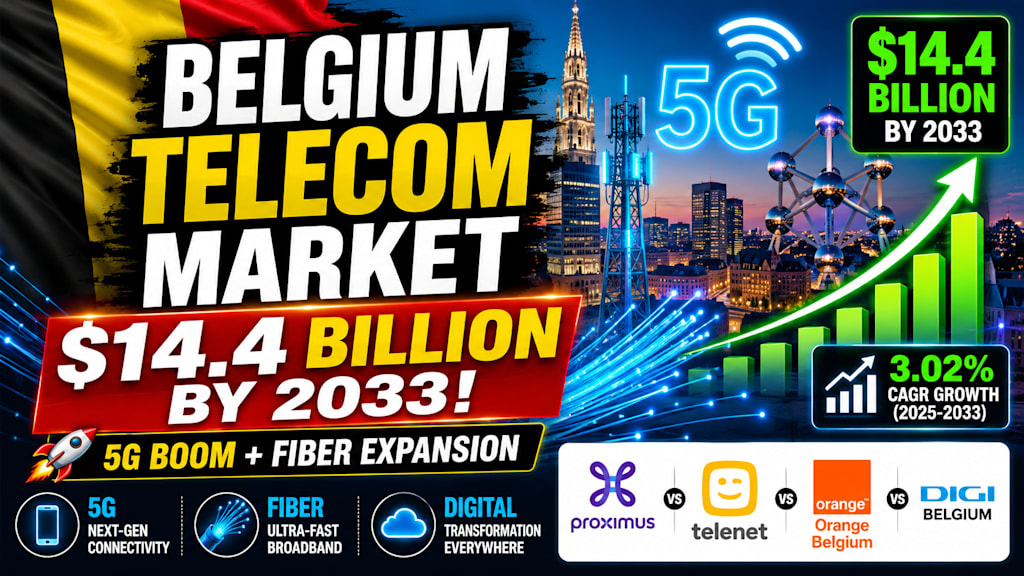
Belgium Telecom Market Outlook 2025–2033
Belgium's telecommunications sector is entering a new era of digital innovation and infrastructure modernization. As businesses and consumers increasingly rely on high-speed connectivity, cloud-based applications, remote work platforms, and digital entertainment services, telecom providers are investing heavily in next-generation technologies to meet growing demand.
According to Renub Research, the Belgium Telecom Market is projected to grow from US$ 11.02 billion in 2024 to US$ 14.4 billion by 2033, expanding at a CAGR of 3.02% during 2025–2033. The market's growth is being fueled by continuous advancements in 5G networks, fiber-optic broadband expansion, digital transformation initiatives, and increasing enterprise demand for secure communication infrastructure.
Belgium has long been recognized as one of Europe's most connected economies. Its strategic location at the heart of Europe, highly urbanized population, strong business ecosystem, and supportive regulatory framework make the country an attractive destination for telecom investment and innovation.
As digital technologies continue to reshape industries, Belgium's telecom sector is expected to play a pivotal role in supporting economic growth, technological development, and digital inclusion throughout the forecast period.
The Evolving Landscape of Belgium's Telecom Industry
Telecommunications in Belgium encompass a broad range of services, including mobile communications, fixed-line telephony, broadband internet, enterprise networking solutions, IoT connectivity, and digital entertainment services.
The industry serves millions of residential customers while also providing critical infrastructure for businesses, government agencies, educational institutions, healthcare providers, and industrial operators.
Major telecom operators are increasingly adopting converged service strategies that combine mobile, internet, television, and fixed-line services into bundled offerings. This approach not only enhances customer convenience but also strengthens customer loyalty in an increasingly competitive marketplace.
Meanwhile, rising digital consumption patterns are creating new opportunities for telecom providers to expand value-added services such as cloud computing, cybersecurity solutions, smart home technologies, and managed enterprise services.
The Belgian telecom industry is no longer simply about voice calls and internet access. It has become the foundation upon which the country's digital economy operates.
5G Expansion Driving the Next Wave of Growth
One of the strongest growth drivers in Belgium's telecom market is the nationwide deployment of 5G technology.
Compared to previous generations of mobile networks, 5G offers dramatically improved speed, ultra-low latency, enhanced reliability, and support for millions of connected devices. These capabilities are transforming both consumer and enterprise communications.
For consumers, 5G enables:
Faster mobile internet
High-definition video streaming
Improved gaming experiences
Seamless smart device connectivity
For businesses, the benefits are even more significant.
Industries such as manufacturing, logistics, transportation, healthcare, and energy are leveraging 5G networks to support automation, real-time monitoring, predictive maintenance, and advanced analytics.
Belgium's telecom operators continue to invest heavily in spectrum deployment, network upgrades, and infrastructure expansion to ensure widespread 5G availability. Government support and regulatory initiatives have also accelerated rollout efforts across urban and industrial regions.
As adoption increases, 5G is expected to become a major catalyst for telecom revenue growth throughout the forecast period.
Fiber Broadband Investments Transform Connectivity
Alongside 5G deployment, fiber-optic broadband expansion is reshaping Belgium's digital infrastructure.
Modern consumers demand ultra-fast internet access for streaming, online education, remote work, gaming, and cloud applications. Businesses require reliable, high-capacity networks to support increasingly digital operations.
To meet these requirements, telecom providers are investing in fiber-to-the-home (FTTH) and fiber-to-the-business (FTTB) networks across the country.
Fiber infrastructure offers several advantages:
Higher download and upload speeds
Improved network reliability
Lower latency
Greater scalability
Enhanced support for future digital services
As demand for bandwidth-intensive applications continues to grow, fiber broadband will remain a key competitive differentiator among Belgian telecom providers.
The expansion of fiber networks also supports national objectives related to digital inclusion and economic competitiveness.
Rising Demand for Bundled Telecom Services
Consumer preferences in Belgium are shifting toward integrated telecom packages that combine multiple services under a single subscription.
Today's households increasingly seek convenience, value, and seamless digital experiences. As a result, bundled offerings that include internet, mobile, television, and fixed-line services have become highly popular.
Telecom providers benefit from bundled services in several ways:
Higher customer retention rates
Increased average revenue per user
Cross-selling opportunities
Stronger brand loyalty
The enterprise segment is experiencing a similar trend.
Businesses are increasingly purchasing comprehensive communication packages that combine connectivity, cloud solutions, cybersecurity services, collaboration tools, and managed IT support.
As convergence continues to redefine customer expectations, telecom operators are focusing on creating more flexible and personalized service bundles.
Digital Transformation Across Industries Boosting Telecom Demand
Belgium's digital transformation journey is creating significant opportunities for telecom providers.
Organizations across both public and private sectors are investing in technologies that improve efficiency, productivity, and customer engagement.
Key areas driving telecom demand include:
Remote and Hybrid Work
The adoption of remote and hybrid work models has increased reliance on secure, high-speed connectivity and cloud collaboration tools.
Digital Healthcare
Healthcare providers are expanding telemedicine, remote patient monitoring, and digital health services that require reliable communication infrastructure.
Smart Education
Educational institutions are increasingly integrating online learning platforms and digital classrooms into their operations.
Government Digitization
Public sector organizations continue to modernize services through digital portals, e-governance platforms, and smart city initiatives.
These trends are increasing demand for advanced telecom services and creating new revenue opportunities for operators.
Challenges Facing Belgium's Telecom Market
Despite favorable growth prospects, the industry faces several challenges.
Regulatory Complexity
Belgium's telecom sector operates within a highly regulated environment shaped by both national and European Union policies.
While regulations promote competition and consumer protection, operators must navigate:
Licensing requirements
Pricing regulations
Network-sharing obligations
Data privacy compliance
Cybersecurity standards
Meeting these requirements can increase operational costs and impact investment decisions.
Intense Competitive Pressure
The market is highly competitive, particularly following the entry of DIGI Belgium as the country's fourth mobile network operator.
Aggressive pricing strategies are putting pressure on incumbent operators, forcing them to innovate and improve customer value propositions.
Competition benefits consumers but may reduce profit margins across the industry.
Rural Connectivity Gaps
Although urban areas enjoy strong telecom infrastructure, certain rural regions still face connectivity challenges.
Expanding high-speed broadband and advanced mobile coverage to less densely populated areas requires substantial investment and coordinated public-private initiatives.
Bridging the digital divide remains a priority for policymakers and telecom providers alike.
Regional Analysis of Belgium's Telecom Market
Antwerp
Antwerp remains one of Belgium's most important telecom markets.
Its strong industrial base, major port operations, logistics ecosystem, and dense urban population generate significant demand for advanced communication services.
Telecom providers continue to prioritize fiber and 5G deployment throughout the region to support both consumer and enterprise users.
Walloon Brabant
Walloon Brabant has emerged as a growing technology and innovation center.
The region's universities, research institutions, and technology companies are driving demand for high-speed broadband, enterprise networking solutions, and digital collaboration tools.
Telecom investments are helping support economic development and innovation across the province.
Flemish Brabant
Flemish Brabant benefits from proximity to Brussels and hosts numerous business centers, technology parks, healthcare facilities, and educational institutions.
Strong demand for digital services, smart infrastructure, and enterprise connectivity continues to fuel telecom growth in the region.
Extensive fiber and 5G deployments are further strengthening the area's digital ecosystem.
Competitive Landscape
Belgium's telecom market is dominated by a mix of established operators and emerging challengers.
Leading companies continue investing in infrastructure, digital services, customer experience improvements, and strategic partnerships to maintain market leadership.
Key market participants include:
Proximus
Orange Belgium
Telenet
DIGI Belgium
Lycamobile Belgium
Competition among these players is expected to intensify as 5G adoption accelerates and fiber broadband coverage expands.
10 Recent Developments Shaping Belgium's Telecom Industry
1. Telenet Launches TADAAM Mobile Services
In April 2025, Telenet introduced TADAAM mobile subscriptions featuring unlimited plans, 5G connectivity, and eSIM activation capabilities.
2. Proximus Increases Consumer Data Allowances
In March 2025, Proximus upgraded mobile data volumes across several subscription plans without increasing customer prices.
3. Proximus Enhances Business Mobile Packages
The company also expanded data allowances for business customers, supporting growing enterprise connectivity needs.
4. DIGI Belgium Enters as Fourth Mobile Operator
DIGI officially entered the Belgian telecom market in December 2024, significantly increasing competition.
5. DIGI Launches Ultra-Low-Cost Mobile Plans
The operator introduced mobile services starting at just EUR 5 per month for 15GB of data.
6. DIGI Introduces Affordable Fiber Broadband
DIGI also launched fiber broadband services priced from EUR 10 per month for 500 Mbps speeds.
7. DIGI Accelerates 5G Expansion Plans
The company announced ambitions to cover 30% of Belgian households with 5G connectivity by 2025.
8. Fiber Network Investments Continue Nationwide
Major telecom operators expanded fiber deployment projects across key urban and suburban regions throughout 2024 and 2025.
9. Enterprise Connectivity Solutions Gain Momentum
Leading operators enhanced cloud, cybersecurity, and managed service offerings to support business digital transformation.
10. Increased Focus on Converged Service Bundles
Telecom providers expanded bundled packages combining mobile, broadband, television, and fixed-line services to improve customer retention and value.
Final Thoughts
Belgium's telecom industry is steadily evolving into a more digitally driven, innovation-focused market. While regulatory complexity, infrastructure costs, and competitive pressures remain challenges, strong investments in 5G networks, fiber broadband, and enterprise digital solutions are creating significant growth opportunities.
The arrival of new competitors such as DIGI Belgium is reshaping pricing dynamics and increasing consumer choice, while established operators continue to modernize their networks and expand service portfolios.
With the market expected to reach US$ 14.4 billion by 2033, Belgium's telecommunications sector is positioned to remain a cornerstone of the country's digital economy. As businesses embrace digital transformation and consumers demand faster, more reliable connectivity, telecom providers will continue playing a crucial role in shaping Belgium's technological future.
About the Creator
Enjoyed the story? Support the Creator.
Subscribe for free to receive all their stories in your feed.
Comments
There are no comments for this story
Be the first to respond and start the conversation.