
Before the World Was Wired
CyberNolan, AOL, and the Adventures of Growing Up Online

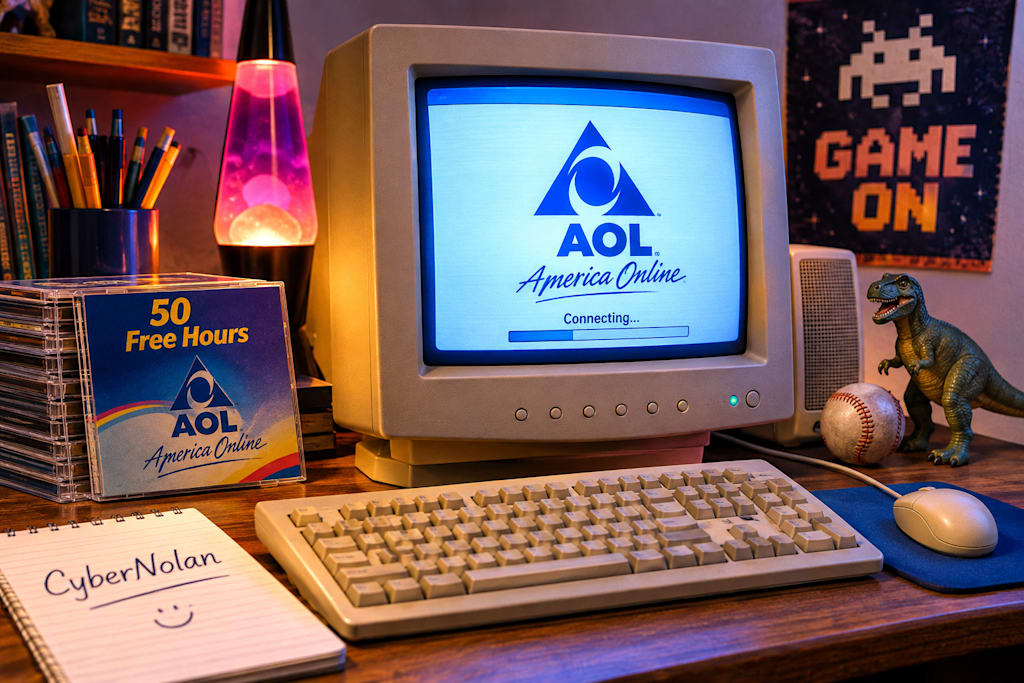
I was born at the beginning of the 1990s, right around the time the internet was beginning its great invasion of American homes. My parents were busy figuring out diapers, bottles, and the mysterious reasons babies cried at inconvenient hours, while somewhere in the world a group of computer enthusiasts was busy figuring out how to connect everybody else to everybody else. By the time I was old enough to understand what a computer could do, the internet had already begun changing the way people lived, worked, communicated, and entertained themselves. I grew up alongside it, although my earliest memories of the experience involved a machine that looked like a small television and a connection that seemed to require the patience of a saint.
Our family computer occupied a desk in the spare room, and it had a bulky monitor, a keyboard with keys that made a satisfying clicking sound, and a tower that seemed far more important than anything else in the house. My father treated the machine with great respect, partly because it had cost a considerable amount of money and partly because he had spent several weekends trying to get everything working. My mother regarded it as an expensive distraction, particularly when my father spent an entire evening staring at a screen while she handled the responsibilities of the household. I regarded it as a mysterious portal to a world that I had barely begun to understand.
My first real introduction to the internet came when I was old enough to use the computer independently. Dad had installed AOL, which came with a collection of software and a promise of access to an enormous online world. The connection process became a family event, complete with the familiar sequence of electronic squeals, static, and mechanical noises produced by the modem. I remember sitting in front of the computer, watching the screen as the connection attempted to establish itself, convinced that something extraordinary was happening behind the scenes. When the welcome screen finally appeared, I felt as if I had gained access to a secret society.
I had absolutely no idea what I was doing.
AOL offered chat rooms, instant messaging, email, games, and more information than I could possibly imagine. The first thing I discovered was that people were communicating with strangers from all over the country, sometimes from other countries, and they were doing it from their bedrooms, living rooms, and offices. I had grown up thinking that meeting someone required going somewhere, being introduced, or attending an event. Here, people were gathering in digital rooms, carrying on conversations with complete strangers as if they had known each other for years. The idea fascinated me, and naturally, I decided to join them.
Creating a screen name became my first major assignment. I wanted something memorable, something that would make people curious about me, and something that sounded considerably cooler than the person sitting in front of the computer. After several attempts, I settled on CyberNolan. Looking back, the name was about as original as naming a dog Rover, but at the time I thought I had accomplished something remarkable. I entered my new identity into the AOL system, admired the result, and prepared to introduce myself to the online community. My digital reputation was officially underway, although my audience consisted of people who had absolutely no reason to care that I had arrived.
My first chat room experience involved a discussion about music, movies, and video games. I remember typing a greeting and waiting for somebody to respond, watching the screen as messages appeared from people whose names I had never seen before. Conversations moved quickly, and I struggled to keep up with the speed of the exchanges. By the time I had finished typing a response, three other people had introduced new subjects, two had made jokes, and somebody had already disappeared from the conversation. It was like walking into a crowded party where everybody knew each other and I had forgotten the reason I came.
Eventually, somebody responded to my greeting. His screen name was PixelPete, and he asked whether I played computer games. I told him I did, although my experience was limited to a handful of games that came with our computer. He mentioned several titles I had never heard of, and I spent the next hour learning about games, websites, and online communities. Pete lived in another state, was a little older than me, and seemed to know everything about computers. I thought he was some kind of internet expert, although he later admitted that most of his knowledge came from spending too much time online himself.
We began meeting in the same chat room whenever our schedules allowed. Eventually, we exchanged screen names and started using AOL Instant Messenger, which made keeping in touch much easier. I remember the excitement of receiving an instant message, particularly when the familiar notification announced that somebody had contacted me. I would rush to the computer, sign in, and discover that Pete had sent me a message about a new game, a funny website, or something ridiculous he had encountered online. Our conversations became part of my routine, and I began to understand how friendships could develop between people who had never occupied the same physical space.
One afternoon, Pete introduced me to something that changed the way I thought about the internet. He sent me a link to a website filled with jokes, cartoons, ridiculous quizzes, and homemade games. It took several minutes to load, and I watched each section appear as if the computer were assembling the page one piece at a time. The website was poorly designed, the graphics were primitive, and some of the jokes were terrible. I thought it was magnificent. I spent the next several hours exploring its contents, following links, and discovering other websites that seemed to exist solely because somebody had an idea and wanted to share it.
That discovery led me to create my own little corner of the internet. I found a free website service that allowed users to build personal pages, and I decided to make one of my own. The process involved choosing colors, selecting backgrounds, arranging text, and adding animated graphics that seemed to serve absolutely no purpose beyond attracting attention. I included a short biography, a list of my favorite games, and a collection of links to websites I thought other people should visit. I even added a visitor counter because I wanted proof that somebody had actually stopped by.
The finished product looked like something assembled by a person who had recently discovered every available color and felt obligated to use all of them. I chose a bright background, several animated graphics, and a font that probably required special consideration from anyone attempting to read it. I was enormously proud of the result. My parents were less impressed, although Dad did spend several minutes looking at the page before offering the observation that I had spent an awful lot of effort creating something nobody had requested. I considered that criticism unfair, given that the internet was full of people creating things nobody had requested.
The experience taught me something I had never considered before. A computer could be more than a machine for playing games or completing school assignments. It could be a place to share ideas, discover interests, and meet people who enjoyed the same things I enjoyed. The internet made the world feel accessible in a way that had been difficult to imagine during my childhood. A teenager sitting in one state could exchange ideas with another teenager several hundred miles away, and neither needed an invitation, a telephone number, or a reason beyond curiosity.
Of course, the experience came with its share of frustrations. Dial-up connections were notoriously unreliable, and losing access halfway through a conversation could ruin an otherwise enjoyable evening. The telephone line was another source of family conflict. If somebody picked up the receiver while I was online, my connection could disappear, leaving me staring at a disconnected screen and wondering which member of the household had committed the offense. My parents eventually established a system for sharing the telephone line, although the arrangement seemed to involve more negotiations than an international peace agreement.
As the years passed, the internet changed rapidly. Websites became more sophisticated, connections became faster, and social networking began transforming the way people interacted. AOL eventually gave way to newer services, and my little personal website disappeared into the forgotten corners of the early internet. PixelPete and I eventually lost touch, as happens with many friendships that begin during a particular chapter of life. I have occasionally wondered what became of him, whether he continued playing computer games, and whether he remembers the teenager who called himself CyberNolan.
I have kept the screen name in my memory, partly because it reminds me of how seriously I took myself during those early online adventures. The name seemed impressive at the time, although I suspect I would have difficulty keeping a straight face if somebody introduced me by it today. Still, I would happily revisit that little AOL chat room if given the opportunity, if only to see how the people who gathered there turned out.
My generation grew up during a remarkable transition, moving from a childhood where information came from books, television, libraries, and conversations into a world where answers could be found with a few keystrokes. I never fully appreciated how significant that change was while it was happening. To me, the internet was simply an exciting new place to explore, and every connection brought another opportunity to discover something I had never encountered before.
About the Creator
Nolan Reed
I write true stories, including unsolved mysteries and events that actually happened.
Enjoyed the story? Support the Creator.
Subscribe for free to receive all their stories in your feed.
Comments
There are no comments for this story
Be the first to respond and start the conversation.