
Before the World Was Online
The first emails, mysterious usernames, dial-up connections, and the extraordinary feeling of discovering a world beyond your own

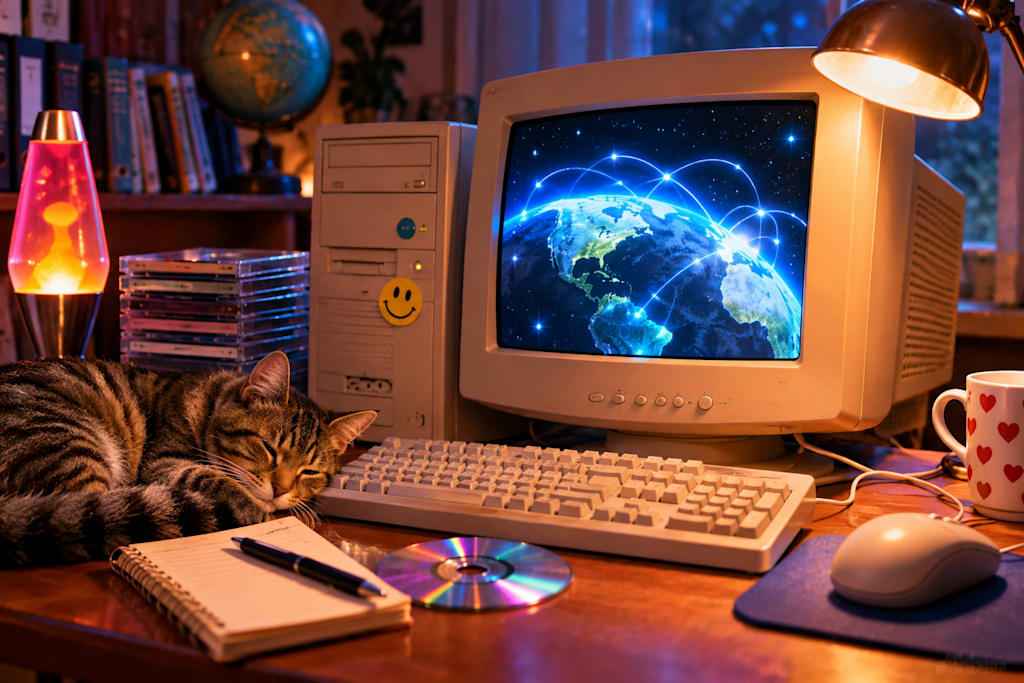
There was a time when connecting to the internet felt like opening a door to another universe.
Today, we carry the internet everywhere. It lives in our phones, follows us through our daily routines, answers our questions, delivers our entertainment, and connects us to people we might never meet in person.
But around the year 2000, things were very different.
The internet was still a relatively new adventure for many households. Having a computer connected to the World Wide Web felt exciting, almost futuristic. It wasn't something we casually checked while standing in line at a grocery store. It was something we deliberately made time for.
And sometimes, getting online was an adventure of its own.
The computer that connected us to the world
Picture a typical home around 2000.
In the family room or a corner of the bedroom stood a desktop computer with a bulky beige monitor, a separate keyboard, and a mouse that needed a proper surface. The computer often occupied an entire desk, surrounded by papers, CDs, notebooks, and perhaps a cup of coffee that someone had forgotten to move.
There was something special about sitting down in front of that machine.
You pressed the power button, waited for the computer to start, and prepared to enter a different world.
If you had a dial-up connection, the process came with its own soundtrack. The modem produced a strange sequence of electronic noises as it attempted to connect. Sometimes the connection worked immediately. Sometimes it didn't.
And if someone picked up the telephone at the wrong moment, your internet connection could disappear.
It seems almost unbelievable now, when high-speed internet is available in so many places. Back then, however, those little technical inconveniences were simply part of the experience.
Once connected, a whole new world appeared on the screen.
Discovering the World Through Yahoo! and AOL
One of the most exciting things about the early internet was searching for information.
Yahoo! was a familiar destination, and search engines were becoming increasingly important. Google was already available, although many people were still discovering how useful it could be.
You could search for practically anything.
Information about celebrities, music, movies, history, travel destinations, hobbies, recipes, and distant countries suddenly became accessible from your own home.
The experience was different from searching today. Websites often had colorful backgrounds, animated graphics, flashing banners, and menus filled with links. Some pages looked wonderfully creative; others were difficult to navigate.
But that was part of the charm.
You never knew exactly what you would discover.
One search could lead to another, and before you realized it, an entire evening had passed.
It was easy to lose track of time while exploring websites that seemed to offer unlimited possibilities.
For someone who had grown up relying on television, newspapers, books, and libraries, this was a remarkable change.
Information was no longer something you always had to go out and find.
It was beginning to come directly to you.
The excitement of email
Email was another revelation.
Before smartphones and instant notifications, receiving an electronic message had a special feeling. You could create an email account, choose an address, and begin communicating with people without waiting for traditional mail.
Services such as Yahoo! Mail and Hotmail became familiar names.
An email address was almost like a new identity. You had to choose a username, and sometimes finding one that wasn't already taken was surprisingly difficult.
There was also something exciting about writing a message, pressing send, and knowing that it could reach someone thousands of miles away.
Of course, you didn't necessarily receive an immediate response.
You might check your inbox later, hoping to find something new. An unfamiliar message could bring excitement, curiosity, or occasionally disappointment.
Today, our inboxes are often overflowing. Back then, receiving a message could feel like an event.
It was one of the first ways many ordinary people experienced the extraordinary reach of digital communication.
Chat rooms and mysterious usernames
Perhaps the most fascinating part of the early internet was meeting people online.
AOL Instant Messenger, commonly known as AIM, became an important part of online social life in the United States. Other services and chat rooms also offered opportunities to communicate with strangers and acquaintances.
Choosing a screen name was serious business.
It had to sound interesting, memorable, mysterious, or perhaps a little clever. Some people used their favorite bands, movie characters, hobbies, or combinations of words and numbers.
Nobody wanted a username that sounded boring.
Once online, you could enter conversations with people you had never met. You might discover someone who loved the same music, enjoyed the same movies, or shared an interest that nobody in your immediate circle seemed to understand.
It was fascinating to realize that someone sitting in California, New York, Texas, or somewhere else entirely could suddenly become part of your evening.
The internet made the world feel smaller.
Of course, not every conversation was meaningful, and not everyone behind a screen was necessarily honest. Even in those early days, it was important to be careful about sharing personal information with strangers.
But the possibility of meeting people beyond your usual surroundings was extraordinary.
For many, it was the beginning of a completely new understanding of communication.
When being online was an event
One thing that made the early internet memorable was the fact that it required some effort.
You had to sit at a computer. You had to wait for the connection. You had to navigate websites and sometimes tolerate pages that loaded painfully slowly.
There were no smartphones constantly demanding attention.
There were no endless social media feeds designed to keep you scrolling for hours.
You generally went online because you wanted to do something specific: check your email, search for information, visit a website, or talk to someone.
And when you finished, you logged off.
The rest of life continued outside the computer screen.
You could go shopping, meet friends, watch television, prepare dinner, or simply enjoy a quiet evening without feeling that you were missing hundreds of notifications.
Looking back, that separation between the online world and everyday life seems particularly interesting.
We were discovering a new technology without yet understanding how completely it would eventually transform our routines.
A different kind of freedom
The early internet also offered something that was difficult to find elsewhere: the freedom to explore subjects without necessarily following someone else's recommendations.
You could search for unusual hobbies, discover independent websites, read personal pages, explore online communities, and learn about things that traditional media rarely covered.
There was a certain independence to it.
You were responsible for deciding where to go and what to read.
Some websites were beautifully designed. Others looked as though someone had created them in an afternoon. Personal homepages were filled with photographs, favorite quotations, animated decorations, and information about their creators.
They weren't always sophisticated, but they were personal.
People were experimenting with a new medium, learning how to express themselves, and discovering that they could publish information for an audience that extended far beyond their neighborhoods.
The internet wasn't just a place to consume information.
It was becoming a place where ordinary people could create and share it.
That idea would eventually change journalism, education, entertainment, business, and almost every other aspect of modern life.
What we gained and what we lost
It is impossible to deny how much better internet technology has become.
Today, we can make video calls across continents, attend online courses, operate businesses from home, access enormous digital libraries, and communicate almost instantly.
Information that once required hours of searching can now be found in seconds.
Yet progress has also changed the experience.
The internet has become crowded with advertising, commercial interests, competing opinions, misinformation, and platforms constantly demanding our attention.
We have more information than ever, but sometimes less patience to explore it.
We have more ways to communicate, but that doesn't necessarily mean our conversations are more meaningful.
And perhaps that is why remembering the internet around 2000 feels so interesting.
It reminds us of a time when the online world still seemed full of undiscovered possibilities.
The magic of the first connection
The most memorable part of those early internet experiences wasn't necessarily a particular website, an email account, or a conversation.
It was the feeling.
The feeling that an ordinary computer in an ordinary home could connect you to something enormous.
You could sit at a desk in a quiet room and discover information from another continent. You could read about a place you had never visited, explore an unfamiliar subject, or communicate with someone whose life was completely different from yours.
For the first time, the world seemed to be gathering behind a screen.
We didn't yet know what the internet would become. We couldn't fully imagine social media, streaming, online shopping on today's scale, smartphones, or artificial intelligence.
We were simply discovering what was possible.
And perhaps that is what I miss most about those early days: the sense of wonder.
Technology has become faster, smarter, and more powerful. The internet has grown into something that touches almost every part of our lives.
But the excitement of discovering it for the first time belongs to a different era.
An era of bulky desktop computers, dial-up connections, creative screen names, Yahoo! searches, AOL messages, and the extraordinary realization that a whole world was waiting just beyond the screen.
We didn't know where that digital journey would take us.
We only knew that we wanted to connect again.
About the Creator
Algieba
Curious observer of the world, exploring the latest ideas, trends, and stories that shape our lives. A thoughtful writer who seeks to make sense of complex topics and share insights that inform, inspire, and engage readers.
Enjoyed the story? Support the Creator.
Subscribe for free to receive all their stories in your feed. You could also become a paid subscriber, letting them know you appreciate their work.
Comments
There are no comments for this story
Be the first to respond and start the conversation.