
Battery Recycling Market: Size, Share and Industry Trends 2026-2034
How Circular Economy Imperatives, EV Battery Growth, and Resource Recovery Are Transforming the Global Battery Recycling Sector

Market Overview
The global battery recycling market represents a critical and rapidly expanding segment of the circular economy, encompassing comprehensive processes to recover valuable materials, reduce environmental impact, and address sustainability imperatives across diverse battery technologies. Battery recycling encompasses collection, sorting, processing, and material recovery from spent batteries including lead-acid, nickel-based, lithium-based, and emerging chemistries. Recovered materials including lithium, cobalt, nickel, manganese, and lead are returned to industrial supply chains, reducing mining pressure, supporting sustainable material sourcing, and enabling battery manufacturing cost reductions.
The sector addresses critical sustainability challenges including hazardous waste management, resource scarcity, environmental protection, and circular economy development. As electric vehicle proliferation, renewable energy storage, and portable device usage expand globally, battery volumes grow exponentially, creating urgency for comprehensive recycling infrastructure and technological innovation. The market encompasses specialized recyclers, battery manufacturers developing closed-loop systems, technology innovators developing advanced recovery processes, and established chemical and metals companies investing in battery material recovery.
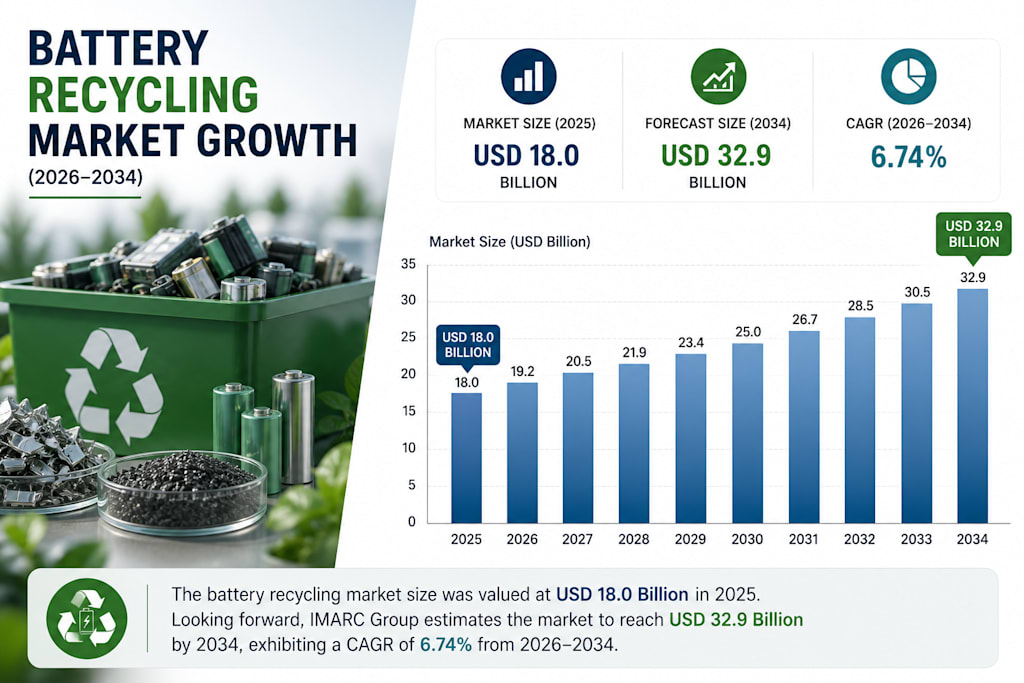
The global battery recycling market size was valued at USD 18.0 Billion in 2025. Looking forward, the market is estimated to reach USD 32.9 Billion by 2034, exhibiting a compound annual growth rate of 6.74% from 2026-2034. Market growth is driven by explosive electric vehicle adoption increasing spent battery volumes, regulatory mandates requiring battery recycling, advancing technologies enabling higher recovery rates and cost efficiency, growing lithium and cobalt scarcity increasing recovered material value, and corporate commitments to circular economy principles and sustainable supply chains.
Request PDF Sample for more detailed market insights:
Role of Innovation in Market Development
• Advanced Recovery Technologies and Process Innovation
Innovation in battery recycling processes dramatically improves material recovery rates, reduce processing costs, and enhance environmental performance. Hydrometallurgical and pyrometallurgical processes recover lithium, cobalt, nickel, and manganese with unprecedented efficiency. Direct cathode material recovery approaches eliminate multiple processing steps, reducing costs and environmental impact while enabling rapid material redeployment into new battery manufacturing.
Artificial intelligence and machine learning optimize recycling process parameters, improve sorting accuracy, and maximize material recovery. Robotics and automation enhance safety, improve consistency, and reduce labor costs in hazardous battery processing environments. These technological advances transform battery recycling from waste management into resource recovery, improving economic viability and environmental performance.
• Closed-Loop Battery Supply Chain Development
Battery manufacturers increasingly develop integrated closed-loop systems where recycled materials directly feed back into battery production. Partnership arrangements between manufacturers and recyclers ensure reliable recovered material supply while reducing battery production costs. Design-for-recycling approaches by battery manufacturers simplify material separation and recovery, improving recycling efficiency and enabling higher recovered material purity.
Blockchain and supply chain transparency technologies track battery lifecycles from manufacturing through collection and recycling, enabling traceability and supporting corporate sustainability reporting. These systems support the transition toward genuinely circular battery supply chains.
• Emerging Battery Technologies and Chemistry Adaptation
Recycling infrastructure increasingly adapts to emerging battery chemistries beyond traditional lithium-ion platforms. Solid-state batteries, sodium-ion batteries, and next-generation chemistries present both challenges and opportunities for recycling process development. Innovative recyclers develop processing capabilities for diverse battery technologies, positioning themselves as essential infrastructure supporting battery technology diversification and advancement.
Global Battery Recycling Market Trends and Drivers
• Explosive Electric Vehicle Adoption and Spent Battery Volumes
Global electric vehicle sales growth creates exponential increase in spent battery volumes requiring recycling. Current EV fleet represents initial recycling opportunity as first-generation vehicles reach end-of-life. The rapid EV market expansion ensures continuous supply of spent batteries for decades, creating stable demand for recycling capacity and capabilities.
Battery second-life applications in stationary energy storage, grid balancing, and backup power systems extend battery lifecycles before recycling, creating complex material recovery timelines and requirements. Comprehensive battery lifecycle management from manufacturing through multiple use phases and ultimate recycling represents essential sustainability infrastructure.
• Regulatory Mandates and Extended Producer Responsibility
Increasingly stringent regulations governing battery collection, recycling, and material recovery drive market expansion. The European Union Battery Directive mandates minimum recycling rates and material recovery targets. Similar regulations in United States, China, and other major markets create compliance imperatives and support market growth through regulatory certainty.
Extended Producer Responsibility (EPR) frameworks require battery manufacturers and importers to fund collection and recycling infrastructure, creating financing mechanisms supporting market development. These regulations transform battery recycling from voluntary sustainability initiative into mandatory operational requirement, fundamentally altering market dynamics.
• Lithium and Critical Material Scarcity
Growing lithium, cobalt, nickel, and other critical material scarcity increases recovered material value, improving battery recycling economics. Mining constraints, geopolitical supply concentration, and environmental concerns associated with primary material extraction create compelling economics for recycled material. Battery manufacturers increasingly target recycled material sourcing to secure reliable, sustainable supply chains while reducing supply chain risk.
Corporate commitments to conflict-free, ethically sourced battery materials drive preference for recycled content, supporting premium pricing for responsibly recovered materials. The circular economy paradigm shift positions recycled battery materials as essential supply chain components rather than waste products.
• Corporate Sustainability Commitments and Circular Economy Integration
Leading technology, automotive, and battery manufacturers establish ambitious circular economy commitments including battery material recovery targets and recycled content requirements. These commitments create downstream demand for recycled battery materials, supporting market economics and infrastructure investment. Corporate sustainability reporting and ESG metrics increasingly include battery material recovery and circular economy progress, driving accountability and market expansion.
Shareholder pressure and consumer preferences increasingly favor companies with genuine circular economy commitments, supporting investment in battery recycling infrastructure and closed-loop supply chains.
Global Battery Recycling Market Segmentation
By Battery Type
Lithium-based Batteries (Fastest Growing - 40% market share in 2025):
• Lithium-ion batteries from EVs
• Lithium-ion batteries from consumer electronics
• Lithium polymer batteries
• Next-generation lithium-based chemistries
Lithium-based battery recycling drives market growth, driven by EV expansion and smartphone/tablet proliferation. Recovered lithium, cobalt, nickel, and manganese support new battery manufacturing. Complex manufacturing requirements and valuable material recovery economics make lithium-based battery recycling increasingly attractive.
Lead-acid Batteries (Largest Historical Segment - 35% market share):
• Automotive starting batteries
• Industrial lead-acid batteries
• Stationary backup power batteries
• UPS system batteries
Lead-acid battery recycling represents the most mature, well-established recycling infrastructure globally. High recycling rates (over 90%) reflect decades of regulatory requirements, established collection infrastructure, and economic viability of lead recovery. Mature market with stable volumes and established recyclers characterizes this segment.
Nickel-based Batteries (15% market share):
• Nickel metal hydride batteries
• Nickel-cadmium batteries
• Transitional battery chemistries
• Specialty industrial batteries
Nickel-based batteries represent transitional technologies increasingly replaced by lithium-ion chemistries. Declining but persistent volumes create ongoing recycling requirements. Established recycling infrastructure supports recovery of nickel and cobalt components.
Others (10% market share):
• Sodium-ion batteries
• Flow batteries
• Emerging chemistries
• Specialty applications
By Battery Source
Automotive (Largest Segment - 45% market share):
• Electric vehicle batteries (fastest growing)
• Hybrid vehicle batteries
• Traditional vehicle starter batteries
• Commercial vehicle batteries
Automotive batteries represent the fastest-growing recycling source driven by EV proliferation. First-generation EV batteries reaching end-of-life create massive recycling opportunities. The predictable battery volumes, standardized collection infrastructure, and high material value optimize automotive battery recycling economics.
Industrial (20% market share):
• Stationary energy storage systems
• Grid-scale battery storage
• Uninterruptible power supplies
• Industrial machinery batteries
Industrial batteries from grid storage, renewable energy integration, and backup power systems create substantial recycling volumes. Long operational lifespans and standardized industrial collection mechanisms support efficient recycling.
Consumer Products (20% market share):
• Smartphones and tablets
• Laptops and portable electronics
• Power tools and home devices
• Wearable electronics
Consumer product batteries represent significant recycling volumes from the enormous installed base of electronic devices. Distributed collection challenges and lower material value per unit require efficient collection and processing infrastructure.
Electronic Appliances (12% market share):
• Renewable energy systems
• Smart home and IoT devices
• Medical equipment batteries
• Telecom infrastructure batteries
Electronic appliance batteries from diverse applications create additional recycling volumes. Growing IoT and smart device proliferation increases battery volumes from this segment.
Others (3% market share):
• Military and defense applications
• Aerospace and aviation
• Marine applications
• Specialty industrial uses
By End-Use Application
Reuse (25% market share):
• Second-life energy storage applications
• Industrial material handling equipment
• Stationary power backup systems
• Grid balancing and load leveling
Battery reuse extends battery lifecycles before recycling, maximizing environmental value and delaying material recovery. Automotive OEMs develop second-life battery programs, extending vehicle battery utilization in stationary storage and grid services. This segment represents growing opportunity as mature EV batteries transition from vehicle to stationary applications.
Extraction (45% market share):
• Recovery of lithium for new batteries
• Cobalt and nickel material recovery
• Manganese and iron extraction
• Lead recovery from lead-acid batteries
Material extraction represents the primary battery recycling end-use, returning valuable materials into industrial supply chains. Economic value of recovered materials supports infrastructure investment and processing technology advancement. Extracted materials directly displace primary mining, reducing environmental impact and supporting supply chain sustainability.
Repackaging (20% market share):
• Battery module reconfiguration
• Energy density optimization
• Application-specific module assembly
• Performance characteristics adjustment
Repackaging involves reassembling functional battery modules for different applications, extending usable battery lifetime. Technicians configure salvaged battery cells into application-specific units, supporting cost-effective power solutions for developing market customers.
Others (10% market share):
• Battery component material recovery
• Thermal processing and energy recovery
• Hazardous waste treatment
• Specialty material applications
By Recovered Material
Lithium (Highest Value - 18% of recovered material market):
• Critical material for battery manufacturing
• Strategic importance and supply constraints
• Growing demand from EV battery production
• Premium pricing for recycled lithium
Cobalt (15% of recovered material market):
• Essential battery cathode component
• Supply concentration and geopolitical risk
• Conflict mineral concerns driving recycled sourcing
• Strong market demand and pricing
Nickel (14% of recovered material market):
• Growing importance in EV battery chemistries
• Substitution for cobalt in battery design
• Industrial and stainless steel applications
• Increasing demand from battery sector growth
Manganese (12% of recovered material market):
• Battery cathode and anode applications
• Industrial chemical uses
• Steel alloying applications
• Moderate material value
Lead (12% of recovered material market):
• Lead-acid battery recycling
• Established, mature recovery processes
• Industrial and chemical applications
• Long-established market with price stability
Aluminium (15% of recovered material market):
• Battery casing and thermal management
• High-volume, lower-value material
• Broad industrial applications
• Efficient recycling and redeployment
Iron (10% of recovered material market):
• Battery component material
• Industrial applications
• High-volume, moderate-value material
• Established recycling infrastructure
Others (8% of recovered material market):
• Copper and copper compounds
• Rare earth elements in specialty batteries
• Electrolyte components
• Binder materials and polymers
Geographic Market Dynamics
Asia-Pacific (Largest Market):
• China's EV dominance driving battery recycling demand
• Growing EV adoption across India, Southeast Asia
• Established battery manufacturing ecosystems
• Rapid capacity expansion and technology innovation
Europe (Second Largest):
• Stringent regulatory requirements driving market growth
• Advanced recycling technology development
• Commitment to circular economy principles
• Premium recovered material sourcing standards
North America (Growing Market):
• Increasing EV adoption and battery volumes
• Regulatory initiatives including Battery Directive alignment
• Investment in recycling infrastructure
• Technology innovation and process advancement
Emerging Markets (Growth Opportunity):
• Expanding EV adoption in developing economies
• Informal battery recycling transitioning to formal infrastructure
• Infrastructure investment opportunities
• Growing material demand from manufacturing expansion
Competitive Landscape
The global battery recycling market includes specialized recycling companies (Accurec, Aqua Metals, Retriev Technologies), battery manufacturers developing integrated recycling (CATL, LG Chem, Samsung SDI), chemical and metals companies (Umicore, Eco-Bat, Johnson Controls), automotive OEMs establishing collection networks, and emerging technology innovators. Competition intensifies based on processing technology sophistication, recovered material purity, cost efficiency, capacity scale, and geographic reach. Companies with advanced recovery technology, sustainable processing practices, and integrated supply chain relationships strengthen competitive positions.
Strategic partnerships between recyclers, battery manufacturers, and material suppliers optimize supply chains and secure feedstock reliability. Technology licensing and joint ventures accelerate innovation diffusion across the global recycling industry.
Market Outlook
The global battery recycling market is expected to experience sustained expansion as electric vehicle adoption accelerates and battery volumes grow exponentially. The market is projected to grow at a compound annual growth rate of 6.74% from 2026-2034. Strategic investments in recycling capacity expansion, technology innovation improving recovery rates and cost efficiency, regulatory compliance ensuring consistent demand, and corporate supply chain integration supporting recycled material sourcing will remain critical growth drivers.
Lithium scarcity and cobalt supply constraints will increasingly drive recovered material sourcing, supporting premium pricing for recycled battery materials. Circular economy maturation and second-life battery development will create additional revenue streams for the recycling industry. Battery recycling will transition from environmental necessity into essential infrastructure supporting global EV transition, renewable energy expansion, and sustainable resource management.
Key Market Opportunities:
• Recycling capacity expansion to accommodate battery volume growth
• Technology innovation improving recovery efficiency and cost
• Second-life battery applications and energy storage market development
• Material scarcity-driven premium for recycled battery materials
• Regulatory compliance and extended producer responsibility financing
• Supply chain integration with battery manufacturers
• Emerging battery chemistry adaptation and process development
• Circular economy infrastructure development in emerging markets
About the Creator
Yoshio
Market Research Analyst with 5+ years of experience in consumer insights and market segmentation. Skilled in data analysis and qualitative research.
Enjoyed the story? Support the Creator.
Subscribe for free to receive all their stories in your feed.
Comments
There are no comments for this story
Be the first to respond and start the conversation.