
Baidu Once Owned the Internet. Then the Search Box Died.
A 90s kid’s autopsy of “Baidu it, you’ll know,” and what the slow collapse of China’s search giant says about closed apps, polluted results, and the AI that ate the web.
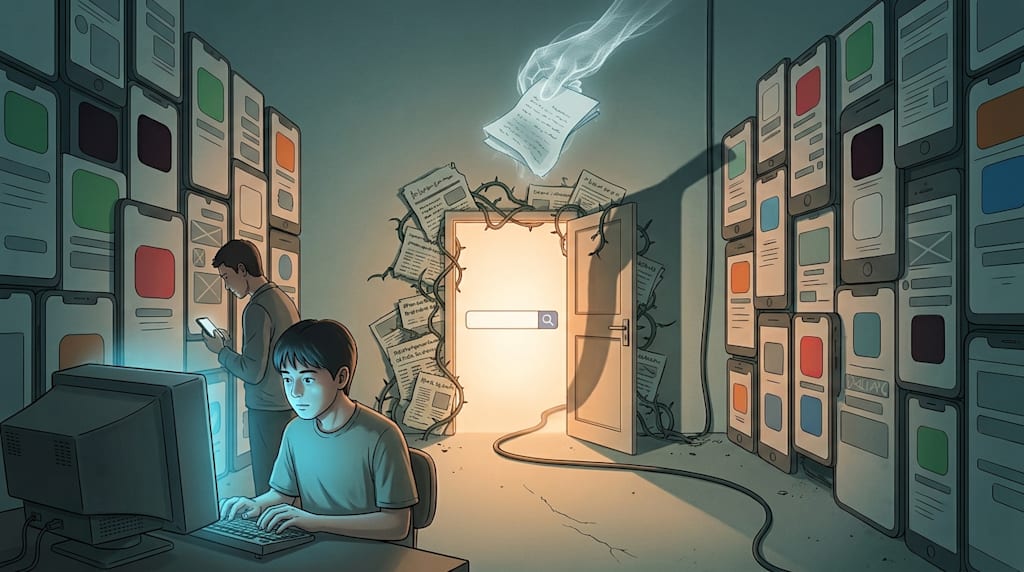
Why Baidu Search Lost Its Way
I was born in 1991. My teens ran into the wildest years of the Chinese internet. Internet cafes were thick with smoke. QQ beeps came and went. Non-mainstream avatars flashed across screens. When I didn't know a question, a song, a character, I didn't ask a teacher. I didn't scroll short videos. I opened a clean homepage and typed a few words into a search box. "Baidu it, and you'll know."
Back then Baidu was the front door to the Chinese internet. It was the key to the information world. Whatever you wanted, it took you there. Tieba, Zhidao, Baike, MP3, Space, Travel, Hi. These products were not all elegant. Together they built a large content pool. Baidu didn't make information. It distributed it. It didn't own content. It held the passage to content.
So when I say Baidu Search declined, I mean one company and one product. I also mean an era ended. That era depended on a search box. It depended on open web pages. It depended on links you clicked. It is over.
The numbers say one thing. Baidu's search share fell from about 87% in 2021 to roughly 50.92% by mid-2025. On desktop, Bing's share, 50.99%, passed Baidu's 30.15%. Baidu App's monthly active users dropped from 702 million in Q2 2025 to 640 million in June 2026. It lost nearly 69 million users in a year. Baidu App's daily searches are around 300 million. Douyin's daily searches are 5.3 billion. WeChat Search has more than 1 billion. In Q2 2026, Baidu's online marketing revenue fell 19% year over year. That was the ninth straight quarter of decline. The search box is no longer the internet's front door.
The web broke into apps
Around 2010, the iPhone arrived. Android arrived. Mobile internet arrived. Baidu didn't panic. It was one of the earliest giants to lay out mobile. In 2013, it spent 1.9 billion USD on 91 Wireless. That was the largest acquisition in Chinese internet history at the time. The logic: mobile users download apps. They go to app stores. Whoever controls the app store controls the entrance. Baidu missed one thing: phone makers would ship their own app stores. Huawei, Xiaomi, OPPO, Vivo. Each had its own market. The kingdom bought with 1.9 billion dollars shrank within a few years. It faded almost without a sound.
Mobile internet changed information from open web pages to closed apps. WeChat public account articles: Baidu cannot search them. Taobao products: Baidu cannot search them. Douyin videos: Baidu cannot search them. Xiaohongshu notes: Baidu cannot search them. The useful content users could find on Baidu grew smaller. Before, a recipe search found food blogs. A travel search found Mafengwo, Qyer. A product search found real forum discussions. Now you find marketing accounts, Baijiahao, aggregation sites, and outdated pages. Search is connection. When the internet stops connecting, search has no source.
Baijiahao filled the gap and made it worse
Facing content drought, Baidu launched Baijiahao. If external content cannot be searched, produce it yourself. Keep traffic inside Baidu. The strategy made business sense. The consequences were disastrous. To fill the content pool quickly, Baijiahao brought in low-quality, rewritten, patched, and fake content. A user searches a keyword. The first page is all Baijiahao. Clickbait titles. Empty content. Repeated reposts. Useful external links are pushed down. The user clicks, finds nothing, backs out, clicks again, is disappointed again. In 2019, "Baidu Search Is Dead" went viral. Its criticism: the first page of Baidu results was almost entirely Baidu's own products. Baidu went from information middleman to information toll booth. From helping you find answers to keeping you on the site. Baidu was both rule-maker for search ranking and a participant in content supply. Referee and player. The trust basis for search fairness dissolved. More people bypassed Baidu. They searched inside WeChat, Douyin, Xiaohongshu, Zhihu, Bilibili. Search didn't disappear. It stopped happening on Baidu.
Products that arrived early and left late
Baidu has a strange ability: it sees the trend early, and falls on its face when the trend arrives. Baidu Space was once one of the largest blog and SNS communities on the Chinese internet. It had a better content base than later Weibo or Xiaohongshu. Baidu tried to force social networking through mandatory upgrades. It turned the blog community into a mess. In 2015, Baidu Space shut down. Countless people's youth moved to Baidu Netdisk. Baidu Hi was Baidu's earliest instant messaging tool, earlier than many later software. It served only internal communication. It never reached the mass market. Baidu Games noticed early that games were a fast lane for traffic monetization. Management changed frequently. Serious corruption appeared internally. Under attack from NetEase and Tencent, the business was marginalized. It sold cheaply for 1.2 billion. Baidu Travel was once a high-quality travelogue and guide community. It launched in 2011, far earlier than many current travel unicorns. Its logic was tool-like. It lacked community stickiness. Users searched for a guide and left. No closed loop formed. Baidu bought Chuanke, wanting to build the Taobao of education. Baidu internally preferred tool products like Zuoyebang. The platform education business was marginalized. It quietly exited. Baidu Tieba was once the largest traffic pool and subculture birthplace on the Chinese internet. Frequent monetization attempts and chaotic management made it miss the best window for transformation. Now it survives in small circles. These products share one thing: Baidu used traffic distribution thinking to build communities, and algorithms to solve human problems. Communities need belonging, relationship chains, cultural identity. Not simple traffic irrigation. Baidu is good at technology. It is not good at understanding people.
Wei Zexi
In 2016, the Wei Zexi incident exploded. A young university student found a hospital through Baidu Search, received ineffective treatment, and died. Behind it was the chaos of Baidu's medical advertising bidding. The blow to Baidu was not only public opinion. It was trust. Baidu Search used to be a trustworthy information entrance. After that, in the public mind, it became an advertising platform. When users no longer trust search results, the value of search drops sharply. After Wei Zexi, Baidu rectified medical advertising. Once trust collapses, it is hard to rebuild. Even today, many people open Baidu Search and assume the first few results are ads.
AI dug up the root
If mobile internet made Baidu Search harder, AI dug up the root of search. Baidu's business model depends on users clicking links. User searches, sees ad, clicks, Baidu charges. AI search changed that. User asks AI, AI gives answer directly. No link click needed. User experience is better. Baidu's ad monetization path is cut. Baidu laid out AI early. It was the first Chinese giant to shout "All in AI." Wenxin Yiyan was the first domestic large model released. First-mover advantage did not turn into market victory. Baidu lacks mobile traffic feedback. ByteDance's Doubao leans on Douyin. Tencent's Yuanbao is embedded in WeChat. Both get huge traffic irrigation. Baidu has no super app to feed Wenxin Yiyan. Its user scale was quickly left behind. By 2025, Wenxin Yiyan's monthly active users were only about 5.3 million. Doubao's were 172 million. Baidu is also torn on AI search. If AI search works too well, users stop clicking ads, and Baidu's revenue collapses. If AI search works poorly, users flow to other AI products. Baidu executives admitted they actively slowed commercialization to transform. Where is the direction? If search itself is no longer an entrance, what can Baidu rely on?
Why Baidu is always half a step behind
Baidu's problem looks like product failure. Deeper down, it is organization and culture. Baidu had leading advantages in algorithms and architecture for a long time. Its products are often arrogant, lacking understanding of people. When Baidu does social, it tries to solve problems with algorithms, ignoring community life. When Baidu does content, it pursues quantity and sacrifices quality. When Baidu does monetization, it is short-termist and overdrafts user trust. Baidu's financial structure, overly dependent on search ad revenue, makes it torn when facing new technological shocks. Search ads are a cash cow and a shackle. Baidu dares not shake this foundation easily. So it patches the old model and misses the best window for transformation. Baidu's strategic vision is good. It saw mobile internet, O2O, AI, autonomous driving. It always arrives early and leaves late. Between strategy and execution lies a huge gap. That gap is organizational capability, corporate culture, understanding of users.
The future
Baidu still has a monopoly position in search. According to public data, Baidu's share of China's search market fell from over 80% at its peak to around half now. It is still the largest player. Baidu App's monthly active users are declining but still number hundreds of millions. Baidu's accumulation in AI, autonomous driving, and intelligent cloud is not without value. The era of search as the general entrance to the internet is over. In the future, Baidu Search may become an AI assistant, an enterprise service tool, a vertical search platform. It may no longer be the Baidu in our generation's memory. It may not disappear. It will just no longer stand at the center of the stage. Where Baidu goes from here is unknown. If Baidu cannot find a new value anchor that does not depend on click ads, its decline is far from over.
The search box
Our generation has complicated feelings about Baidu. It was once our teacher, our dictionary, our map, our playground. We followed stars on Baidu Tieba. We answered questions on Baidu Zhidao. We wrote diaries on Baidu Space. We downloaded songs from Baidu MP3. Those products shut down, migrated, were forgotten, folded into memory like parts of youth. The decline of Baidu Search is bigger than one company. It tracks a larger shift. The internet moved from open pages to closed apps. Search gave way to recommendation, and links gave way to answers. When information is locked in apps, when algorithms choose for us, when AI gives answers directly, the era of the search box was going to end. It is not the fault of the post-00s that they do not know Baidu. They grew up in a different internet. They swipe. They ask. An answer appears. They do not need to remember "Baidu it." They have too many places to "it." Our generation can only, when occasionally opening Baidu and seeing screens full of Baijiahao and ads, drift into the memory of that clean homepage, that simple search box, and that slogan rarely spoken now: "Baidu it, and you'll know." Back then, we thought that as long as we searched, we would know. The search box is still there. Fewer people use it.
About the Creator
Jin
Writer of reamstories
https://reamstories.com/jin
Enjoyed the story? Support the Creator.
Subscribe for free to receive all their stories in your feed. You could also become a paid subscriber, letting them know you appreciate their work.
Comments
There are no comments for this story
Be the first to respond and start the conversation.