
Automotive Robotics Market Accelerates Toward a Smart Manufacturing Future as EV Production and Industry 4.0 Drive Adoption
Rising demand for electric vehicles, advancements in artificial intelligence, and the push for highly efficient manufacturing are transforming the global automotive robotics industry.

The automotive industry has always been at the forefront of technological innovation. From assembly line manufacturing introduced more than a century ago to today's intelligent production facilities, automakers continuously seek new ways to improve efficiency, precision, quality, and safety. In recent years, one technology has become increasingly central to this transformation: robotics.
Automotive robotics has evolved far beyond traditional automated welding arms. Modern robotic systems now incorporate artificial intelligence, machine learning, computer vision, advanced sensors, and real-time connectivity, enabling manufacturers to build vehicles faster, more accurately, and with greater flexibility than ever before.
As the automotive sector undergoes a major transition toward electric vehicles (EVs), connected mobility, and smart manufacturing, robotics is emerging as one of the industry's most critical technologies.
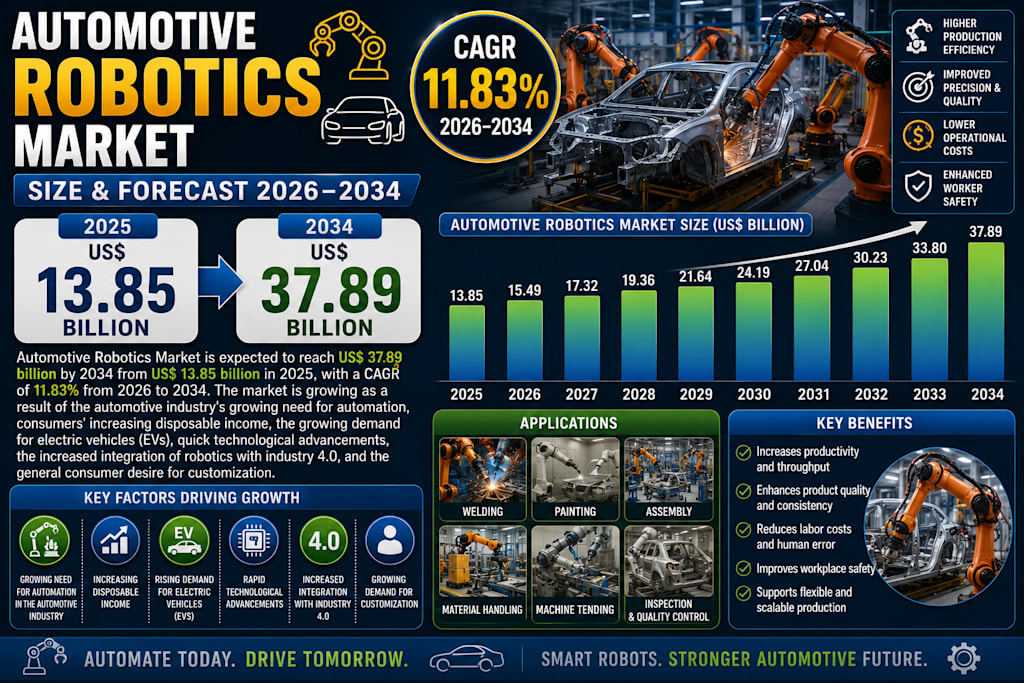
According to Renub Research, the Automotive Robotics Market is projected to grow from US$13.85 billion in 2025 to US$37.89 billion by 2034, expanding at a remarkable compound annual growth rate (CAGR) of 11.83% between 2026 and 2034. Rising automation demand, growing EV production, Industry 4.0 adoption, and continuous technological advancements are expected to fuel this strong market growth.
Automotive Robotics Has Become the Backbone of Modern Vehicle Manufacturing
Automotive robotics refers to the use of programmable robotic systems designed to perform manufacturing tasks within vehicle production facilities.
These robots are commonly deployed for welding, painting, assembly, material handling, inspection, cutting, packaging, and logistics operations. Their ability to perform repetitive and complex tasks with exceptional precision makes them indispensable within modern automotive plants.
Today's automotive manufacturing facilities increasingly rely on a combination of industrial robots, collaborative robots (cobots), autonomous guided vehicles (AGVs), and vision-guided robotic systems.
Together, these technologies improve production speed, enhance consistency, reduce operational costs, and support safer working environments.
As vehicle manufacturing becomes more complex, robotics continues to expand its role throughout the production process.
Electric Vehicle Production Is Driving Robotics Demand
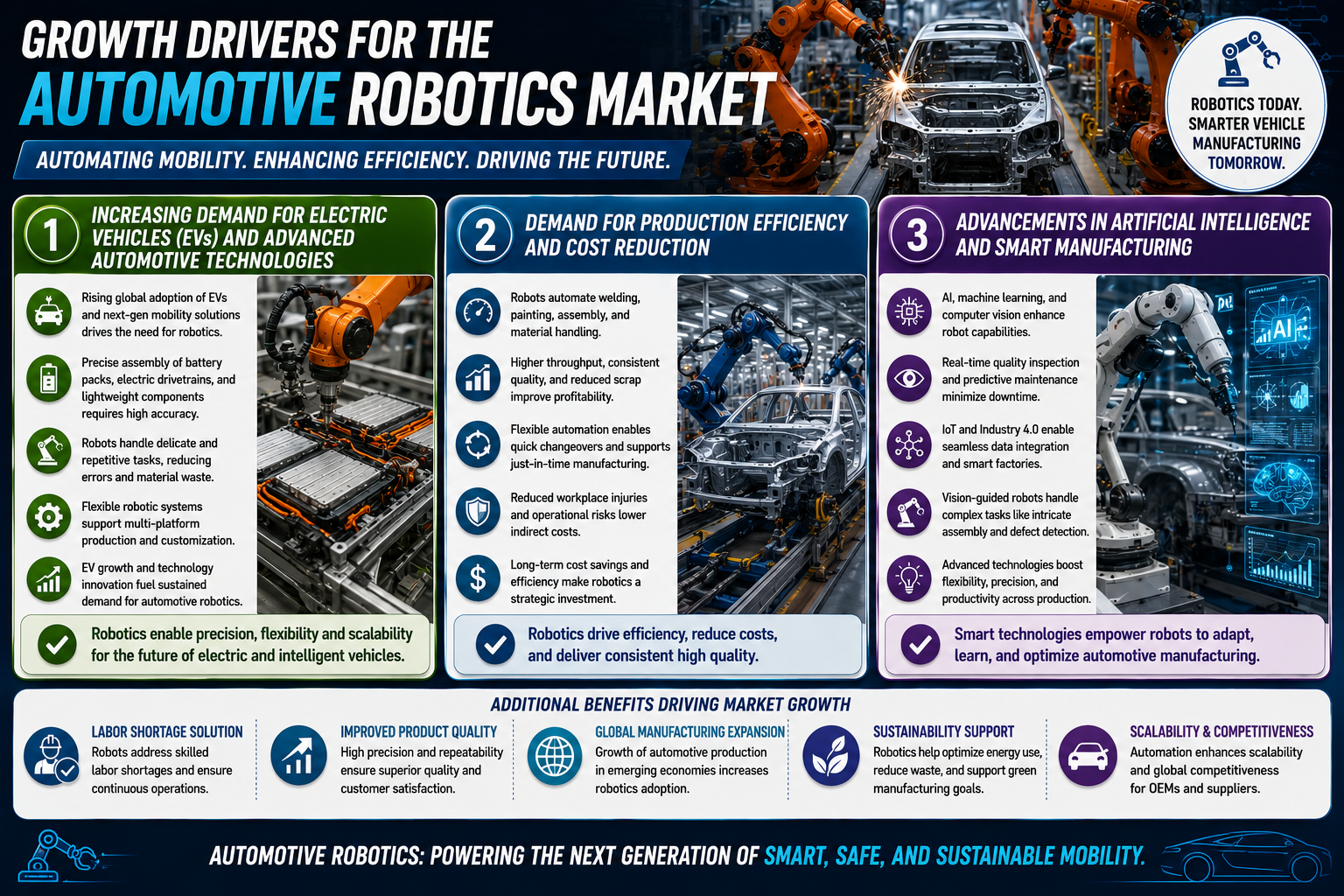
One of the strongest growth drivers for the automotive robotics market is the rapid expansion of electric vehicle production.
Unlike traditional internal combustion engine vehicles, electric vehicles require specialized manufacturing processes involving battery packs, electric motors, power electronics, and lightweight materials.
These components demand extremely high levels of precision and consistency during assembly.
Robotic systems are ideally suited for these tasks because they can handle delicate materials, perform intricate assembly operations, and maintain strict quality standards throughout production.
Battery manufacturing, in particular, relies heavily on automation to ensure safety, accuracy, and efficiency.
As global EV adoption accelerates, automakers are investing heavily in robotic technologies to support expanding production capacity and meet growing consumer demand.
Manufacturers Are Seeking Greater Production Efficiency
The automotive industry remains highly competitive, with manufacturers constantly seeking ways to reduce costs while maintaining product quality.
Robotics offers significant advantages in this regard.
Automated systems can operate continuously with minimal downtime, increasing production throughput while reducing human error. Tasks such as welding, painting, assembly, and material handling can be performed faster and more consistently by robotic systems than through manual labor alone.
Additionally, robots help reduce waste, improve resource utilization, and minimize costly production defects.
These operational benefits directly contribute to profitability and competitiveness, making robotics an increasingly attractive investment for automotive manufacturers worldwide.
Industry 4.0 Is Transforming Automotive Factories
The rise of Industry 4.0 has fundamentally changed the role of robotics within manufacturing environments.
Traditional industrial robots were primarily programmed to perform repetitive tasks. Modern robotic systems, however, are increasingly connected, intelligent, and capable of real-time decision-making.
Industry 4.0 technologies integrate robotics with artificial intelligence, cloud computing, data analytics, sensors, and the Internet of Things (IoT).
This connectivity allows production equipment to communicate, monitor performance, and respond dynamically to changing conditions.
Smart factories use these capabilities to optimize workflows, improve productivity, and reduce downtime.
As automotive manufacturers continue embracing digital transformation, demand for advanced robotics solutions is expected to increase significantly.
Artificial Intelligence Enhances Robotic Capabilities
Artificial intelligence has become one of the most influential technologies shaping the future of automotive robotics.
AI-powered robots can analyze data, recognize patterns, adapt to changing production conditions, and make informed decisions without constant human intervention.
Machine learning algorithms help robotic systems improve performance over time, while computer vision technologies allow robots to identify components, detect defects, and perform complex inspection tasks.
Predictive maintenance systems use AI to monitor equipment health and identify potential failures before they occur, reducing costly production interruptions.
The integration of AI into robotic systems is enabling manufacturers to achieve unprecedented levels of efficiency, flexibility, and quality control.
Collaborative Robots Are Expanding Factory Applications
Collaborative robots, commonly known as cobots, represent one of the fastest-growing segments within the automotive robotics market.
Unlike traditional industrial robots that operate within isolated safety cages, cobots are designed to work alongside human employees safely and efficiently.
These systems combine robotic precision with human creativity and problem-solving capabilities.
Cobots are particularly valuable for tasks requiring flexibility, adaptability, and close human interaction.
They can assist workers with assembly operations, material handling, inspection processes, and repetitive tasks that may otherwise contribute to fatigue or injury.
As manufacturers seek more flexible production environments, cobot adoption is expected to continue rising.
Vision-Guided Systems Improve Precision
Computer vision technologies are significantly enhancing robotic performance across automotive production facilities.
Vision-guided robots use cameras, sensors, and image-processing software to identify objects, inspect components, and guide movements with exceptional accuracy.
These systems enable robots to perform highly detailed tasks such as part alignment, defect detection, dimensional inspection, and quality assurance.
Unlike traditional automation systems that rely on fixed positioning, vision-guided robots can adapt to variations in components and production conditions.
This flexibility improves operational efficiency while reducing the likelihood of production errors.
As vehicle designs become increasingly complex, vision technologies are expected to play an even larger role in automotive robotics.
Material Handling Automation Gains Momentum
Material handling remains one of the most important applications for automotive robotics.
Automotive manufacturing involves the movement of thousands of components across production facilities every day. Efficient material handling is essential for maintaining productivity and minimizing bottlenecks.
Autonomous guided vehicles (AGVs), robotic transport systems, and automated storage solutions help streamline logistics operations while reducing manual labor requirements.
These technologies improve workflow efficiency, reduce workplace accidents, and support just-in-time manufacturing practices.
As production volumes continue increasing, automated material handling systems are becoming increasingly important within automotive facilities.
Welding Remains a Core Robotics Application
Welding continues to be one of the largest applications for automotive robotics.
Vehicle manufacturing requires thousands of welds to join structural components, body panels, and chassis assemblies.
Robotic welding systems provide unmatched precision, consistency, and speed compared to manual welding processes.
These systems can perform complex welding operations repeatedly while maintaining uniform quality standards.
Robotic welding also improves worker safety by reducing exposure to heat, fumes, and hazardous environments.
As automakers continue prioritizing production efficiency and quality, robotic welding remains a cornerstone of automotive automation.
Painting Robots Improve Quality and Sustainability
Painting operations have long been among the most challenging aspects of automotive manufacturing.
Robotic painting systems offer significant advantages by delivering consistent coating thickness, reducing overspray, and minimizing material waste.
Advanced robotic sprayers can precisely control paint application while ensuring uniform finishes across vehicle surfaces.
These systems also help manufacturers meet increasingly strict environmental regulations by reducing emissions and optimizing paint utilization.
As sustainability becomes a greater priority within automotive production, robotic painting solutions are gaining additional importance.
Articulated Robots Dominate the Market
Among various robot types, articulated robots continue to dominate the automotive robotics market.
These robots feature multiple rotating joints that provide exceptional flexibility and range of motion.
Their versatility allows them to perform a wide variety of tasks, including welding, assembly, painting, material handling, and inspection.
Articulated robots can operate in confined spaces while maintaining high levels of precision and repeatability.
Their widespread adoption across automotive manufacturing facilities reflects their ability to handle diverse production requirements efficiently.
Workforce Transformation Remains a Challenge
Despite the many benefits of robotics, workforce adaptation remains an important challenge.
Automation can reduce demand for certain manual labor roles while increasing the need for employees with technical expertise in robotics, programming, maintenance, and system management.
Many manufacturers face difficulties recruiting workers with the skills necessary to operate and maintain advanced robotic systems.
Upskilling and workforce development initiatives have become increasingly important as automation adoption accelerates.
Successfully integrating robotics while supporting workforce transition will remain a critical priority for the industry.
High Capital Costs Continue to Affect Adoption
One of the primary barriers to robotics implementation is the significant upfront investment required.
Purchasing, installing, programming, and integrating robotic systems often involves substantial capital expenditure.
Additional costs related to maintenance, software updates, training, and facility modifications further increase implementation expenses.
While large automotive manufacturers can often justify these investments through long-term efficiency gains, smaller suppliers may face greater financial challenges.
Reducing deployment costs and improving accessibility will be important for expanding adoption across the broader automotive ecosystem.
The United States Remains a Major Innovation Hub
The United States automotive robotics market benefits from advanced manufacturing capabilities, strong technology ecosystems, and growing investment in electric vehicle production.
Major automakers increasingly utilize robotics to support assembly, welding, painting, material handling, and quality inspection operations.
The country's focus on smart manufacturing and Industry 4.0 adoption continues accelerating robotics deployment.
Government support for advanced manufacturing, along with expanding EV production facilities, is creating significant opportunities for robotics suppliers.
As the automotive sector evolves, the United States is expected to remain a key market for automation technologies.
Germany Continues to Lead Global Automotive Automation
Germany remains one of the world's most advanced automotive robotics markets.
The country's reputation for engineering excellence, precision manufacturing, and automotive innovation has made robotics a central component of its production strategy.
German manufacturers continue investing heavily in automation, artificial intelligence, and smart factory technologies.
The transition toward electric mobility is further strengthening demand for advanced robotic systems.
With a strong research infrastructure and global automotive leadership, Germany is expected to remain at the forefront of robotics innovation.
China Emerges as the Fastest-Growing Market
China's position as the world's largest automotive manufacturing hub makes it a critical market for robotics.
Rapid growth in electric vehicle production, government support for automation, and expanding Industry 4.0 initiatives are driving substantial investment.
Chinese manufacturers increasingly adopt advanced robotics to improve efficiency, quality, and global competitiveness.
The country's focus on smart manufacturing and technological self-sufficiency is expected to support continued market expansion.
Final Thoughts
The automotive robotics market is entering a period of extraordinary growth as manufacturers embrace automation, digital transformation, and intelligent production systems.
Driven by electric vehicle adoption, Industry 4.0 initiatives, artificial intelligence, and the need for greater efficiency, robotics is becoming an essential component of modern automotive manufacturing.
With the market projected to grow from US$13.85 billion in 2025 to US$37.89 billion by 2034, opportunities are substantial for robotics manufacturers, software developers, automotive companies, and investors.
While challenges related to implementation costs and workforce adaptation remain, ongoing technological advancements continue to improve accessibility and performance.
As the automotive industry evolves toward smarter, more sustainable, and highly automated production environments, robotics will remain one of the most transformative technologies shaping the future of vehicle manufacturing.
About the Creator
Enjoyed the story? Support the Creator.
Subscribe for free to receive all their stories in your feed.
Comments
There are no comments for this story
Be the first to respond and start the conversation.