
Automotive Lighting Market Is Driving the Future of Safer, Smarter, and More Stylish Vehicles
From adaptive LED headlights to intelligent lighting systems for electric and autonomous vehicles, automotive lighting is becoming one of the most innovative segments in the global automotive industry.

Automotive lighting is no longer just about visibility. In today’s rapidly evolving automotive industry, lighting systems are becoming central to vehicle safety, energy efficiency, branding, and advanced driving technologies. Modern automobiles increasingly rely on intelligent lighting systems that enhance driver awareness, improve communication on the road, and create distinctive vehicle identities.
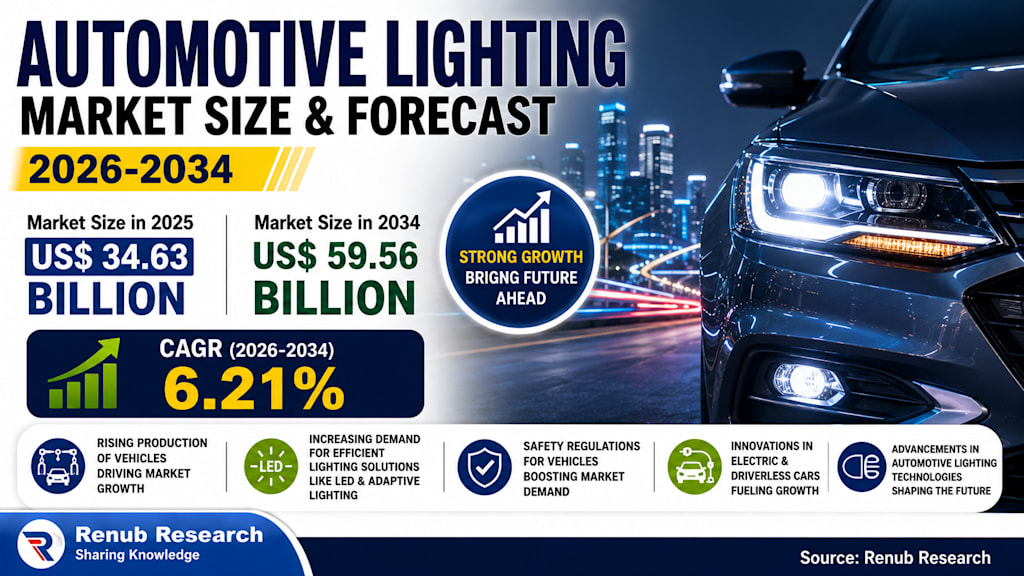
According to Renub Research, the global automotive lighting market is projected to grow from US$ 34.63 billion in 2025 to US$ 59.56 billion by 2034, expanding at a compound annual growth rate (CAGR) of 6.21% between 2026 and 2034.
The market’s growth is being fueled by rising vehicle production, rapid adoption of advanced lighting technologies such as LED and OLED systems, stricter road safety regulations, and the global expansion of electric and smart mobility solutions. As vehicles become increasingly connected and technologically sophisticated, automotive lighting is evolving into a major innovation platform for manufacturers worldwide.
Automotive lighting has become essential to modern mobility
Automotive lighting plays a critical role in road safety and vehicle communication. Headlights, taillights, brake lights, turn signals, daytime running lights, fog lamps, and interior illumination systems all contribute to safer driving conditions, particularly during nighttime travel and poor weather conditions.
However, lighting systems today serve a much larger purpose than basic visibility. They are now central to the overall design language of modern vehicles. Consumers increasingly associate premium lighting systems with advanced technology, luxury, and brand identity.
This shift has encouraged automakers to invest heavily in innovative lighting solutions that combine functionality with visual appeal. Distinctive LED signatures, animated lighting effects, adaptive beam systems, and dynamic turn indicators are becoming common features even in mid-range vehicles.
Lighting has effectively become a form of automotive communication—not only between vehicles and drivers but also between brands and consumers.
Rising global vehicle production is accelerating demand
One of the strongest drivers of the automotive lighting market is the continuous growth of global vehicle production. Increasing urbanization, rising income levels, and expanding transportation needs are fueling demand for both passenger and commercial vehicles across major economies.
As more vehicles are manufactured, demand naturally rises for lighting components such as headlights, rear lights, fog lights, and interior lighting systems.
The automotive industry is also benefiting from growing mobility services, ride-sharing expansion, and commercial transportation development. These sectors increase the number of vehicles on roads and create additional demand for durable and efficient lighting systems.
Vehicle production remains especially strong in regions such as Asia-Pacific, North America, and Europe. China, the United States, and Japan continue to dominate global automobile manufacturing, with China leading significantly due to its strong domestic demand, growing electric vehicle market, and export expansion.
This large-scale automotive production environment creates consistent opportunities for lighting manufacturers, suppliers, and technology innovators.
LED lighting is transforming the industry
One of the most important developments in the market is the rapid adoption of LED lighting technology. Traditional halogen systems are increasingly being replaced by LEDs because of their superior efficiency, brightness, durability, and design flexibility.
LED lighting consumes less energy, lasts longer, and responds faster than conventional lighting technologies. These advantages make it especially valuable in modern vehicles, particularly electric vehicles where energy efficiency is extremely important.
Automotive manufacturers are also using LED systems to create distinctive visual identities. Signature lighting patterns and customized LED designs help brands stand out in highly competitive automotive markets.
Beyond aesthetics, LED technology significantly improves road safety. Brighter and more responsive lighting systems improve visibility in low-light environments and adverse weather conditions, helping reduce accident risks.
Adaptive LED systems represent another major innovation. These systems automatically adjust beam patterns based on traffic conditions, vehicle speed, road curves, and surrounding environments. This enhances visibility while reducing glare for other drivers.
As consumers increasingly demand advanced vehicle technologies, LED lighting is rapidly becoming the industry standard.
Electric vehicles are creating new opportunities
The rise of electric vehicles is reshaping the automotive lighting industry in important ways. EV manufacturers often emphasize futuristic design, energy efficiency, and advanced digital technologies—all areas where innovative lighting systems play a key role.
Lighting has become a major visual feature in electric vehicles. Many EV brands use sleek LED strips, animated welcome lighting, and futuristic headlamp designs to create modern vehicle identities.
Energy efficiency is another important factor. Because electric vehicles depend heavily on battery optimization, low-energy LED systems are highly attractive compared to traditional lighting technologies.
Autonomous and semi-autonomous vehicle technologies are also increasing the importance of intelligent lighting systems. Smart lighting can communicate vehicle intentions, improve pedestrian awareness, and support advanced driver assistance systems.
As electric mobility continues expanding globally, automotive lighting manufacturers are expected to play a critical role in shaping the next generation of vehicle experiences.
Safety regulations are pushing technological upgrades
Governments and transportation authorities around the world are implementing stricter vehicle safety regulations, which is significantly boosting demand for advanced automotive lighting systems.
Daytime running lights, adaptive headlights, automatic lighting controls, and enhanced rear visibility systems are becoming mandatory in many markets. These regulations are designed to improve vehicle visibility and reduce accident rates, especially during nighttime driving and poor weather conditions.
Safety testing and vehicle rating systems are also influencing manufacturer decisions. Automakers increasingly invest in advanced lighting technologies to achieve higher safety scores and meet evolving compliance requirements.
This focus on safety extends beyond passenger vehicles. Commercial fleets, transportation operators, and logistics companies are also adopting improved lighting systems to enhance road safety and operational reliability.
As global road safety awareness continues to increase, regulatory pressure is expected to remain one of the strongest long-term growth drivers for the automotive lighting industry.
Passenger vehicles remain the dominant segment
Passenger vehicles account for a major share of the automotive lighting market. Sedans, hatchbacks, SUVs, and crossover vehicles increasingly feature sophisticated lighting systems designed to improve safety while enhancing visual appeal.
Consumers today expect vehicles to include premium lighting features, even in non-luxury segments. LED daytime running lights, adaptive headlights, dynamic turn signals, and ambient interior lighting are becoming common expectations among buyers.
Automakers are responding by using lighting systems as key design differentiators. In many cases, vehicle lighting signatures have become instantly recognizable brand features.
Passenger vehicle growth is also being supported by urbanization, rising disposable income, and expanding middle-class populations in emerging economies. These trends are contributing to higher demand for modern vehicles equipped with advanced technologies.
As automobile manufacturers continue innovating around vehicle aesthetics and user experience, passenger vehicle lighting will remain one of the most influential segments in the industry.
Rear lighting systems are gaining strategic importance
Rear automotive lighting is becoming increasingly sophisticated as manufacturers focus more heavily on road communication and vehicle identity.
Brake lights, reverse lights, taillights, and rear turn signals are essential for maintaining visibility and preventing collisions. Modern LED rear lighting systems improve brightness, response time, and durability compared to older technologies.
Dynamic rear lighting systems are also becoming popular because they improve communication between vehicles on the road. Animated turn signals and enhanced brake lighting patterns provide clearer signals to surrounding drivers.
Rear lighting additionally plays an important role in branding. Many automakers now design highly distinctive rear light configurations to create recognizable vehicle appearances.
Because rear-end visibility is closely tied to road safety, this segment continues to receive significant investment from manufacturers and regulators alike.
The aftermarket segment continues to expand
The automotive lighting aftermarket represents another important growth opportunity. Consumers frequently replace or upgrade vehicle lighting systems due to accidents, wear and tear, maintenance needs, or aesthetic preferences.
Many vehicle owners are upgrading from traditional halogen bulbs to LED systems for improved brightness and energy efficiency. Decorative lighting products are also gaining popularity among consumers interested in vehicle customization.
The growth of the global vehicle fleet is contributing directly to aftermarket demand. Older vehicles often require replacement lighting components, while enthusiasts continue seeking upgraded systems that enhance style and performance.
Rising awareness of road safety and visibility is also encouraging consumers to invest in better lighting solutions after purchasing vehicles.
India is emerging as a major growth market
India’s automotive lighting market is experiencing rapid expansion due to strong growth in the country’s automotive industry and rising vehicle ownership.
Urbanization, improving economic conditions, and increasing disposable incomes are driving demand for passenger and commercial vehicles across the country. As vehicle numbers rise, so does the need for advanced lighting systems.
Indian automakers are increasingly adopting LED headlights, daytime running lights, and modern lighting technologies to improve both safety and design appeal.
Government road safety initiatives are also encouraging adoption of better lighting systems. Meanwhile, the country’s expanding electric vehicle sector is creating additional demand for energy-efficient lighting technologies.
With a large consumer base and strong automotive manufacturing activity, India represents one of the most promising long-term markets for automotive lighting companies.
The United States continues leading innovation
The United States remains one of the most technologically advanced automotive lighting markets globally. Strong consumer demand for premium vehicles, electric vehicles, and advanced safety technologies is driving innovation throughout the industry.
American consumers increasingly expect vehicles equipped with adaptive headlights, intelligent lighting systems, ambient interior lighting, and advanced LED technologies.
Strict safety standards are also pushing manufacturers toward more efficient and effective lighting solutions.
The growth of electric vehicles and luxury automotive segments further supports demand for innovative lighting technologies designed to enhance both performance and brand identity.
The United Kingdom is emphasizing sustainability and safety
The United Kingdom automotive lighting market is benefiting from strong automotive manufacturing capabilities and increasing emphasis on energy-efficient mobility solutions.
Growing electric vehicle adoption is encouraging automakers to use advanced lighting technologies that improve efficiency while supporting modern vehicle aesthetics.
Strict safety and regulatory standards are also encouraging innovation in adaptive and intelligent lighting systems. British consumers increasingly prefer vehicles with enhanced safety features and premium functionality.
As sustainability and smart mobility become more important across Europe, the UK market is expected to remain an important center for automotive lighting innovation.
Saudi Arabia is witnessing growing demand for durable lighting systems
Saudi Arabia’s automotive lighting market is expanding steadily as vehicle ownership rises and road infrastructure continues to improve.
Harsh environmental conditions such as dust storms and extreme heat increase the importance of reliable and high-performance lighting systems in the country.
Consumers and manufacturers are increasingly adopting LED headlights and fog lighting systems because they offer better brightness, durability, and lifespan.
Government efforts to improve road safety and transportation infrastructure are also supporting market growth. Meanwhile, rising interest in modern and premium vehicles is increasing demand for advanced automotive lighting technologies.
Cost and complexity remain major industry challenges
Despite strong growth prospects, the automotive lighting industry still faces several important challenges.
One of the biggest obstacles is the high cost associated with advanced lighting technologies such as LED, OLED, and laser systems. These technologies require expensive materials, sophisticated manufacturing processes, and significant research and development investment.
As a result, advanced lighting systems can increase overall vehicle production costs. This creates challenges in price-sensitive markets where consumers prioritize affordability.
Design complexity is another major issue. Modern lighting systems must integrate seamlessly with vehicle electronics, software platforms, sensors, and smart technologies. Adaptive headlights, matrix LED systems, and laser lighting require highly sophisticated engineering and integration processes.
Balancing innovation, safety, affordability, and design complexity will remain one of the industry’s biggest long-term challenges.
Final Thoughts
The automotive lighting market is evolving into one of the most innovative and strategically important sectors within the global automotive industry. What was once a purely functional component is now a central part of vehicle safety, energy efficiency, aesthetics, and smart mobility.
According to Renub Research, the market is projected to grow from US$ 34.63 billion in 2025 to US$ 59.56 billion by 2034, reflecting the rising global demand for advanced vehicle lighting systems.
The future of automotive lighting will be shaped by electric vehicles, autonomous driving technologies, intelligent safety systems, and evolving consumer expectations around design and performance.
For automakers, lighting has become far more than illumination—it has become a defining element of vehicle identity and innovation.
About the Creator
Enjoyed the story? Support the Creator.
Subscribe for free to receive all their stories in your feed.
Comments
There are no comments for this story
Be the first to respond and start the conversation.