
Australia Smart Home Market Is Redefining Modern Living Through AI and Connected Technology
Rising demand for energy efficiency, home automation, and AI-powered security systems is transforming Australian households into intelligent living spaces.

Australian homes are becoming smarter, more connected, and increasingly automated. What was once considered a luxury technology reserved for high-end properties is now entering mainstream residential life. From voice-controlled lighting and intelligent security systems to AI-powered cleaning robots and energy management platforms, smart home technology is changing how Australians live, work, and manage their homes.
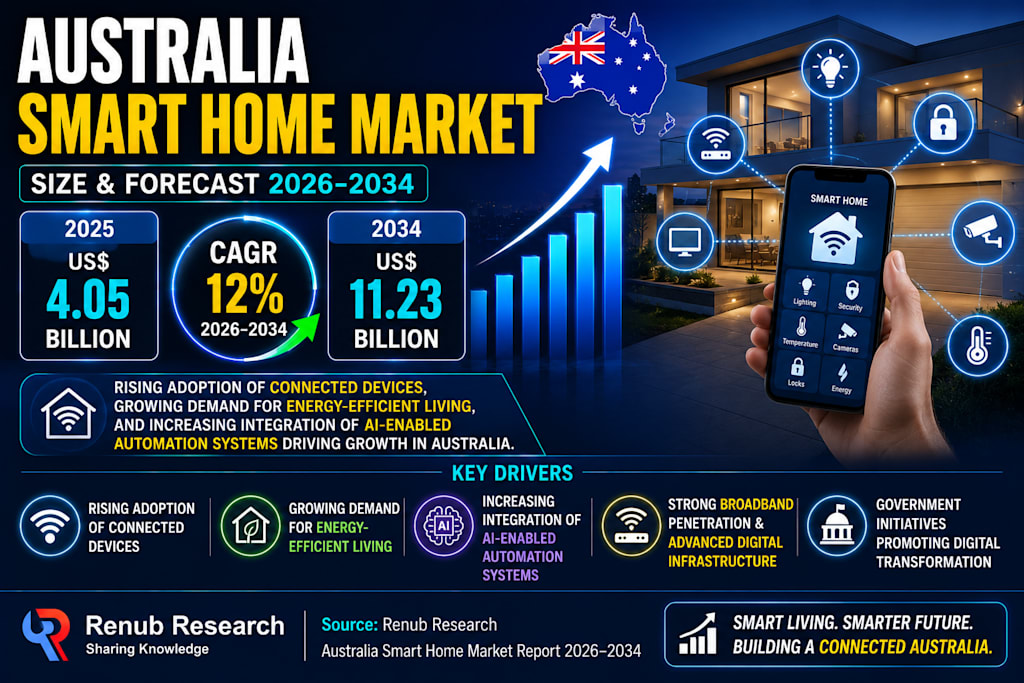
According to Renub Research, the Australia Smart Home Market is projected to grow from US$ 4.05 billion in 2025 to US$ 11.23 billion by 2034, expanding at a CAGR of 12% from 2026 to 2034. The market’s growth is being driven by increasing adoption of connected devices, rising demand for energy-efficient living, expanding use of AI-enabled automation systems, and strong broadband and 5G infrastructure across the country.
As digital lifestyles continue evolving, smart homes are becoming less about novelty and more about convenience, sustainability, security, and personalized living.
Smart homes are becoming part of everyday life
A smart home is a connected residential environment where devices such as lighting systems, appliances, entertainment units, climate controls, and security technologies communicate through a central digital network.
These systems rely on technologies such as Wi-Fi, sensors, artificial intelligence, cloud computing, and voice assistants to automate household functions and improve user convenience. Homeowners can remotely control lighting, temperature, security cameras, and appliances through smartphones, tablets, or smart speakers.
One of the most important features of modern smart homes is automation. AI-enabled systems can learn user behavior over time and automatically adjust settings based on preferences, schedules, or environmental conditions.
This level of personalization is making connected living increasingly attractive to Australian consumers who value convenience, efficiency, and digital integration.
AI and IoT are driving market expansion
The rapid adoption of artificial intelligence, Internet of Things (IoT) devices, and voice-controlled assistants is one of the strongest growth drivers in Australia’s smart home market. Consumers are increasingly integrating smart speakers, thermostats, connected appliances, and automated lighting systems into their homes.
Voice-controlled ecosystems allow users to manage multiple household functions using simple commands, while AI-powered systems optimize operations such as lighting, climate control, and energy consumption automatically.
The expansion of IoT ecosystems is also improving interoperability between devices, creating more seamless and unified smart home networks. Consumers increasingly prefer integrated systems that allow entertainment, security, lighting, and energy management devices to communicate efficiently within a single platform.
Global technology companies are continuously introducing more affordable and compatible smart home products, helping accelerate adoption across Australian households.
The rise of remote work, digital entertainment, and connected lifestyles is further increasing demand for intelligent residential environments that support productivity and convenience.
Rising energy costs are encouraging smarter living
Australia’s increasing household energy costs are pushing consumers toward energy-efficient smart home technologies. Homeowners are adopting smart thermostats, automated climate control systems, energy monitoring platforms, and smart lighting solutions to reduce electricity consumption and lower utility bills.
Smart systems can automatically respond to occupancy levels, environmental conditions, and usage patterns, helping reduce unnecessary energy waste. Many homeowners are also integrating smart energy management tools with solar power systems to optimize renewable energy usage.
The country’s growing focus on sustainability and carbon reduction is also strengthening demand for eco-friendly smart technologies. Government initiatives supporting renewable energy adoption and energy-efficient infrastructure are encouraging wider use of connected home systems.
Consumers increasingly want real-time insights into household energy consumption, and smart home technologies provide the visibility and automation needed to support greener lifestyles.
Smart security systems are becoming essential
Home security has become one of the most influential segments within Australia’s smart home market. Growing concerns about property safety and remote monitoring are encouraging homeowners to install smart cameras, video doorbells, motion detectors, and connected alarm systems.
These systems provide real-time alerts, remote access, cloud-based video storage, and AI-powered intrusion detection. Homeowners can monitor their properties from anywhere using smartphones while receiving instant notifications regarding suspicious activity or visitor arrivals.
AI-driven facial recognition and automated lighting systems are also improving the effectiveness of smart security technologies.
Insurance incentives, rising safety awareness, and increasing affordability are helping expand adoption across both urban and suburban households. The availability of wireless and easy-to-install solutions has made smart security systems more accessible to mainstream consumers.
High upfront costs remain a challenge
Despite strong market momentum, affordability continues to be one of the biggest challenges facing the Australian smart home industry. Smart home systems often require significant upfront investment for devices, installation, integration, and maintenance.
Larger homes may require extensive automation infrastructure, increasing overall costs substantially. Compatibility issues between brands and ecosystems can also create technical complexity and additional expenses.
Some consumers remain hesitant due to concerns about device obsolescence, software updates, and long-term maintenance requirements.
For first-time users, navigating multiple connected devices, mobile apps, and automation settings can also feel overwhelming. These challenges continue limiting adoption among budget-conscious households and lower-income regions.
Cybersecurity and privacy concerns are growing
As smart homes become increasingly connected, concerns about data privacy and cybersecurity are becoming more important. Smart devices rely heavily on internet connectivity, cloud services, and data sharing, which can create vulnerabilities if systems are not properly secured.
Consumers are becoming more aware of the risks associated with hacking, unauthorized access, and misuse of personal data collected through connected devices.
Connectivity reliability also remains a challenge, particularly in rural and remote areas where internet infrastructure may be less stable. Smart home systems depend on continuous connectivity to function effectively, making broadband quality an important factor in adoption.
Manufacturers and service providers must continuously invest in software updates, cybersecurity protections, and privacy safeguards to maintain consumer trust.
New South Wales leads smart home adoption
New South Wales remains one of Australia’s most advanced smart home markets due to high urbanization, strong broadband infrastructure, and widespread technology adoption.
Cities such as Sydney are major centers for smart lighting, climate control, entertainment systems, and integrated security technologies. Modern apartment developments increasingly include built-in smart automation features as standard residential offerings.
The state’s focus on sustainability also encourages adoption of smart energy management systems and automated climate solutions.
Strong consumer awareness and broad retail availability continue accelerating market penetration throughout New South Wales.
Victoria is embracing connected living rapidly
Victoria’s smart home market is expanding quickly due to strong digital literacy, urban density, and growing interest in connected technologies.
Melbourne consumers are particularly active adopters of smart lighting systems, surveillance technologies, and AI-powered home assistants.
High electricity costs and sustainability initiatives are encouraging broader use of energy monitoring and efficiency solutions. The expansion of broadband and 5G infrastructure is also improving device connectivity and system reliability.
Residential construction trends increasingly favor modern homes equipped with integrated automation technologies.
Queensland is benefiting from energy-focused adoption
Queensland’s warm climate and expanding residential development are helping drive demand for smart climate control systems, automated lighting, and energy-efficient technologies.
Cities such as Brisbane and Gold Coast are seeing growing adoption of connected home systems supported by stronger broadband infrastructure and rising consumer awareness.
The tourism and short-term rental sectors are also contributing to market growth through adoption of smart locks, remote surveillance, and automated property management systems.
Western Australia is expanding smart energy solutions
Western Australia’s smart home market is being strengthened by growing adoption of smart security systems, climate control technologies, and solar-integrated energy management platforms.
Perth is leading the region in smart home integration, particularly in newly developed residential projects and premium housing communities.
The state’s warm climate and increasing solar adoption are encouraging homeowners to invest in automation systems that improve comfort while reducing energy costs.
Recent innovations show how fast the market is evolving
Recent product launches demonstrate how rapidly innovation is advancing in Australia’s smart home sector.
In October 2025, Ovox launched its R8 window-cleaning robot in Australia, introducing automated window-cleaning technology with intelligent surface adaptation features.
In March 2025, Roborock introduced its Saros, F25, and Qrevo EdgeC smart cleaning devices in Australia. These products feature advanced AI navigation, robotic arm technology, and stronger suction capabilities designed specifically for modern connected homes.
These innovations highlight the growing role of AI-powered automation within household management and daily living.
Competition among global technology companies is intensifying
The Australian smart home market includes major global technology companies competing across security systems, entertainment devices, energy management, and connected appliances. Key companies highlighted in the report include Philips Dynalite, Sonos, Alarm.com, Allegion, Electrolux, Amazon, Apple, Xiaomi, and Honeywell International.
Competition is expected to intensify as consumers increasingly prioritize convenience, sustainability, and integrated digital experiences.
Final thoughts
Australia’s smart home market is entering a period of rapid expansion driven by AI integration, connected living, energy efficiency, and advanced home automation technologies. According to Renub Research, the market’s projected growth from US$ 4.05 billion in 2025 to US$ 11.23 billion by 2034 reflects the increasing role of intelligent systems in modern residential life.
Smart homes are no longer limited to luxury properties or early technology adopters. They are becoming mainstream lifestyle solutions that combine convenience, sustainability, entertainment, and security within a single connected ecosystem.
About the Creator
Enjoyed the story? Support the Creator.
Subscribe for free to receive all their stories in your feed.
Comments
There are no comments for this story
Be the first to respond and start the conversation.