
Australia’s Colonoscopy Devices Market Is Advancing Through Early Cancer Detection and Medical Innovation
Rising Colorectal Cancer Screening, Aging Population, and Advanced Endoscopy Technologies Are Driving Growth in Australia's Colonoscopy Devices Market

The fight against colorectal cancer is becoming one of the most important public health priorities in Australia. As awareness of early detection continues to grow, healthcare providers across the country are investing in advanced diagnostic technologies that improve patient outcomes and support preventive healthcare strategies. At the center of this effort is the colonoscopy device market, which plays a critical role in identifying and treating gastrointestinal diseases before they become life-threatening.
Colonoscopy remains one of the most effective tools for detecting colorectal cancer, polyps, Crohn’s disease, ulcerative colitis, and other gastrointestinal conditions. As screening programs expand and technological innovation accelerates, demand for sophisticated colonoscopy equipment is rising throughout hospitals, clinics, and ambulatory surgical centers.
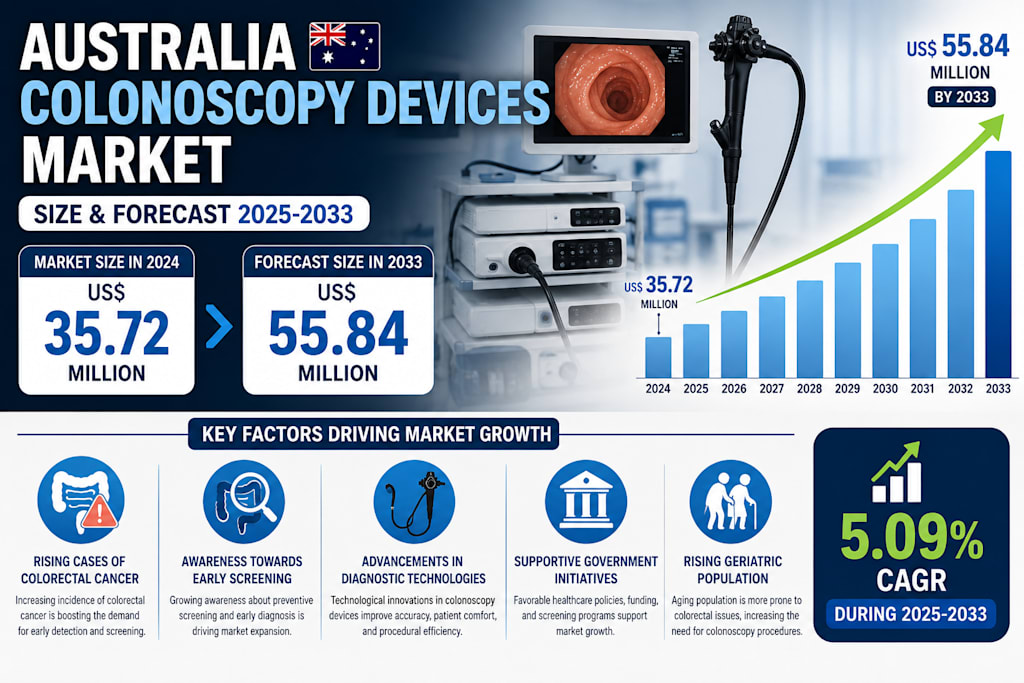
According to Renub Research, the Australia Colonoscopy Devices Market is expected to grow from US$ 35.72 million in 2024 to US$ 55.84 million by 2033, registering a compound annual growth rate (CAGR) of 5.09% during 2025–2033. Rising colorectal cancer incidence, government-led screening initiatives, growing health awareness, and continuous advancements in endoscopy technologies are among the key factors supporting market expansion.
As Australia continues strengthening its healthcare infrastructure and promoting preventive medicine, colonoscopy devices are becoming increasingly important in safeguarding public health.
Why Colonoscopy Devices Matter More Than Ever
Colonoscopy devices are specialized medical instruments used to examine the interior lining of the colon and rectum.
The primary component is the colonoscope—a flexible tube equipped with a high-resolution camera and light source that enables physicians to visualize abnormalities within the gastrointestinal tract.
Modern colonoscopy systems can do much more than simply observe tissue. Many devices include biopsy capabilities, polyp removal tools, advanced imaging technologies, and therapeutic instruments that allow physicians to diagnose and treat conditions during the same procedure.
This ability to combine diagnosis and treatment makes colonoscopy one of the most valuable tools in modern gastroenterology.
As healthcare increasingly focuses on early detection and preventive care, the role of colonoscopy devices continues to expand.
Colorectal Cancer Is Driving Significant Demand
One of the strongest growth drivers for the Australian colonoscopy devices market is the high prevalence of colorectal cancer.
Australia consistently records some of the highest colorectal cancer rates globally, making early detection a major healthcare priority.
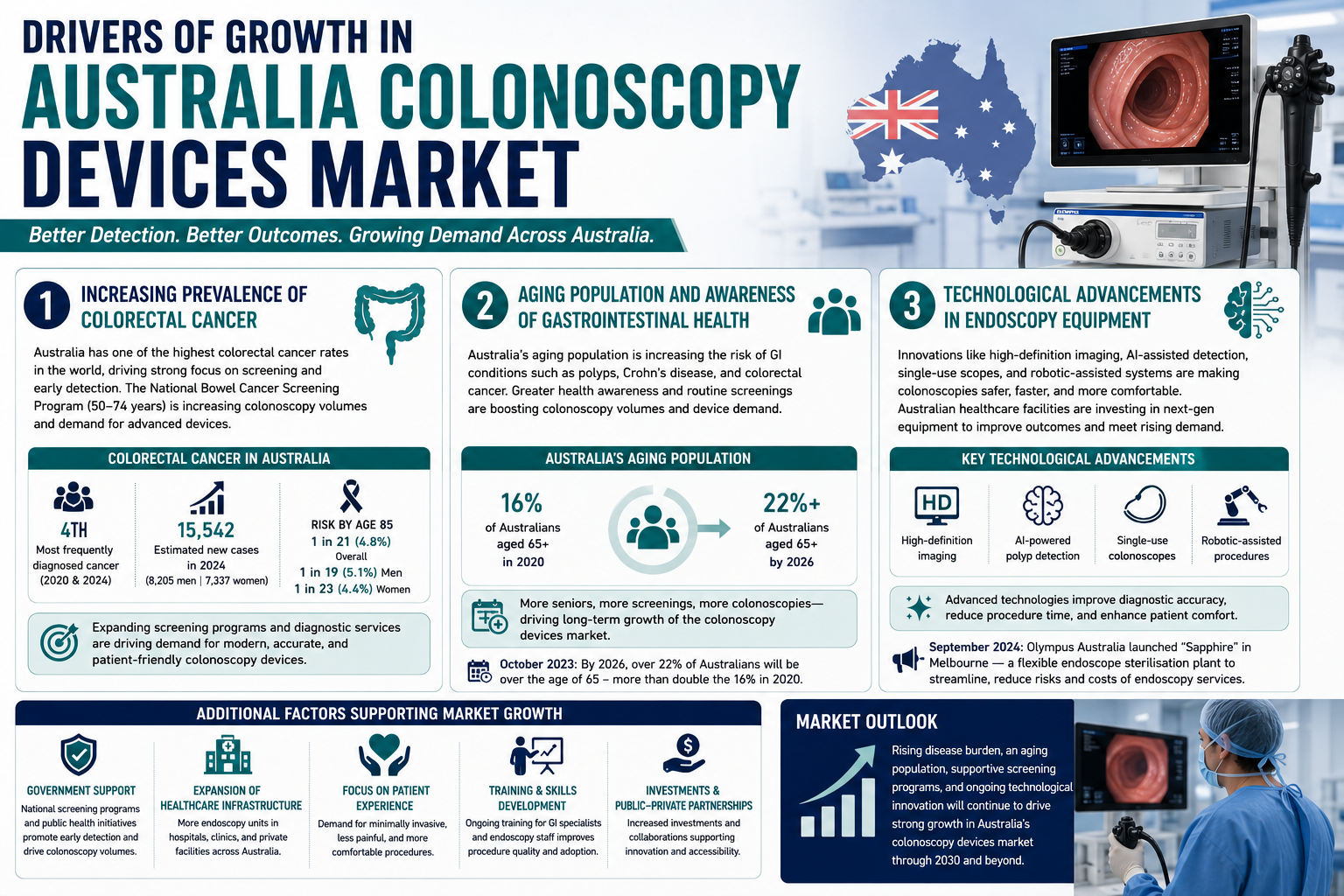
According to the report, colorectal cancer was the fourth most commonly diagnosed cancer in Australia in 2020, with 14,534 new cases recorded. By 2024, this figure is expected to rise to approximately 15,542 new cases, highlighting the growing importance of screening and early intervention.
The Australian Government's National Bowel Cancer Screening Program encourages individuals aged 50–74 years to undergo regular screening, helping identify cancer and precancerous conditions at earlier stages.
Positive screening results often lead to follow-up colonoscopy procedures, directly increasing demand for advanced colonoscopy equipment.
As awareness campaigns continue encouraging participation in screening programs, the need for high-performance diagnostic devices is expected to grow steadily.
Early Detection Is Transforming Patient Outcomes
The effectiveness of colonoscopy extends far beyond diagnosis.
One of the most significant advantages of colonoscopy is its ability to identify and remove polyps before they develop into cancer.
This preventive capability has made colonoscopy one of the most powerful tools available for reducing colorectal cancer mortality.
Healthcare professionals increasingly emphasize the importance of routine screening because early-stage colorectal cancer often develops without obvious symptoms.
Detecting abnormalities before symptoms emerge dramatically improves treatment success rates and long-term patient outcomes.
As preventive healthcare becomes a greater priority within Australia's healthcare system, colonoscopy adoption is expected to continue rising.
Australia's Aging Population Is Fueling Market Growth
Demographic trends are creating additional demand for colonoscopy procedures and associated devices.
Australia's population is aging rapidly, and older adults are significantly more likely to develop gastrointestinal conditions that require endoscopic evaluation.
The report notes that by 2026, more than 22% of Australians are expected to be over the age of 65, compared with approximately 16% in 2020.
Age is a major risk factor for colorectal cancer, polyps, inflammatory bowel disease, and other digestive disorders.
As a result, healthcare providers are performing increasing numbers of colonoscopies among older patient populations.
This demographic shift is creating sustained demand for advanced diagnostic equipment, particularly in hospitals and specialized gastroenterology centers.
Technological Innovation Is Revolutionizing Colonoscopy
Technological advancement has transformed colonoscopy into a safer, more accurate, and more comfortable procedure.
Modern colonoscopy systems now incorporate features such as high-definition imaging, 4K visualization, artificial intelligence-assisted detection, and enhanced maneuverability.
These innovations improve physicians' ability to identify subtle abnormalities while reducing procedure times and enhancing patient outcomes.
Artificial intelligence is becoming particularly important in colorectal cancer screening.
AI-powered software can assist physicians by highlighting suspicious lesions, polyps, and abnormal tissue patterns during procedures.
This technology improves detection rates and reduces the likelihood of missed abnormalities.
As healthcare facilities continue modernizing their endoscopy departments, adoption of advanced colonoscopy technologies is expected to accelerate.
Olympus and Industry Innovation Are Shaping the Market
Leading medical technology companies continue investing heavily in Australia's endoscopy sector.
A notable development occurred in September 2024 when Olympus Australia launched "Sapphire", its first flexible endoscope sterilization facility in Melbourne. The initiative supports Olympus On-Demand services and aims to improve efficiency while reducing operational risks associated with endoscopy services.
Such investments demonstrate the growing importance of infection control, equipment management, and operational efficiency within modern healthcare environments.
Manufacturers are increasingly focused on providing integrated solutions that combine advanced imaging, workflow optimization, and enhanced patient safety.
These innovations are helping healthcare providers deliver more effective and reliable diagnostic services.
Colonoscopes Remain the Core Market Segment
Among all product categories, colonoscopes remain the largest and most important segment of the market.
Healthcare facilities across Australia are upgrading from traditional systems to high-definition and 4K video colonoscopes capable of delivering superior image quality.
Improved visualization enables more accurate diagnoses and better treatment planning.
Single-use colonoscopes are also attracting attention due to their infection-control advantages.
These disposable systems eliminate the need for reprocessing and reduce the risk of cross-contamination between patients.
As healthcare providers prioritize patient safety and operational efficiency, demand for advanced colonoscope technologies is expected to remain strong.
Crohn’s Disease and Gastrointestinal Disorders Support Market Expansion
While colorectal cancer remains a major growth driver, other gastrointestinal conditions are also contributing to market demand.
Crohn's disease, ulcerative colitis, inflammatory bowel disease, and various digestive disorders often require ongoing monitoring through colonoscopy procedures.
For patients with chronic gastrointestinal conditions, colonoscopy serves as an essential tool for assessing disease progression and treatment effectiveness.
As awareness of digestive health increases and diagnostic capabilities improve, healthcare providers are performing more endoscopic evaluations than ever before.
This trend is creating additional opportunities for device manufacturers serving the gastroenterology sector.
Hospitals Continue to Dominate End-User Demand
Hospitals represent the largest end-user segment within the Australian colonoscopy devices market.
Major healthcare institutions perform high volumes of screening, diagnostic, and therapeutic procedures, making them key purchasers of advanced colonoscopy equipment.
Hospitals often invest in state-of-the-art endoscopy suites featuring integrated imaging systems, AI-assisted technologies, and sophisticated sterilization infrastructure.
Public and private healthcare investments continue supporting equipment modernization efforts nationwide.
As demand for gastrointestinal diagnostics grows, hospitals are expected to remain primary drivers of market expansion.
Regional Markets Show Strong Potential
Victoria
Victoria, particularly Melbourne, serves as one of Australia's leading healthcare and medical research hubs.
The region benefits from strong healthcare infrastructure, specialized colorectal centers, and active adoption of advanced endoscopy technologies.
Western Australia
Western Australia continues expanding healthcare access through infrastructure investments, mobile screening programs, and telemedicine initiatives designed to serve remote communities.
South Australia
South Australia's emphasis on public health campaigns and cancer screening programs continues supporting demand for colonoscopy devices and diagnostic services.
Challenges Facing the Market
Despite positive growth prospects, several challenges remain.
High Equipment Costs
Advanced colonoscopy systems require significant investment.
The cost of acquiring, maintaining, sterilizing, and operating sophisticated endoscopy equipment can create financial barriers, particularly for smaller clinics and regional healthcare facilities.
Limited Rural Access
Australia's large geographic footprint creates disparities in healthcare access.
Many rural and remote communities face shortages of trained specialists and advanced diagnostic equipment, leading to delays in screening and treatment.
While telehealth and mobile healthcare initiatives are helping address these challenges, access gaps remain an important issue for healthcare providers.
Final Thoughts
Australia's colonoscopy devices market is becoming increasingly important as healthcare systems prioritize early detection, preventive care, and advanced diagnostic capabilities.
According to Renub Research, the Australia Colonoscopy Devices Market is forecast to grow from US$ 35.72 million in 2024 to US$ 55.84 million by 2033, reflecting rising demand driven by colorectal cancer screening, demographic changes, and technological innovation.
As artificial intelligence, high-definition imaging, and next-generation endoscopy technologies continue improving diagnostic accuracy and patient outcomes, colonoscopy devices will remain at the forefront of gastrointestinal healthcare.
The future of colonoscopy is no longer solely about detecting disease—it is about preventing it, improving quality of life, and helping Australians benefit from earlier, safer, and more effective medical care.
About the Creator
Enjoyed the story? Support the Creator.
Subscribe for free to receive all their stories in your feed.
Comments
There are no comments for this story
Be the first to respond and start the conversation.