
ATM Market: Size, Share and Growth Forecast 2026-2034
How Digital Transformation, Biometric Security, and Financial Inclusion Are Reshaping the Worldwide Automated Teller Machine Industry

Market Overview
The global ATM market encompasses automated teller machines and comprehensive cash management solutions deployed across diverse locations including financial institutions, retail environments, transportation hubs, and underserved communities. ATMs provide essential financial services including cash withdrawal, balance inquiry, fund transfers, bill payments, and deposits through secure, user-friendly interfaces accessible 24/7. Modern ATMs integrate advanced technologies including biometric authentication, contactless payment capabilities, dynamic user interfaces, real-time connectivity, and enhanced security features enabling improved customer experiences and expanded service offerings.
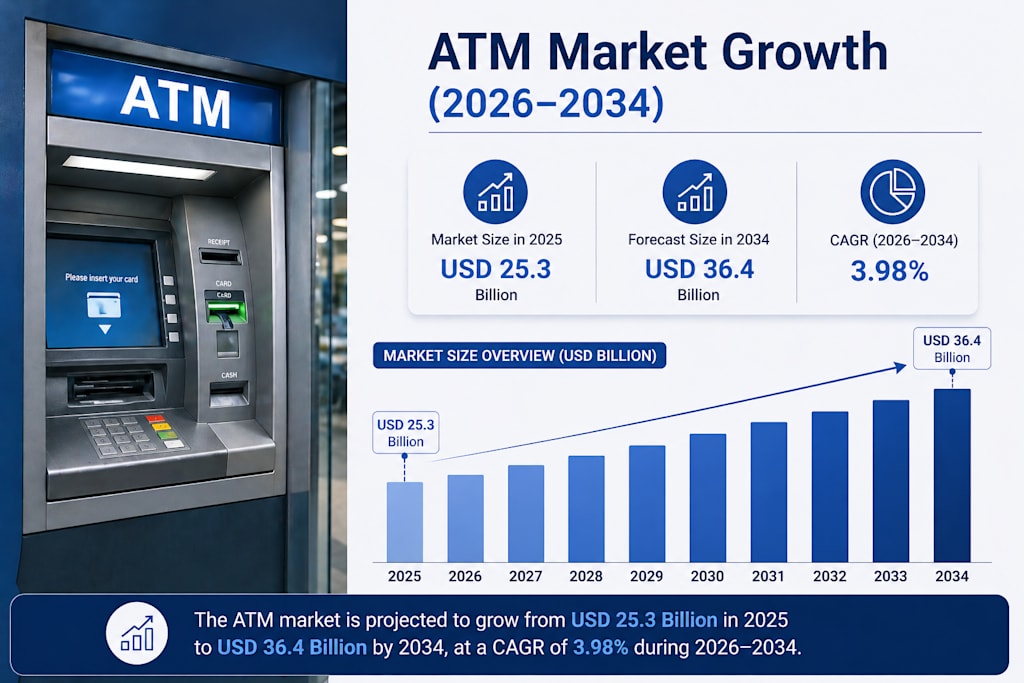
The global ATM market size was valued at USD 25.3 Billion in 2025 and is projected to reach USD 36.4 Billion by 2034, exhibiting a compound annual growth rate of 3.98% during 2026-2034. Market growth is being driven by digital transformation advancements, ATM convenience and accessibility benefits, rapid globalization and increased international tourism, and integration of innovative technologies including biometric authentication, contactless payment methods, and real-time cash management systems.
Request PDF Sample for more detailed market insights:
Role of Innovation in Market Development
• Biometric Authentication and Multi-Factor Security
Advanced biometric technologies including fingerprint recognition, facial authentication, and iris scanning significantly enhance ATM security while streamlining user verification processes. Biometric authentication eliminates reliance on PIN codes alone, substantially reducing fraud risk while improving user experience through faster, more secure authentication. Integration of multiple biometric modalities provides defense-in-depth security architecture protecting against unauthorized access and identity theft. Enhanced encryption protocols, anti-skimming technologies, and real-time fraud detection systems further strengthen ATM security posture.
• Contactless and NFC Payment Technology
Near-field communication technology enables seamless contactless transactions through smartphone tapping, wearable device interaction, and card-based payment methods. Contactless ATM capabilities reduce physical contact, enhance hygiene standards, and provide convenient payment options aligned with contemporary consumer preferences for touchless interactions. Integration with mobile banking applications enables cardless withdrawals and advanced payment functionality expanding ATM utility beyond traditional cash services.
• Advanced User Interface and Digital Design
Larger, high-resolution touchscreen displays featuring intuitive user interfaces significantly improve usability and accessibility for diverse user populations. Dynamic graphics, interactive menus, voice-guided interfaces, and personalized content enhance user engagement while supporting marketing and promotional opportunities. Accessibility features including text-to-speech, adjustable font sizes, and audio guidance serve visually impaired and elderly customers, promoting inclusive financial service access.
Global ATM Market Trends and Drivers
• Rapid Urbanization and Digital Transformation
Rapid urbanization globally increases demand for convenient, accessible financial services. Urban populations depend on ATMs for reliable 24/7 cash access and banking services. Digital transformation initiatives by financial institutions drive modernization of ATM networks with advanced technologies and expanded capabilities. Urban expansion in developing nations creates substantial opportunities for ATM deployment in newly developed commercial and residential areas.
• Financial Inclusion and Banking Access Expansion
ATMs provide critical banking infrastructure in underserved and rural communities where traditional bank branch networks are limited or nonexistent. Strategic ATM deployment addresses geographic banking disparities, ensuring equitable financial service access for underbanked populations. Financial inclusion initiatives supported by governments and development organizations drive ATM expansion in remote regions, enabling previously unbanked populations to access formal financial systems. This expansion fosters economic development, improves quality of life, and facilitates economic participation for underserved communities.
• International Tourism and Cross-Border Travel
Growing international tourism and business travel drive demand for ATMs providing foreign currency withdrawal capabilities. Travelers rely on ATMs for convenient access to local currency without currency exchange intermediaries. ATM networks in airports, tourist destinations, and international travel hubs support growing numbers of global travelers. Foreign exchange functionality enables visitors to access local currency efficiently, supporting tourism industry growth and international commerce.
• Technology Integration and Expanded Service Offerings
Integration of mobile banking, biometric authentication, artificial intelligence, and advanced analytics expands ATM capabilities beyond traditional cash withdrawal services. Modern ATMs function as multiservice financial platforms delivering diverse transactions including deposits, transfers, bill payments, mobile top-ups, and account management. Smart ATMs provide targeted advertising, promotional content, and personalized financial offers leveraging large display screens and analytics capabilities.
• Cash Dependency and Essential Financial Access
Despite digital payment expansion, cash remains essential for daily financial transactions across diverse economies and demographics. Cash provides financial access for individuals without smartphone technology or digital payment infrastructure. ATMs ensure reliable cash availability for essential transactions, emergency access to funds, and backup financial services during digital system outages.
Global ATM Market Segmentation
By Solution
Deployment Solutions (53.5% market share):
• Onsite ATM
• Offsite ATM
• Work Site ATM
• Mobile ATM
Managed Services
Deployment solutions represent the largest segment, encompassing comprehensive ATM site selection, installation, network connectivity configuration, ongoing maintenance, and operational management. Financial institutions and ATM operators require specialized expertise to efficiently deploy and manage machines across diverse geographic locations and operational environments. Comprehensive deployment strategies address security, regulatory compliance, and operational efficiency requirements. Managed services include monitoring, servicing, cash replenishment, compliance management, and performance optimization supporting long-term ATM network efficiency.
By Screen Size
• 15 Inches and Below (65% market share)
• Above 15 Inches
ATMs with 15-inch and smaller screens dominate the market due to their compact size, cost efficiency, and suitability for diverse deployment locations. Smaller screen ATMs efficiently handle essential transactions while requiring minimal installation space. Larger screen ATMs (above 15 inches) enable enhanced user experience, improved visibility, integrated marketing capabilities, and advanced interactive displays supporting premium customer experiences.
By Application
• Withdrawals (69% market share)
• Transfers
• Deposits
Cash withdrawal dominates ATM applications, representing the primary reason consumers utilize ATMs. Fund transfers enable convenient inter-account and person-to-person payments. Deposit functionality provides check and cash deposit capabilities at participating ATM locations, expanding service offerings beyond withdrawal transactions.
By ATM Type
• Conventional/Bank ATM (33.2% market share)
• Brown-Label ATM
• White-Label ATM
• Smart ATM
• Cash Dispenser
Conventional bank ATMs dominate due to their widespread presence, customer trust, and direct integration with core banking systems. Brown-label ATMs, operated by non-bank entities under bank sponsorship, extend financial service access through retail and convenience locations. White-label ATMs operated independently generate transaction-based revenue for retailers and service providers. Smart ATMs incorporate advanced technologies including biometric authentication, real-time analytics, and contactless payments.
By Region
• North America (35.3% market share)
• Asia Pacific
• Europe
• Latin America
• Middle East and Africa
North America dominates the global ATM market with the largest regional market share. The region benefits from strong financial infrastructure, high urbanization rates, robust regulatory frameworks, and significant investment in advanced ATM technologies. The United States accounts for 83.50% of North American ATM market share, driven by widespread ATM deployment, advanced technology adoption, and strong consumer demand for cash access. Europe represents a mature ATM market with emphasis on technology modernization, security enhancement, and expanded service offerings. Asia-Pacific demonstrates rapid growth driven by urbanization, financial inclusion initiatives, high cash-based economies, and expanding middle-class populations. Developing nations in Asia including India, China, and Southeast Asian countries show substantial ATM deployment growth addressing financial inclusion and banking access expansion. Latin America and Middle East & Africa regions demonstrate growing ATM adoption as financial inclusion initiatives and urbanization expand banking service accessibility.
Competitive Landscape
Major global ATM manufacturers including Diebold Nixdorf, NCR Corporation, Triton Systems, Hitachi-Omron Terminal Solutions, Nautilus Hyosung, GRG Banking Equipment, and others drive innovation through continuous technology advancement. Independent ATM deployers (IADs) play crucial roles, particularly in offsite locations and retail environments. Competition intensifies through strategic partnerships, geographic expansion, and technological innovation. Companies offering integrated solutions combining advanced hardware, intelligent software, comprehensive managed services, and superior customer support strengthen competitive positions. Emerging fintech collaborations and new market entrants targeting niche applications and specific customer needs contribute to competitive dynamics.
Market Outlook
The global ATM market is expected to witness steady growth as digital transformation continues and consumer preferences evolve. The market is projected to grow at a compound annual growth rate of 3.98% during 2026-2034. Investments in biometric security technologies, contactless payment capabilities, intelligent ATM analytics, cloud connectivity, and expanded ATM networks in underserved regions will remain critical for competitive success. Government financial inclusion initiatives, regulatory support for cash infrastructure, and ongoing urbanization will continue driving ATM deployment and modernization. ATMs will maintain vital roles in providing accessible, convenient financial services globally while supporting transitions toward integrated digital-physical financial ecosystems that accommodate diverse consumer preferences and financial inclusion requirements.
Key Market Opportunities:
• Expansion of ATM networks in underserved geographic regions
• Integration of advanced biometric and security technologies
• Development of smart ATMs with expanded service capabilities
• Deployment of mobile ATMs in remote areas
• Integration with digital banking platforms for seamless omnichannel experiences
• ATM modernization programs in mature markets
• Deployment in high-growth emerging markets
• Development of specialized ATMs for healthcare, hospitality, and retail sectors
About the Creator
Yoshio
Market Research Analyst with 5+ years of experience in consumer insights and market segmentation. Skilled in data analysis and qualitative research.
Enjoyed the story? Support the Creator.
Subscribe for free to receive all their stories in your feed.
Comments
There are no comments for this story
Be the first to respond and start the conversation.