
Asphalt Drum Mix Plant Supplier Chassis Engineering Must Survive Mountain Track Transit
Partnering with an international asphalt drum mix plant supplier for mountain road infrastructure work means the integrated single-chassis frame will absorb off-road towing stress that no factory acceptance test replicates.

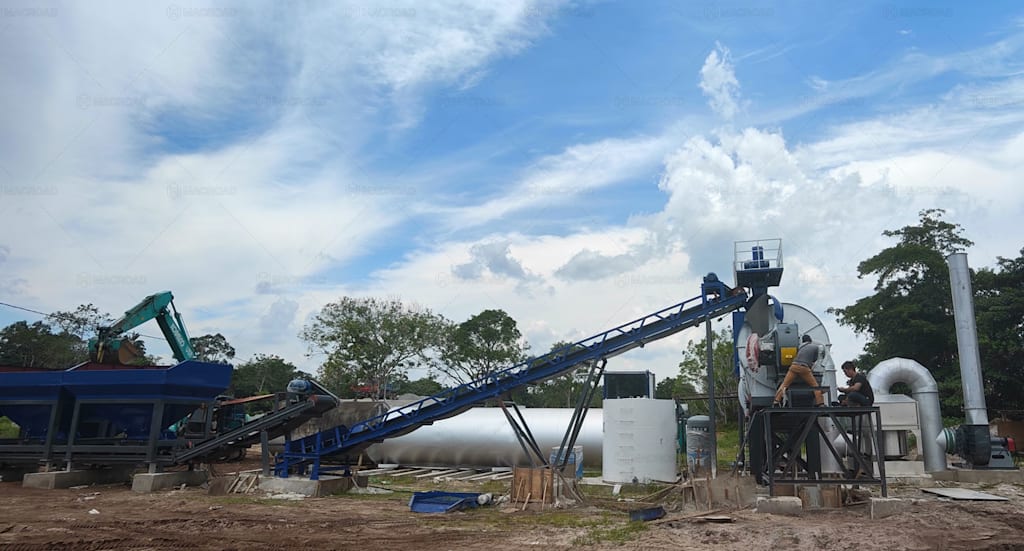
Partnering with an international asphalt drum mix plant supplier for mountain road infrastructure work means the integrated single-chassis frame will absorb off-road towing stress that no factory acceptance test replicates. Small asphalt plants deployed on unpaved mountain tracks face a structural challenge that flatland project experience does not prepare suppliers for — steep gradient transitions, tight switchback cornering, and irregular surface profiles combine into a cumulative fatigue loading sequence that exposes every under-engineered weld joint on the single-chassis frame. Verifying chassis structural engineering before partnership commitment is the procurement step that separates a reliable mountain deployment from a field welding crisis on the most inaccessible section of the project corridor.

What Mountain Track Towing Does to Single-Chassis Frame Integrity
Unpaved mountain tracks generate a combined stress profile on small asphalt plants that urban and flatland towing never produces at equivalent severity. Steep gradient transitions create longitudinal pitch loads that shift the plant's center of gravity forward and rearward dynamically — loading drum support bracket welds and cold feed bin attachment points in alternating tension and compression with each crest and dip. Switchback corners on mountain tracks simultaneously apply lateral moment loads across the chassis frame, twisting the single-chassis structure in a torsional racking pattern that open I-beam primary members cannot absorb without transmitting peak stress directly into cross-member junction welds.
Any asphalt drum mix plant supplier who has not characterized their chassis under this combined loading condition is offering structural evidence developed for a different deployment environment. Specifically, request dynamic load analysis documentation covering mountain gradient and switchback towing conditions — not static structural certifications that reveal nothing about fatigue crack initiation risk under repeated off-road stress cycles.

How Experienced Asphalt Drum Mix Plant Suppliers Engineer Against Weld Fatigue
Reputable asphalt drum mix plant supplier designs for mountain deployment address weld fatigue through box-section primary chassis members, compliant weld fabrication standards, and gusset reinforcement at high-stress attachment zones. Box-section members resist torsional racking loads substantially better than open I-beam profiles of equivalent steel weight — directly reducing the stress amplitude at cross-member welds during switchback cornering. This is a verifiable geometry specification, and any asphalt drum mix plant supplier unable to confirm box-section primary members is defaulting to a cost-reduced frame that transmits mountain towing inputs into weld joints rather than absorbing them in the member cross-section.
Weld fabrication compliance under AWS D1.1 or ISO 3834 governs preheat procedures at thick-section attachments — the drum support brackets and cold bin mounting plates where fatigue cracking initiates under repeated mountain towing cycles. In light of this, request third-party weld inspection certificates for these specific attachment locations from every small asphalt plants supplier under evaluation. Magnetic particle or ultrasonic inspection records tied to the actual chassis being purchased confirm that critical welds were independently verified — not assumed compliant from a generic factory procedure document.

Suspension and Corrosion Protection for Extended Mountain Deployment
Multi-axle suspension specification on small asphalt plants for mountain track deployment must be verified against the plant's actual loaded transfer weight, not the unladen chassis rating. Equalizing beam suspension — where adjacent axles share load through a mechanical rocker — prevents single-axle overloading on uneven mountain surfaces that would concentrate shock energy at individual frame attachment welds. Consequently, confirm that suspension component ratings were selected against loaded transfer weight documentation from your specific asphalt drum mix plant supplier, not derived from a generic platform rating.
Corrosion protection at weld heat-affected zones is a structural integrity issue on mountain deployments where humid conditions, rainfall exposure, and temperature cycling accelerate section loss at precisely the locations where fatigue cracking initiates. Hot-dip galvanizing or multi-layer epoxy coating on all chassis structural members — with verified coating continuity at weld zones specifically — extends the structural service life that mountain track transit demands across a multi-phase project corridor.
Conclusion
Partnering with an asphalt drum mix plant supplier for mountain track deployment requires confirmed box-section chassis geometry, joint-specific weld inspection certification, loaded-weight rated suspension, and corrosion-protected weld zones — because small asphalt plants that arrive on remote mountain sites with frame distortion and fatigue cracks have already failed the structural engineering test that the partnership selection process should have identified before the first towing journey began.
About the Creator
Macroad Asphalt Plant
Macroad, a global leading manufacturer in asphalt mixing plants, offers a wide range of specifications to meet diverse project needs. Its high-quality, efficient equipment is widely applied in road construction.
Enjoyed the story? Support the Creator.
Subscribe for free to receive all their stories in your feed.
Comments
There are no comments for this story
Be the first to respond and start the conversation.