
Asia Pacific Smartphone Market to Reach US$ 346.49 Billion by 2033 as 5G Expansion and Digital Lifestyles Accelerate Demand
Rising Middle-Class Spending, Affordable 5G Devices, and E-Commerce Growth Are Reshaping the Smartphone Industry Across Asia Pacific

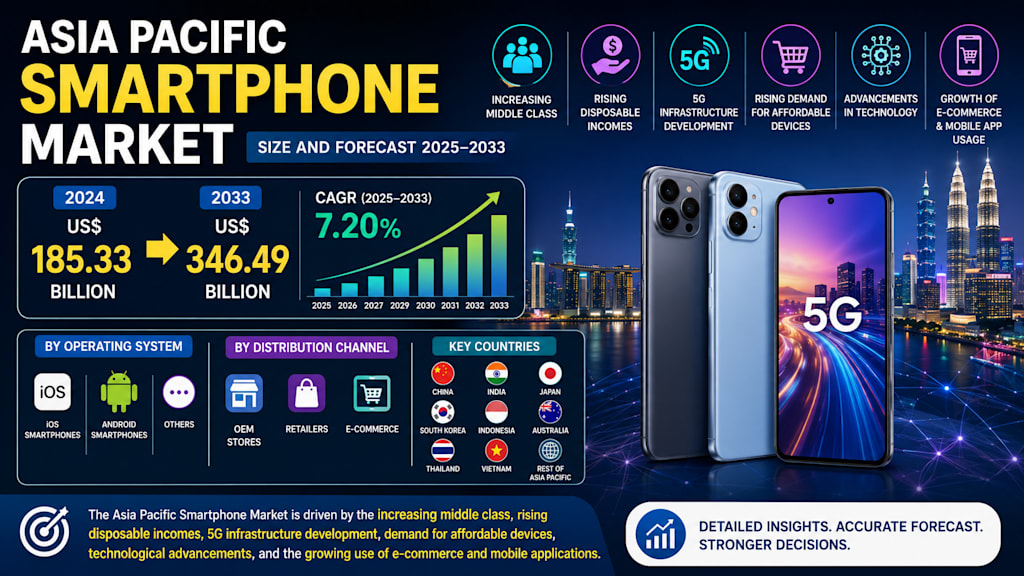
The Asia Pacific smartphone market is witnessing strong expansion as consumers across the region increasingly adopt advanced mobile technologies, digital services, and connected lifestyles. According to Renub Research, the Asia Pacific Smartphone Market is expected to grow from US$ 185.33 billion in 2024 to US$ 346.49 billion by 2033, registering a CAGR of 7.20% from 2025 to 2033. Rising disposable incomes, expansion of 5G infrastructure, increasing demand for affordable smartphones, rapid technological innovation, and growing use of e-commerce and mobile applications are among the major factors driving the market.
Smartphones have evolved beyond communication devices into essential digital tools used for entertainment, online shopping, mobile banking, education, social media, gaming, and productivity. Consumers now rely heavily on smartphones for both personal and professional activities, making them one of the most important consumer electronics products globally.
The Asia Pacific region continues to dominate global smartphone growth due to its large population base, expanding internet penetration, strong manufacturing ecosystem, and increasing digital adoption. Countries such as China, India, Japan, South Korea, and Southeast Asian nations remain central to the global smartphone industry.
5G Infrastructure Expansion Is Creating Massive Market Opportunities
The rapid expansion of 5G infrastructure is one of the biggest growth drivers for the Asia Pacific smartphone market. Telecom operators and governments across the region are investing aggressively in next-generation connectivity networks to improve mobile internet speed, reliability, and digital accessibility.
The uploaded report highlights that Japan approved the installation of 5G base stations on approximately 208,000 traffic lights to accelerate nationwide network deployment and reduce infrastructure costs.
As 5G networks expand, consumers are increasingly upgrading their devices to access faster connectivity, smoother streaming, cloud gaming, improved video communication, and AI-powered applications. This shift is significantly boosting demand for 5G-enabled smartphones across both premium and mid-range categories.
Manufacturers are therefore focusing heavily on expanding their 5G smartphone portfolios, particularly in emerging markets where millions of users are expected to upgrade from 4G devices over the next few years.
The rollout of 5G is also supporting growth in related industries such as mobile gaming, streaming services, fintech applications, and digital commerce, all of which depend heavily on advanced smartphone adoption.
Technological Advancements Continue to Drive Consumer Upgrades
Continuous technological innovation remains a key factor driving smartphone demand across Asia Pacific. Consumers increasingly seek devices with better cameras, improved processors, enhanced battery life, AI-powered features, larger storage capacity, and immersive display technologies.
The report highlights the launch of TECNO’s SPARK 20 Pro 5G in India during July 2024 as an example of how manufacturers are offering advanced features at affordable prices. The smartphone includes support for ten 5G bands, a 108MP camera, up to 16GB RAM, 256GB storage, Dolby Atmos audio, and a 120Hz Full-HD+ display powered by the MediaTek Dimensity 6080 chipset.
Manufacturers are now competing aggressively on innovation by introducing foldable smartphones, AI-enhanced photography, high-refresh-rate displays, ultra-fast charging technologies, gaming-focused devices, and advanced mobile processors.
Artificial intelligence is becoming increasingly integrated into smartphones, improving photography, battery optimization, voice recognition, productivity features, and personalized user experiences.
As innovation cycles shorten, consumers are upgrading devices more frequently, supporting long-term market growth across the region.
Growing Middle Class Is Expanding Smartphone Accessibility
The rise of the middle class throughout Asia Pacific is another major factor fueling smartphone demand. Increasing disposable incomes are allowing more consumers to purchase smartphones, especially in rapidly developing economies such as India, Indonesia, Vietnam, Thailand, and the Philippines.
According to the uploaded report, the growing middle class is encouraging manufacturers to offer both affordable and premium devices to meet diverse consumer preferences.
Smartphones are increasingly viewed as essential lifestyle products rather than luxury items. Consumers now use smartphones extensively for online education, entertainment, mobile payments, e-commerce, social media, digital content creation, and work-related communication.
The growing popularity of digital ecosystems and mobile applications is also encouraging first-time smartphone adoption in rural and semi-urban regions across Asia Pacific.
Affordable financing options, trade-in programs, and online sales platforms are further improving smartphone accessibility for middle-income consumers.
E-Commerce and Online Retail Are Transforming Smartphone Sales
E-commerce has become one of the most influential distribution channels in the Asia Pacific smartphone market. Online platforms allow consumers to compare prices, access discounts, read product reviews, and purchase devices conveniently from home.
The report identifies e-commerce as one of the major distribution channels alongside OEM stores and physical retailers.
Online smartphone sales are growing particularly rapidly in India and Southeast Asia due to expanding internet access and increasing consumer trust in digital shopping platforms. Flash sales, festive discounts, exchange offers, and EMI financing are helping e-commerce platforms attract millions of smartphone buyers.
Brands are also increasingly launching products online first before expanding to offline retail channels. This strategy helps companies reduce operational costs while reaching broader audiences quickly.
Social media marketing, influencer campaigns, and live-commerce strategies are further strengthening online smartphone sales across the region.
China Smartphone Market Remains Highly Competitive and Innovation-Driven
China continues to be one of the largest and most competitive smartphone markets globally. The uploaded report notes that domestic companies such as Vivo, Oppo, Xiaomi, and Huawei dominate the market by offering products across low-cost, mid-range, and premium categories.
Chinese manufacturers are aggressively investing in 5G technology, advanced camera systems, foldable smartphones, AI capabilities, and high-performance processors to maintain competitive advantage.
China’s mature e-commerce ecosystem, widespread digital payments infrastructure, and strong consumer demand for premium features continue to support high smartphone penetration levels.
Despite increasing market maturity, the country remains a global center for smartphone innovation and manufacturing, influencing worldwide product trends and pricing strategies.
India Smartphone Market Emerges as One of the Fastest-Growing Globally
India remains one of the fastest-growing smartphone markets in the world due to increasing internet penetration, expanding middle-class income, and growing demand for affordable smart devices.
The report highlights intense competition between local and international companies including Xiaomi, Realme, Samsung, Apple, and Google.
A major development noted in the report is Google’s announcement in August 2024 regarding local production of Pixel 8 smartphones in India under the “Make in India” initiative. This move is expected to reduce import costs and improve access to premium smartphones for Indian consumers.
India’s smartphone market is also benefiting from affordable mobile data, rapid expansion of digital payment systems, increasing online shopping activity, and government-led digital inclusion initiatives.
Localization strategies, regional-language interfaces, and budget-friendly 5G devices are expected to play critical roles in future market expansion.
Japan Smartphone Market Focuses on Premium and Advanced Devices
Japan’s smartphone market remains heavily focused on premium devices and advanced technologies. Apple continues to maintain a strong position in the country, driven largely by the popularity of the iPhone series.
The market is being supported by rising consumer demand for 5G connectivity, AI-powered applications, and high-end smartphone features. Domestic companies such as Sony and Sharp continue offering advanced devices tailored to local consumer preferences.
Japan also benefits from a highly developed retail ecosystem where smartphones are widely available through physical stores, telecom partnerships, and online platforms.
However, market growth remains relatively moderate because smartphone penetration levels are already very high, making replacement cycles and premium upgrades the primary growth drivers.
Intense Competition Continues to Pressure Profit Margins
The Asia Pacific smartphone market remains extremely competitive due to the presence of numerous international and regional brands competing across different price categories.
According to the uploaded report, manufacturers face constant pressure from price wars, continuous innovation requirements, and heavy marketing investments.
Brands compete aggressively on design, camera quality, battery performance, gaming capabilities, software ecosystems, AI features, and pricing. This intense competition often reduces profit margins, especially within the mid-range and budget smartphone segments.
To remain competitive, companies must continuously invest in research and development while also maintaining strong supply chain efficiency.
Market Saturation Is Becoming a Challenge in Developed Economies
Market saturation is another important challenge facing the Asia Pacific smartphone industry, especially in mature economies such as China, Japan, and South Korea.
The report notes that because smartphone ownership is already widespread in these countries, opportunities for acquiring new users are becoming limited.
As a result, manufacturers increasingly focus on replacement demand, premium upgrades, foldable devices, gaming phones, and AI-enhanced features to encourage consumers to upgrade existing devices.
Companies are also targeting niche segments and expanding into emerging markets where smartphone penetration still has room for growth.
Recent Developments by Leading Smartphone Companies
- Google announced local production of Pixel 8 smartphones in India under the “Make in India” initiative to improve affordability and local supply.
- TECNO launched the SPARK 20 Pro 5G smartphone featuring a 108MP camera, 120Hz display, and MediaTek Dimensity chipset.
- Samsung continued expanding its foldable smartphone lineup across Asia Pacific markets.
- Apple strengthened its premium smartphone ecosystem with continued expansion of iPhone sales and services integration.
- Xiaomi increased investment in affordable 5G smartphone models targeting emerging markets.
- Oppo and Vivo expanded AI-powered photography and camera enhancement technologies in flagship devices.
- Huawei continued focusing on premium smartphone innovation despite international regulatory challenges.
- Lenovo expanded gaming-oriented smartphone offerings aimed at younger consumers.
- Sony continued emphasizing premium camera-focused smartphone technologies for advanced users.
- Smartphone manufacturers increased investments in AI integration, fast charging systems, and foldable display technologies.
Competitive Landscape Remains Dynamic
The Asia Pacific smartphone market includes several major global and regional players competing aggressively across multiple price segments.
Companies covered in the report include Nokia Corporation, Sony Corporation, Samsung, Huawei, LG Display, Panasonic Corporation, Lenovo, HTC Corporation, and Apple Inc.
Competition continues to intensify as brands focus on innovation, pricing strategies, AI integration, premium user experiences, and ecosystem development to capture long-term consumer loyalty.
Final Thoughts
The Asia Pacific smartphone market is expected to remain one of the most influential and fastest-growing technology sectors globally. Renub Research’s forecast of the market reaching US$ 346.49 billion by 2033 highlights the enormous opportunities created by 5G expansion, digital transformation, rising disposable income, and rapid technological innovation.
Smartphones are increasingly becoming central to modern lifestyles, supporting communication, entertainment, education, commerce, healthcare, and financial services. As consumers demand faster, smarter, and more feature-rich devices, manufacturers will continue investing heavily in innovation and digital ecosystems.
Although intense competition and market saturation present ongoing challenges, strong demand from emerging markets, increasing 5G adoption, and expanding digital infrastructure are expected to ensure sustained long-term growth for the Asia Pacific smartphone industry.
About the Creator
Enjoyed the story? Support the Creator.
Subscribe for free to receive all their stories in your feed.
Comments
There are no comments for this story
Be the first to respond and start the conversation.