
Asia Pacific Data Centre Market Expected to Reach US$122.48 Billion by 2034 as Cloud Adoption and AI Infrastructure Surge
Rising digital transformation, expansion of 5G networks, and increasing cloud investments are accelerating data centre growth across the Asia-Pacific region

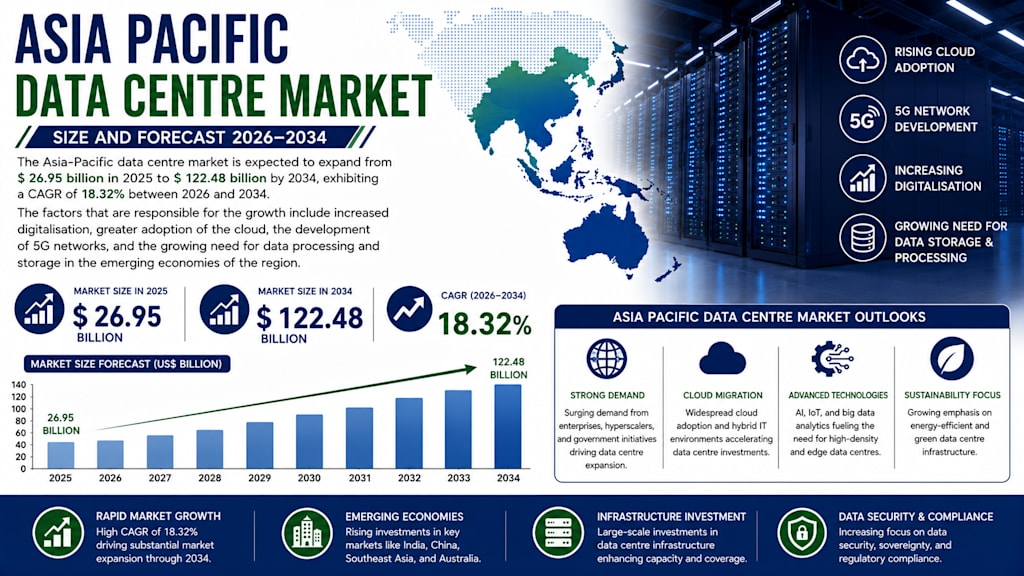
The Asia-Pacific data centre market is entering a phase of extraordinary expansion as governments, enterprises, and technology providers invest heavily in digital infrastructure to support the region’s rapidly evolving digital economy. From cloud computing and artificial intelligence to e-commerce and fintech platforms, the need for large-scale data processing and storage capabilities is reshaping the future of technology infrastructure across Asia-Pacific.
According to Renub Research, the Asia-Pacific data centre market is projected to grow from US$26.95 billion in 2025 to approximately US$122.48 billion by 2034, expanding at an impressive compound annual growth rate (CAGR) of 18.32% between 2026 and 2034.
The market’s growth is being fueled by rising cloud adoption, rapid digitalization, expansion of 5G networks, increasing internet penetration, and the growing demand for data storage and processing across emerging economies such as China, India, and Southeast Asian nations.

Data Centres Have Become the Backbone of the Digital Economy
Data centres are facilities designed to store, process, and manage large volumes of digital information. These facilities contain critical infrastructure such as servers, networking equipment, cooling systems, storage technologies, and power management solutions.
Modern economies increasingly depend on data centres to support:
Cloud computing services, artificial intelligence workloads, online banking systems, e-commerce platforms, video streaming services, mobile applications, and enterprise digital operations.
The Asia-Pacific region has experienced a dramatic increase in internet usage and digital service consumption over the past decade. Countries including China, India, Singapore, South Korea, and Indonesia are witnessing explosive growth in mobile connectivity, cloud computing, and online transactions.
As businesses continue migrating operations online, data centres are becoming one of the most essential components of regional economic infrastructure.
Rapid Digital Transformation Is Accelerating Market Growth
One of the biggest drivers behind the Asia-Pacific data centre market is the region’s accelerating digital transformation.
Enterprises across industries are increasingly adopting cloud technologies to improve operational efficiency, scalability, and digital service delivery. Hybrid cloud and multi-cloud strategies are becoming especially common among large corporations seeking flexibility and improved performance.
Digital transformation trends are expanding rapidly across sectors such as:
Banking and financial services, e-commerce, healthcare, telecommunications, manufacturing, logistics, and government services.
The growth of digital platforms and online consumer services is generating enormous amounts of data that require secure storage and real-time processing capabilities.
According to IDC, nearly 90% of Asia-Pacific firms now operate heavy workloads across multiple public cloud environments, while hybrid cloud adoption continues rising sharply in countries such as India.
Global technology companies are therefore increasing investments in hyperscale data centres to meet growing enterprise demand across the region.
Expansion of 5G Networks Is Increasing Data Traffic
The rapid rollout of 5G networks across Asia-Pacific is also significantly boosting demand for advanced data centre infrastructure.
5G technology enables faster internet speeds, lower latency, and support for highly data-intensive applications such as:
Online gaming, video streaming, Internet of Things (IoT) systems, smart cities, autonomous technologies, and AI-driven applications.
Countries such as South Korea, Japan, China, and Australia are leading the deployment of 5G infrastructure, resulting in growing demand for edge computing and localized data processing capabilities.
In addition, smartphone adoption and internet penetration continue increasing rapidly across emerging markets in Southeast Asia and South Asia.
According to the report, nearly 88% or approximately 402 million people in the region are expected to participate in e-commerce activities by 2027, while smartphone internet access continues rising sharply.
This surge in digital traffic is creating enormous pressure for faster, more efficient, and scalable data centre networks.
Government Support and Foreign Investments Are Driving Infrastructure Development
Government initiatives and foreign investments are playing a critical role in the expansion of the Asia-Pacific data centre market.
Several countries are introducing favorable policies, tax incentives, and infrastructure programs designed to attract global data centre operators and strengthen domestic digital ecosystems.
Singapore, Indonesia, India, Japan, and Malaysia are increasingly positioning themselves as strategic digital infrastructure hubs because of their connectivity advantages and growing enterprise demand.
Public-private partnerships are also accelerating infrastructure development across the region.
In January 2025, the Japanese government announced plans to encourage industries such as semiconductor manufacturing and data centres to establish operations near low-carbon energy sources including offshore wind farms and nuclear facilities.
These initiatives reflect how governments increasingly view data centres as strategic national infrastructure critical to economic growth and digital competitiveness.
Cloud Computing Is Becoming the Largest Growth Engine
Cloud data centres represent one of the fastest-growing segments within the Asia-Pacific market.
Cloud facilities provide scalable computing power, storage, analytics, and virtualization services that support enterprise digital transformation initiatives.
Countries such as Singapore and Japan have emerged as major cloud infrastructure hubs because of strong connectivity, political stability, and business-friendly environments.
The increasing adoption of hybrid cloud and multi-cloud architectures is encouraging enterprises to rely more heavily on hyperscale cloud providers.
Cloud infrastructure is becoming essential for supporting:
Artificial intelligence, machine learning, big data analytics, SaaS platforms, fintech systems, and IoT applications.
As enterprise digital operations continue expanding, cloud data centres are expected to remain one of the most important pillars of regional digital infrastructure growth.
AI and High-Performance Computing Are Reshaping Data Centre Demand
Artificial intelligence and high-performance computing workloads are dramatically increasing demand for advanced data centre infrastructure.
Massive data centres designed for AI applications require sophisticated cooling technologies, automation systems, and highly efficient power management capabilities.
Countries such as Japan and South Korea are becoming major hubs for AI-driven data centre deployment because of advanced technological ecosystems and strong connectivity infrastructure.
AI workloads now support applications such as:
Predictive analytics, machine learning, autonomous systems, financial modeling, real-time data processing, and generative AI platforms.
The rapid expansion of AI adoption across industries is expected to significantly increase long-term demand for hyperscale and high-capacity data centres throughout Asia-Pacific.
Sustainability and Energy Consumption Remain Major Challenges
Despite strong growth prospects, the Asia-Pacific data centre market faces major challenges related to energy consumption and environmental sustainability.
Data centres require enormous amounts of electricity to operate servers, networking systems, and cooling infrastructure.
As demand for digital services grows, energy consumption is becoming a serious concern for governments, operators, and environmental regulators.
Key challenges include:
High electricity usage, rising carbon emissions, cooling system efficiency, renewable energy integration, and sustainability compliance.
Governments across Asia-Pacific are tightening environmental regulations while encouraging the use of renewable energy sources and energy-efficient technologies.
Data centre operators are increasingly investing in:
Green energy solutions, liquid cooling systems, AI-based power optimization, and low-carbon infrastructure development.
Sustainability is expected to become one of the most important competitive factors within the industry over the next decade.
Data Localization Laws Are Increasing Operational Complexity
Regulatory complexity and data localization requirements are also creating operational challenges for global data centre providers.
Countries such as China and India increasingly require sensitive data to be stored within national borders.
These regulations are intended to improve cybersecurity and national data sovereignty, but they also increase infrastructure costs and operational complexity for multinational companies.
Data centre operators must navigate:
Licensing procedures, data protection laws, cybersecurity standards, cross-border data transfer regulations, and local compliance requirements.
While these regulations create barriers for expansion, they are also driving demand for localized domestic data centre infrastructure.
Retail and Colocation Data Centres Are Expanding Rapidly
Retail or colocation data centres are seeing strong growth across Asia-Pacific as businesses seek cost-effective digital infrastructure solutions.
Colocation facilities provide shared infrastructure, hosting services, storage capabilities, and connectivity solutions for companies that prefer not to build private data centres.
Demand is especially strong among:
Small and medium-sized enterprises, startups, fintech companies, e-commerce platforms, and technology firms.
Countries such as Indonesia and Malaysia are experiencing significant growth in colocation services because of expanding digital economies and rising cloud adoption.
The flexibility and scalability offered by colocation providers make them highly attractive for businesses undergoing digital transformation.
BFSI and E-Commerce Sectors Are Driving Heavy Data Demand
BFSI Data Centres
The banking, financial services, and insurance (BFSI) sector is becoming one of the largest users of high-security data centres in Asia-Pacific.
The rapid rise of digital banking, mobile payments, and fintech innovation is creating strong demand for secure and highly reliable infrastructure.
BFSI data centres increasingly rely on:
Encryption technologies, disaster recovery systems, real-time monitoring, and zero-downtime operations.
E-Commerce Data Centres
E-commerce platforms also require powerful data infrastructure to support:
Customer databases, payment processing, inventory systems, personalized recommendations, and real-time analytics.
China and India continue dominating regional e-commerce growth because of massive consumer populations and rapidly expanding online shopping ecosystems.
The continued growth of mobile commerce and digital payments is expected to further accelerate demand for e-commerce-focused data centres.
China, India, and Japan Lead Regional Expansion
China
China remains the largest data centre market in Asia-Pacific due to massive investments in cloud computing, artificial intelligence, and digital infrastructure.
The country’s “Eastern Data, Western Computing” initiative continues driving large-scale regional data centre expansion.
India
India is experiencing exceptional growth because of rapid digitization, fintech adoption, smart city development, and government support for data localization policies.
India’s installed data centre capacity is expected to expand dramatically over the coming years.
Japan
Japan’s market benefits from advanced technology infrastructure, strong cybersecurity standards, and increasing investments in renewable-energy-powered data centres.
Government incentives supporting regional infrastructure development are also strengthening Japan’s position within the regional market.
Major Companies Intensify Competition
Competition within the Asia-Pacific data centre market continues intensifying as global operators expand regional infrastructure investments.
Major companies include:
Digital Realty Trust, Equinix, KT Corporation, NTT Ltd., Princeton Digital Group, NEXTDC, and Canberra Data Centres.
Companies are increasingly focusing on sustainability, hyperscale expansion, AI-ready infrastructure, and low-latency edge computing capabilities.
Final Thoughts
The Asia-Pacific data centre market is rapidly becoming one of the most strategically important technology infrastructure sectors in the world.
With the market projected to reach approximately US$122.48 billion by 2034, data centres are expected to play a central role in supporting cloud computing, artificial intelligence, 5G connectivity, fintech innovation, and digital transformation across the region.
However, the industry must continue addressing challenges related to energy efficiency, sustainability, regulatory compliance, and rising infrastructure costs.
As digital economies continue expanding and data generation accelerates across Asia-Pacific, the demand for advanced, scalable, and energy-efficient data centre infrastructure is likely to remain exceptionally strong throughout the next decade.
About the Creator
Enjoyed the story? Support the Creator.
Subscribe for free to receive all their stories in your feed.
Comments
There are no comments for this story
Be the first to respond and start the conversation.