
Asia Air Conditioner Market 2026-2034: Rising Heatwaves and Smart Cooling Demand Fuel Massive Industry Expansion
Growing urbanization, climate change, smart infrastructure, and energy-efficient technologies are transforming the Asia air conditioner market into one of the fastest-growing HVAC sectors globally.

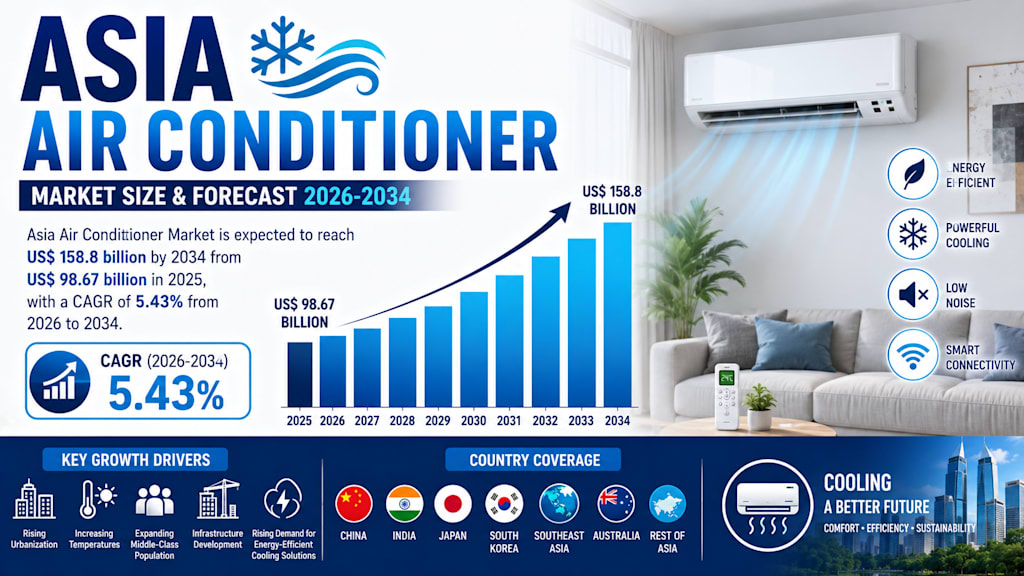
The Asia air conditioner market is entering a powerful growth phase as rising temperatures, rapid urbanization, and expanding middle-class populations continue to reshape cooling demand across the region. According to Renub Research, the Asia air conditioner market is projected to increase from US$ 98.67 billion in 2025 to US$ 158.8 billion by 2034, growing at a CAGR of 5.43% from 2026 to 2034.
Air conditioners are no longer viewed as luxury appliances in Asia. In many countries, they are becoming essential household and commercial infrastructure as climate conditions become more extreme. Longer summers, rising humidity levels, and frequent heatwaves are pushing both consumers and businesses toward advanced cooling systems that improve comfort, energy efficiency, and indoor air quality.
At the same time, governments and manufacturers are accelerating the shift toward smart HVAC technologies, sustainable refrigerants, and energy-efficient systems. The result is a rapidly evolving industry where technology, sustainability, and urban development are deeply connected.
Why the Asia air conditioner market is growing rapidly
Urbanization remains one of the strongest growth engines for the regional HVAC industry. Across Asia, cities are expanding rapidly, leading to large-scale residential construction, commercial real estate projects, shopping centers, hospitals, airports, hotels, and office developments. Every new building project increases demand for modern cooling systems.
Renub Research highlights that governments and private developers are heavily investing in smart city projects, transportation infrastructure, and mixed-use developments. These investments are driving installation of split air conditioners, centralized HVAC systems, and commercial cooling technologies across metropolitan regions.
Rising disposable income is also changing consumer behavior. Millions of middle-class households across India, Vietnam, Indonesia, the Philippines, and other emerging Asian economies are purchasing air conditioners for the first time. Consumers increasingly prefer inverter air conditioners and smart cooling systems that offer lower electricity consumption and enhanced comfort.
Climate change is another major factor accelerating market expansion. Many Asian countries are experiencing higher average temperatures, extreme heat events, and growing humidity levels. Residential users, businesses, hospitals, schools, and public facilities are investing heavily in air conditioning systems to maintain comfort, productivity, and safety during prolonged heatwaves.
Technology is reshaping the HVAC industry
One of the most important transformations in the market is the shift toward intelligent and energy-efficient cooling systems. Manufacturers are increasingly integrating artificial intelligence, Internet of Things connectivity, and automation into HVAC products.
Smart air conditioners can now automatically adjust temperature settings, monitor indoor climate conditions, optimize electricity usage, and even predict maintenance needs. These features are becoming highly attractive for consumers looking to reduce electricity bills while maintaining convenience.
The rise of smart homes and connected infrastructure is further increasing demand for AI-enabled HVAC systems. Businesses are also adopting digitally connected cooling systems for offices, hotels, hospitals, and industrial facilities where energy optimization has become a major operational priority.
Environmental sustainability is also influencing product innovation. Governments across Asia are tightening regulations around refrigerants and energy efficiency. Manufacturers are responding by introducing environmentally friendly refrigerants with lower global warming potential and by improving compressor efficiency to reduce emissions and electricity consumption.
This transition is reshaping competition within the market. Companies are no longer competing only on cooling performance. They are increasingly competing on smart technology integration, energy savings, sustainability, and digital service capabilities.
Southeast Asia still offers massive untapped potential
One of the biggest opportunities for manufacturers lies in Southeast Asia, where air conditioner penetration rates are still below mature markets like Japan and South Korea.
Renub Research cites International Energy Agency data showing that household air conditioner penetration in Singapore reached 77.5% in 2023, while Vietnam stood at 41.1%. Thailand reached 35.8%, whereas Indonesia and the Philippines remained near 13%. Japan continues to lead with household penetration rates close to 89.5%.
These numbers reveal enormous room for future expansion, especially as incomes rise and urbanization continues across developing economies. For manufacturers, this represents a long-term demand opportunity that could reshape regional HVAC production and distribution strategies for the next decade.
Energy consumption remains a serious challenge
Despite strong growth prospects, the market faces several important challenges. One of the biggest concerns is the rapid increase in electricity demand caused by rising air conditioner usage.
Cooling systems are energy-intensive appliances, and large-scale adoption across residential and commercial sectors is putting heavy pressure on regional power grids. Many Asian countries experience electricity shortages and higher utility costs during peak summer seasons because of increased cooling demand.
Governments are therefore focusing heavily on energy-efficiency standards, appliance labeling programs, and sustainable cooling policies to manage electricity consumption and reduce carbon emissions.
Consumers in price-sensitive markets also face affordability concerns. While inverter and smart HVAC systems reduce long-term operating costs, the higher upfront price can slow adoption among middle-income households.
Environmental regulations are changing product development
Environmental regulations are becoming increasingly strict across Asia, especially regarding refrigerants used in cooling systems. Traditional refrigerants contribute significantly to greenhouse gas emissions, leading governments to push manufacturers toward low-global-warming-potential alternatives.
However, transitioning to eco-friendly refrigerants is not simple. Manufacturers must invest heavily in research, redesign equipment, train technicians, and upgrade supply chains. These adjustments increase operational costs and create additional pressure on companies competing in highly price-sensitive markets.
Even so, sustainability is expected to become one of the defining themes of the industry over the next decade. Companies that successfully balance energy efficiency, affordability, and environmental compliance are likely to gain significant competitive advantages.
India is emerging as a major growth engine
India has become one of the fastest-growing air conditioner markets in Asia due to rising temperatures, expanding urbanization, and growing middle-class purchasing power. Residential construction, commercial development, and improving electricity access are driving rapid adoption of cooling systems across urban and semi-urban regions.
Consumers are increasingly choosing inverter air conditioners and smart cooling technologies that reduce electricity consumption while offering improved comfort. Government initiatives supporting domestic manufacturing and energy-efficient appliances are also strengthening industry expansion.
India’s rapidly growing digital economy is creating another major opportunity for advanced cooling technologies. Data centers require sophisticated thermal management systems, and this is opening the door for next-generation HVAC providers specializing in energy-efficient cooling infrastructure.
Renub Research notes that startups focusing on immersion cooling technologies are particularly well-positioned as India expands its AI and digital infrastructure ecosystem.
China continues to dominate manufacturing and innovation
China remains one of the world’s largest air conditioner markets and a global manufacturing powerhouse for HVAC equipment. Strong urbanization, large-scale residential construction, and industrial expansion continue driving significant demand for cooling systems.
Chinese manufacturers are aggressively investing in inverter technologies, smart air conditioners, and energy-efficient systems. Government policies encouraging sustainable cooling solutions and energy conservation are also influencing product development across the industry.
The country’s enormous production capacity gives it a major competitive advantage. Renub Research notes that China’s domestic production capacity for household air conditioners approached 300 million units in 2025, while annual production and shipment volumes exceeded 200 million units.
This manufacturing scale allows China to serve both domestic demand and global export markets, reinforcing its position as a central player in the international HVAC industry.
Japan and Singapore continue leading in smart cooling
Japan remains one of the most technologically advanced HVAC markets globally. Consumers increasingly demand compact, AI-enabled, and environmentally friendly air conditioning systems equipped with air purification and automated climate management features.
Strong environmental regulations and energy-efficiency standards continue encouraging innovation among Japanese manufacturers. Smart homes and connected appliances are further accelerating demand for IoT-enabled HVAC systems with remote monitoring capabilities.
Singapore is also experiencing steady market growth because of its tropical climate, high urban density, and strong sustainability initiatives. Air conditioning remains essential across residential, commercial, healthcare, and data center infrastructure.
The Singapore government actively promotes green building initiatives and energy-efficient HVAC technologies, creating strong demand for smart cooling systems and environmentally friendly refrigerants.
recent company developments
Daikin Industries expanded investments in inverter-based and smart HVAC technologies to strengthen energy-efficient cooling solutions across Asia.
Carrier Global increased focus on sustainable refrigeration and intelligent building climate systems for commercial infrastructure projects.
Mitsubishi Heavy Industries accelerated development of AI-enabled HVAC technologies designed for energy optimization and smart building integration.
Trane Technologies expanded environmentally friendly cooling solutions aimed at reducing emissions and improving operational efficiency.
Hitachi-Johnson Controls Air Conditioning strengthened its portfolio of smart residential and commercial cooling systems across Asia-Pacific markets.
Emerson Electric increased investment in advanced compressor technologies and automated HVAC control systems.
Electrolux expanded energy-efficient appliance offerings to address rising consumer demand for sustainable cooling products.
Daikin Industries continued promoting low-global-warming-potential refrigerants to align with stricter environmental regulations.
Carrier Global expanded digital HVAC monitoring and predictive maintenance solutions for commercial facilities and data centers.
Trane Technologies increased focus on green building partnerships and intelligent climate-control systems for sustainable infrastructure projects.
Final thoughts
The Asia air conditioner market is evolving into one of the most strategically important sectors within the global HVAC industry. Climate change, urban expansion, smart infrastructure, and rising consumer expectations are combining to create long-term demand for advanced cooling technologies.
Renub Research’s forecast of US$ 158.8 billion by 2034 reflects more than just rising appliance sales. It highlights how cooling systems are becoming essential infrastructure for modern economies across Asia.
The next phase of competition will likely focus on smart connectivity, sustainability, energy efficiency, and environmentally responsible refrigerants. Companies capable of balancing affordability, innovation, and regulatory compliance will be best positioned to lead the future of Asia’s rapidly expanding air conditioner industry.
About the Creator
Enjoyed the story? Support the Creator.
Subscribe for free to receive all their stories in your feed.
Comments
There are no comments for this story
Be the first to respond and start the conversation.