
Artificial Insemination Market to Reach US$ 4.97 Billion by 2033 as Fertility Innovation Reshapes Parenthood
Rising infertility rates, advanced reproductive technologies, and changing social attitudes are driving unprecedented growth in the global artificial insemination industry.

For millions of individuals and couples worldwide, the dream of parenthood is increasingly being supported by medical innovation. Artificial insemination, once considered a specialized fertility treatment, has evolved into one of the most accessible and widely used reproductive technologies available today.
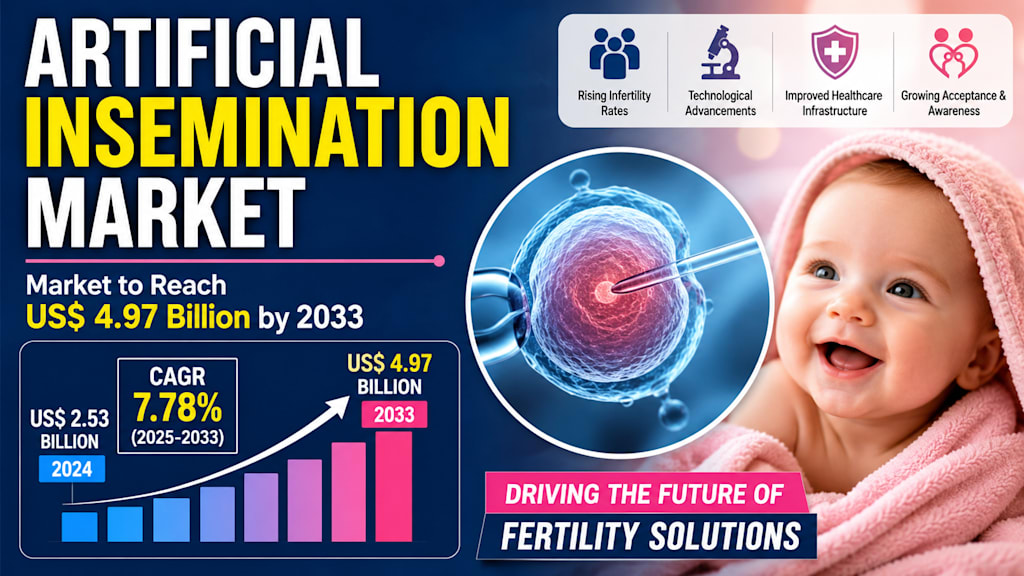
According to recent market analysis, the Global Artificial Insemination Market is projected to grow from US$ 2.53 Billion in 2024 to US$ 4.97 Billion by 2033, expanding at a CAGR of 7.78% during 2025–2033. The remarkable growth reflects rising infertility rates, expanding fertility awareness, advancements in reproductive medicine, and growing acceptance of diverse family structures worldwide.
As healthcare systems improve and fertility services become more accessible, artificial insemination is emerging as a crucial solution for individuals and couples seeking to build families.
Understanding Artificial Insemination
Artificial insemination is a fertility treatment that involves placing sperm directly into a woman's reproductive tract to increase the chances of conception. The procedure can utilize sperm from a partner or donor and is often performed during ovulation to maximize success rates.
Compared to more complex fertility treatments such as in vitro fertilization (IVF), artificial insemination is generally less invasive, less expensive, and easier to access. These advantages have made it a preferred first-line fertility treatment for many patients.
The procedure is commonly recommended for:
Low sperm count
Cervical mucus complications
Unexplained infertility
Single women seeking pregnancy
Same-sex couples planning families
Mild male infertility conditions
As fertility awareness expands globally, artificial insemination continues to gain popularity as a practical and effective reproductive option.
Why Infertility is Becoming a Global Health Concern
One of the strongest drivers behind market growth is the increasing prevalence of infertility.
According to the World Health Organization, approximately one in six adults globally experiences infertility during their lifetime. Modern lifestyles have significantly contributed to this trend. Delayed parenthood, increasing stress levels, obesity, poor nutrition, environmental pollution, and sedentary lifestyles have all been linked to declining fertility rates.
Many individuals now choose to delay having children while pursuing education, careers, and financial stability. However, fertility naturally declines with age, increasing demand for reproductive assistance.
As infertility affects both men and women, healthcare providers are witnessing growing demand for fertility services, particularly those that are cost-effective and minimally invasive. Artificial insemination fits this need perfectly, positioning it as a major growth segment within reproductive healthcare.
Technology is Transforming Fertility Treatment
Technology is revolutionizing virtually every aspect of reproductive medicine.
Modern fertility clinics are integrating advanced laboratory systems, artificial intelligence, machine learning, and automation technologies to improve treatment outcomes.
One notable example is Genea Pty Limited, which has invested heavily in innovation programs designed to improve fertility treatment accuracy and efficiency. Advanced embryo assessment tools, laboratory automation, and AI-powered analytics are helping fertility specialists make more informed decisions.
Artificial intelligence is increasingly being used to analyze reproductive data and identify patterns that may improve treatment success. Machine learning algorithms can help clinicians evaluate embryo quality, optimize treatment protocols, and personalize fertility care.
Additional innovations include:
Enhanced sperm selection technologies
Improved cryopreservation techniques
Time-lapse embryo imaging
Genetic screening technologies
Digital fertility monitoring systems
These developments are improving patient outcomes while making fertility treatment more efficient and accessible.
Expanding Healthcare Infrastructure Supports Market Growth
Healthcare infrastructure improvements are playing a major role in expanding access to artificial insemination services.
Many emerging economies are investing heavily in fertility clinics, reproductive health centers, diagnostic laboratories, and specialist training programs. As healthcare networks expand, more patients gain access to advanced fertility treatments.
Urban fertility centers are increasingly equipped with sophisticated diagnostic equipment and reproductive technologies. Meanwhile, telemedicine platforms are helping patients in remote locations connect with fertility specialists.
Government support programs and private-sector investments are also accelerating growth. As reproductive healthcare becomes a priority across many countries, fertility treatments are becoming available to wider segments of the population.
Improved infrastructure not only increases accessibility but also enhances treatment quality, patient safety, and success rates.
Growing Acceptance of Diverse Family Structures
Social attitudes toward family planning have changed dramatically over the past decade.
Today, artificial insemination is no longer viewed solely as a treatment for infertility. It is increasingly used by:
Single parents by choice
Same-sex couples
LGBTQ+ families
Individuals pursuing delayed parenthood
Greater social acceptance has helped normalize fertility treatments, encouraging more people to seek professional reproductive assistance.
Fertility clinics have responded by offering personalized services tailored to diverse family-building needs. This inclusivity is helping expand the market while reducing stigma associated with reproductive healthcare.
As societal norms continue evolving, demand for fertility services is expected to grow further.
Challenges Facing the Artificial Insemination Market
Despite its strong growth prospects, the market faces several challenges.
High Treatment Costs
Although artificial insemination is less expensive than IVF, it can still represent a significant financial burden for many patients.
Costs often include:
Medical consultations
Fertility testing
Hormonal medications
Ultrasound monitoring
Laboratory procedures
Multiple treatment cycles may be necessary before achieving pregnancy, increasing overall expenses.
In many regions, fertility treatments receive limited insurance coverage, making affordability a major concern for patients.
Emotional and Psychological Stress
Infertility can have a profound emotional impact.
Patients frequently experience anxiety, depression, frustration, and uncertainty throughout the treatment process. The possibility of unsuccessful treatment cycles can further increase psychological strain.
Relationship stress is also common among couples undergoing fertility treatment. Mental health support and counseling services are therefore becoming increasingly important components of comprehensive fertility care.
Addressing emotional wellbeing will remain essential for improving patient experiences and treatment adherence.
Regional Market Insights
United States
The United States remains one of the largest artificial insemination markets globally.
Strong healthcare infrastructure, technological innovation, and growing awareness of fertility treatment continue to drive demand. Increasing insurance coverage and greater acceptance of non-traditional family structures are also supporting market expansion.
Germany
Germany's advanced healthcare system and favorable reproductive health policies have contributed to steady market growth.
Rising awareness, high-quality fertility clinics, and strong treatment success rates continue attracting patients seeking reproductive assistance.
India
India is emerging as one of the fastest-growing markets for artificial insemination.
Government programs such as the National Artificial Insemination Program (NAIP) and Rashtriya Gokul Mission are promoting widespread adoption of artificial insemination technologies. Increased healthcare investment and growing fertility awareness are further accelerating growth.
Saudi Arabia
Saudi Arabia is witnessing increasing adoption of artificial insemination technologies through government-supported livestock improvement initiatives and expanding healthcare modernization efforts.
Continued investments in veterinary and reproductive technologies are helping strengthen the country's position within the regional market.
10 Recent Developments by Leading Companies
1. Genea Pty Limited Launches Advanced Innovation Initiatives
Genea expanded research programs focused on fertility automation, AI-assisted embryo assessment, and laboratory optimization technologies.
2. Vitrolife Enhances Reproductive Healthcare Portfolio
Vitrolife continues strengthening its reproductive technology offerings through advanced fertility solutions and laboratory products.
3. FUJIFILM Irvine Scientific Expands Fertility Product Line
The company increased investments in fertility laboratory media and reproductive healthcare technologies.
4. Kitazato Corporation Advances Cryopreservation Technologies
Kitazato has introduced innovations designed to improve sperm and embryo preservation outcomes.
5. Rinovum Women's Health Expands Fertility Accessibility Programs
The company continues promoting accessible reproductive healthcare solutions for patients worldwide.
6. Pride Angel Strengthens Donor Matching Services
Digital platform enhancements are helping improve donor selection and family planning support services.
7. Conceivex Expands Donor Network Capabilities
Conceivex continues growing its donor sperm banking and matching infrastructure.
8. Rocket Medical Enhances Fertility Procedure Equipment
The company remains focused on specialized medical devices used in reproductive healthcare settings.
9. HI-TECH SOLUTIONS Invests in Fertility Laboratory Automation
Advanced automation solutions are helping fertility clinics improve operational efficiency.
10. Industry Adoption of Artificial Intelligence Accelerates
Leading fertility providers worldwide are increasingly incorporating AI-driven analytics to improve treatment precision and success rates.
The Future of Artificial Insemination
The future of artificial insemination appears exceptionally promising.
Advances in artificial intelligence, genetic testing, laboratory automation, and personalized medicine are expected to further improve treatment outcomes. At the same time, expanding healthcare infrastructure and growing societal acceptance will continue broadening access to fertility services.
As infertility rates rise and family-building preferences evolve, artificial insemination is positioned to become an increasingly important component of reproductive healthcare worldwide.
Final Thoughts
Artificial insemination has evolved from a niche medical procedure into a mainstream reproductive solution that is helping millions of people pursue parenthood. With the market expected to nearly double in value by 2033, the sector is entering a transformative period driven by innovation, accessibility, and growing public awareness.
As technology continues advancing and healthcare systems expand, artificial insemination will remain at the forefront of modern fertility treatment, creating new opportunities for individuals, couples, and families across the globe.
About the Creator
Enjoyed the story? Support the Creator.
Subscribe for free to receive all their stories in your feed.
Comments
There are no comments for this story
Be the first to respond and start the conversation.