
AR in Education: Making Every Lesson Come Alive
How Augmented Reality is Revolutionizing Classrooms and Student Engagement

Introduction
Think back to your school days. How often did you wish a history lesson could transport you to ancient civilizations or a science class could let you explore the human body from the inside out? For generations, students have relied on textbooks, diagrams, and lectures to understand complex topics. While these methods remain valuable, technology is opening up exciting new ways to learn.
One of the most promising innovations in modern education is Augmented Reality (AR). By blending digital content with the real world, AR creates interactive learning experiences that help students see, explore, and understand concepts in ways that were once impossible. From virtual science experiments to interactive geography lessons, AR is changing how knowledge is delivered and absorbed.
Read :- AR in Education: Transforming Learning Through Immersive Technology
What Is Augmented Reality in Education?
Augmented Reality is a technology that overlays digital elements such as images, animations, videos, and 3D objects onto the physical world through smartphones, tablets, or AR-enabled devices.
Unlike Virtual Reality (VR), which places users in a completely digital environment, AR enhances the environment around them. Students can remain in their classroom while interacting with digital models, simulations, and educational content that appear right before their eyes.
This combination of real-world interaction and digital enhancement creates a learning experience that feels both engaging and practical.
Why AR Is Making Learning More Effective
Increased Student Engagement
Keeping students focused can be challenging, especially when lessons involve abstract concepts. AR transforms passive learning into active participation.
Instead of simply reading about the solar system, students can explore 3D planets floating in front of them. Rather than looking at a diagram of a cell, they can examine every component from multiple angles. These interactive experiences naturally capture attention and spark curiosity.
Better Understanding of Complex Topics
Some subjects are difficult to visualize through text alone. AR helps bridge that gap by turning complicated ideas into interactive experiences.
For example:
- Biology students can explore organs and body systems in 3D.
- Chemistry students can observe molecular structures up close.
- Physics learners can interact with simulations that demonstrate scientific principles.
When students can see and interact with concepts, understanding often comes more naturally.
Personalized Learning Experiences
Every student learns differently. AR gives learners the freedom to explore content at their own pace.
Students can spend extra time on challenging topics, revisit simulations, and interact with lessons as often as needed. This flexibility supports different learning styles and encourages independent exploration.
Encouraging Collaboration
AR isn't just beneficial for individual learning—it can also support teamwork.
Students can work together on interactive projects, solve problems collaboratively, and explore digital models as a group. These activities help develop communication, critical thinking, and collaboration skills that are valuable both inside and outside the classroom.
Popular AR Tools Used in Education
Several educational platforms are already demonstrating how effective AR can be in the classroom.
Merge Cube
Merge Cube allows students to hold and interact with virtual 3D objects. Whether they're studying planets, fossils, or the human body, learners can examine educational content from every angle.
Google Expeditions AR
This platform brings learning environments to life by allowing students to explore historical landmarks, famous locations, and scientific concepts through immersive AR experiences.
Quiver
Quiver combines creativity and technology by turning colored worksheets into animated 3D experiences. Students can literally watch their artwork come to life.
zSpace
Widely used for STEM education, zSpace provides interactive simulations that help students conduct virtual experiments and explore complex scientific concepts safely and effectively.
These tools highlight how AR can be adapted across different subjects and age groups.
Real-World Applications of AR in Education
Science and Biology
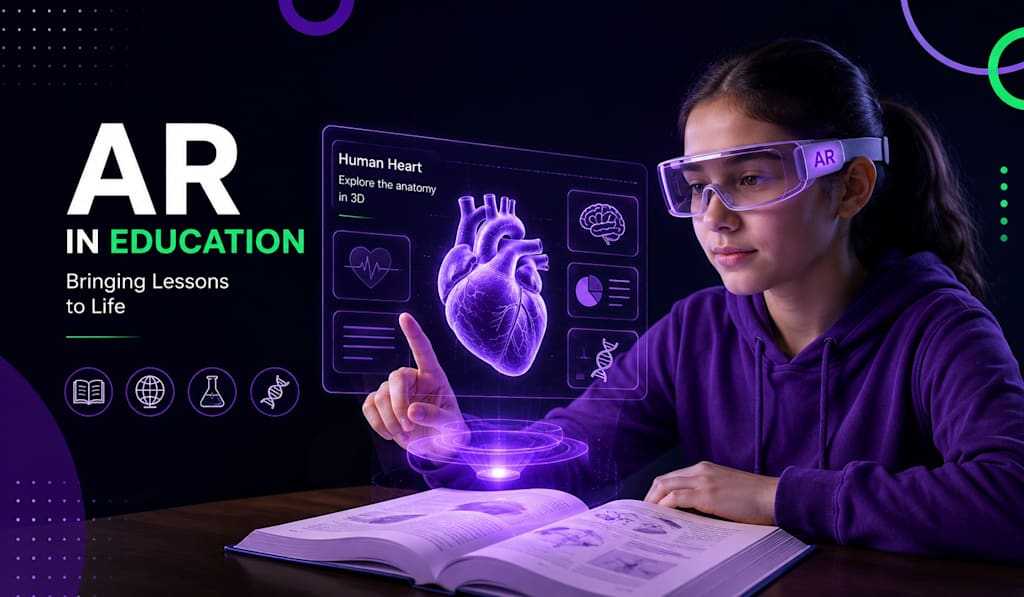
Imagine studying the human heart by viewing a fully interactive 3D model that shows how blood flows through each chamber. AR allows students to move beyond static diagrams and experience anatomy in a more realistic way.
History and Geography
History lessons become far more engaging when students can explore ancient civilizations, historical landmarks, or significant events through immersive visual experiences.
Similarly, geography students can examine mountains, rivers, and landscapes in three dimensions, helping them better understand the world around them.
Language Learning
AR can make language education more interactive by providing real-time translations, pronunciation assistance, and vocabulary activities that connect words to real-world objects.
This practical approach often helps students retain information more effectively.
Challenges Schools Should Consider
While AR offers exciting possibilities, successful implementation requires thoughtful planning.
Accessibility and Device Availability
Not every school has the resources to provide AR-enabled devices for all students. Ensuring equal access remains an important consideration.
Teacher Training
Technology is most effective when educators feel confident using it. Teachers may need training and support to integrate AR into lessons in meaningful ways.
Budget Considerations
Advanced AR software and equipment can involve significant costs. Schools must evaluate which tools provide the greatest educational value for their investment.
Despite these challenges, many educational institutions are finding that the long-term benefits make AR a worthwhile addition to the learning environment.
The Future of AR in Education
The future of education is becoming increasingly interactive, and AR is likely to play a major role in that transformation.
As technology continues to improve, we may see classrooms featuring virtual learning assistants, interactive educational environments, and personalized AR experiences tailored to each student's needs.
What seems innovative today could soon become a standard part of everyday learning.
Conclusion
Augmented Reality is reshaping education by making learning more engaging, interactive, and memorable. It helps students move beyond simply reading and listening, allowing them to experience concepts in a hands-on and meaningful way.
Whether it's exploring the solar system, understanding human anatomy, or bringing history lessons to life, AR has the potential to make education more exciting and effective for learners of all ages.
As schools continue to embrace new technologies, Augmented Reality stands out as a powerful tool that can inspire curiosity, deepen understanding, and prepare students for a future driven by innovation.
About the Creator
Enjoyed the story? Support the Creator.
Subscribe for free to receive all their stories in your feed.
Comments
There are no comments for this story
Be the first to respond and start the conversation.