
Aquaculture’s Silent Profit Killer: Why Bacterial Disease Detection Is Now a Strategic Imperative
Bacterial Diagnostics in Aquaculture Market Outlook from 2026 to 2033

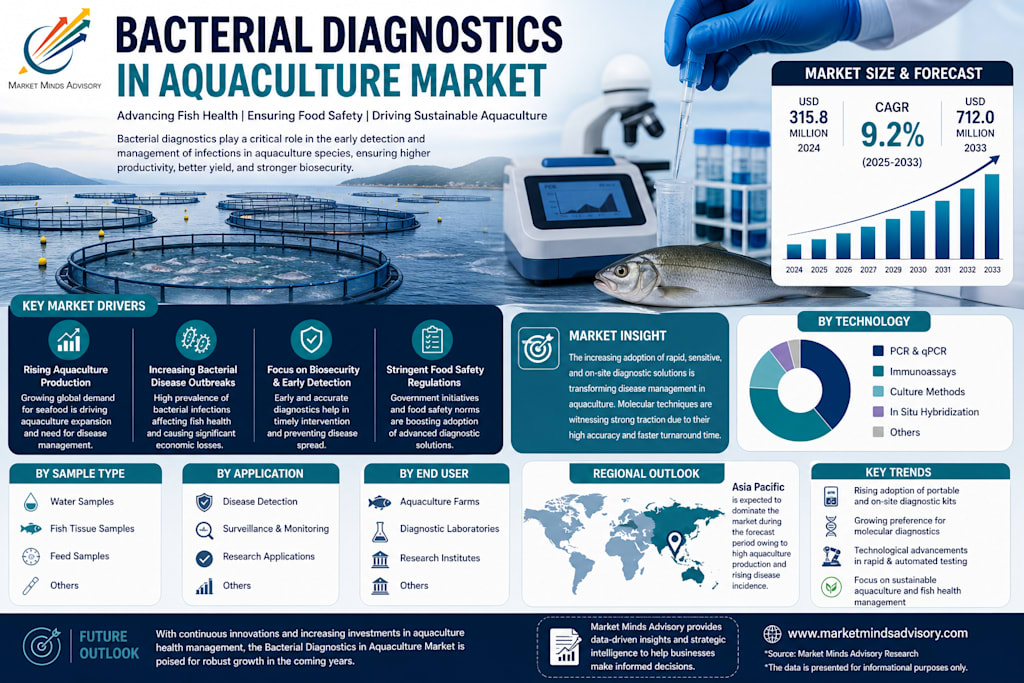
The global aquaculture industry loses an estimated $6 billion annually to bacterial infections, yet most operators still rely on diagnostic methods that take days to deliver results by which time entire stocks can be compromised. As production intensifies and antibiotic resistance tightens regulatory scrutiny, the gap between detection speed and disease spread has become a critical business vulnerability that no serious player can afford to ignore.
Why Diagnostic Precision Suddenly Became Non-Negotiable
The economics of aquaculture have fundamentally shifted. With wild fish stocks depleting and global protein demand surging, farmed seafood now accounts for over half of all fish consumed worldwide. This production intensity has created the perfect storm: higher stocking densities, faster disease transmission, and razor-thin margins that make every mortality event financially consequential.
Traditional culture-based diagnostics, which can take 48 to 72 hours, are increasingly incompatible with modern aquaculture economics. A single day’s delay in identifying Vibrio, Aeromonas, or Streptococcus infections can mean the difference between a contained outbreak and a total harvest loss. Meanwhile, regulatory pressure against prophylactic antibiotic use has eliminated the safety net that many operators previously relied upon. The result is a market where diagnostic capability has evolved from operational nice-to-have to strategic necessity.
What makes this shift particularly urgent is the convergence of three forces: tightening food safety standards in major import markets, growing consumer awareness around antibiotic residues, and the emergence of antibiotic-resistant bacterial strains that render conventional treatment protocols ineffective. Companies that continue operating with outdated diagnostic infrastructure are not just risking individual harvest cycles—they’re jeopardizing market access and brand equity in an increasingly quality-conscious global marketplace.
Structural Shifts Driving the Market
Molecular Diagnostics Are Rewriting Response Timelines
PCR-based and next-generation sequencing technologies have compressed diagnostic windows from days to hours, fundamentally altering disease management protocols. Early adopters are reporting 30-40% reductions in mortality rates simply by catching infections before they reach epidemic thresholds within production systems. The technology’s ability to detect multiple pathogens simultaneously and identify antibiotic resistance markers is transforming diagnostics from a reactive cost center into a proactive risk management tool. However, adoption remains uneven—larger integrated producers are moving quickly while smaller operations struggle with upfront capital requirements and technical expertise gaps.
Regulatory Convergence Is Eliminating Competitive Arbitrage
The days when producers could offset higher disease burdens with aggressive antibiotic programs are ending. The EU’s strict residue limits, combined with similar movements in North America and key Asian markets, have created a regulatory floor that’s rising globally. This isn’t just about compliance—it’s about market access. Producers in regions with lax standards are discovering that their cost advantage evaporates when export markets demand verifiable pathogen-free certification. The diagnostic infrastructure required to meet these standards represents a significant barrier to entry, effectively consolidating market share toward operators with sophisticated monitoring capabilities.
On-Site Testing Is Decentralizing Diagnostic Power
The emergence of portable, farm-deployable diagnostic platforms is disrupting the traditional lab-centric model. Point-of-care devices that deliver results within hours, without requiring samples to leave the production site, are changing the economics of disease surveillance. This shift is particularly significant for remote or offshore operations where sample transport logistics previously created unacceptable delays. The strategic implication extends beyond speed—on-site capability enables continuous monitoring protocols that catch infections at subclinical stages, before behavioral or visual symptoms appear. Companies that build this capability into their standard operating procedures are creating a structural cost advantage that competitors will find difficult to replicate.
Where the Real Opportunity Lies
The highest-value applications aren’t in treating obvious outbreaks—they’re in preventing them entirely. Shrimp aquaculture, which represents the single largest value segment globally, faces particularly acute bacterial challenges due to intensive farming practices and the species’ susceptibility to Vibrio pathogens. Operators who implement routine screening protocols report not just lower mortality, but improved feed conversion ratios and faster growth rates as subclinical infections are eliminated.
Salmon farming presents a different opportunity profile. With longer production cycles and higher per-unit values, the cost-benefit calculation for advanced diagnostics becomes even more compelling. A single bacterial kidney disease outbreak in a salmon cage can destroy 18 months of investment. Diagnostic programs that enable early intervention are effectively insurance policies with measurable ROI.
The emerging opportunity, however, lies in integrated biosecurity platforms that combine diagnostics with environmental monitoring and predictive analytics. Forward-thinking operators are building systems that correlate bacterial loads with water quality parameters, stocking densities, and feeding patterns to predict outbreak probability before pathogens reach detectable levels. This shift from diagnostic to predictive capability represents the next competitive frontier.
The Competitive Landscape Is Fragmenting Along Capability Lines
The market is bifurcating between commodity diagnostic services and high-value integrated solutions. Traditional laboratory networks are facing margin pressure as molecular technologies become more accessible, while specialized providers offering rapid, on-site capabilities command premium pricing. This creates a strategic dilemma for mid-tier players who lack the scale for commodity competition or the technical differentiation for premium positioning.
Vertical integration is emerging as a defensive strategy. Large aquaculture producers are bringing diagnostic capabilities in-house, viewing pathogen monitoring as core intellectual property rather than an outsourced service. This trend threatens independent diagnostic providers while creating opportunities for technology suppliers who can enable this internalization through equipment sales and training programs.
The risk of commoditization is real but not uniform. Basic bacterial identification is becoming table stakes, but capabilities around antibiotic resistance profiling, strain typing, and predictive modeling remain differentiated. Companies that position themselves as disease management partners rather than testing services are maintaining pricing power and customer stickiness.
The Cost of Delayed Action
Organizations that postpone diagnostic infrastructure investment face compounding consequences:
Market access erosion: Major retailers and importers are implementing supplier certification programs that require documented pathogen monitoring. Producers without these systems will find themselves excluded from premium market channels.
Operational blindness: Without real-time pathogen data, operators are managing disease risk through intuition and lagging indicators. This approach guarantees higher mortality rates and more frequent catastrophic losses.
Regulatory vulnerability: As governments tighten antibiotic use restrictions, companies without diagnostic alternatives will face production constraints that competitors with robust monitoring can avoid.
Capital efficiency deterioration: Every undetected subclinical infection reduces feed conversion efficiency and extends time-to-harvest, quietly eroding margins even when outright mortality is avoided.
Talent retention challenges: Skilled aquaculture professionals increasingly expect to work with modern diagnostic tools. Operations running outdated protocols struggle to attract and retain top-tier technical staff.
About the Creator
Sanjay Vane
At Market Minds Advisory, we’re more than just consultants—we’re partners in your journey to growth and success.
Enjoyed the story? Support the Creator.
Subscribe for free to receive all their stories in your feed.
Comments
There are no comments for this story
Be the first to respond and start the conversation.