
Application Security Testing Tools Every Growing Business Should Consider
Learn how to evaluate, compare, and choose application security testing tools that help protect growing businesses from evolving cyber threats.

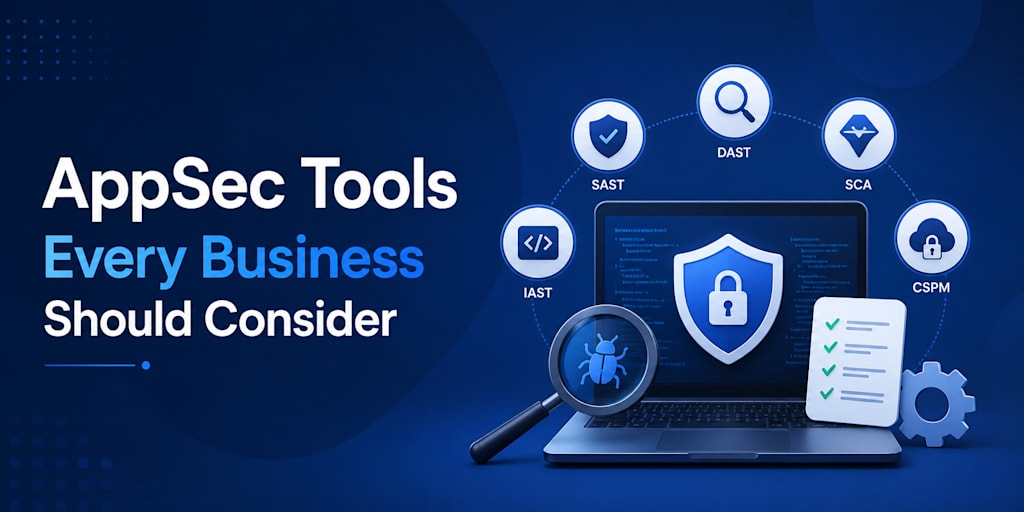
For startup founders and technical leaders, every engineering decision is also a business decision. As your product gains traction and your user base grows, so does your attack surface, and so does the cost of a security failure that damages customer trust right when you need it most.
Scaling Securely in a Digital Threat Era
Growing companies often inherit security debt without realizing it. Early-stage development prioritizes speed, and security testing gets pushed to "later," until later arrives in the form of a breach disclosure, a failed enterprise sales audit, or a compliance gap that blocks a major deal.
The numbers back up the urgency. The global average cost of a data breach dropped to $4.44 million in 2025, while web application breaches now account for 25% of all incidents. That's a category most growing businesses are squarely exposed to.
This is where evaluating application security testing tools becomes a strategic exercise rather than a purely technical one. The right tool doesn't just find vulnerabilities, it protects your roadmap, your customer relationships, and your ability to scale into regulated markets without rebuilding your security posture from scratch.
For lean teams, scalability also means automation. Manual security reviews don't scale with headcount growth, and hiring a large in-house security team isn't realistic for most early-stage companies. Tools that automate detection while keeping false positives low let small teams punch above their weight.
This is especially true during fundraising and enterprise sales cycles, when prospective investors and customers increasingly request evidence of a functioning security program. A startup that can point to continuous, automated testing with documented results is in a far stronger negotiating position than one scrambling to produce ad-hoc evidence under deadline pressure.
Critical Reasons to Automate Vulnerability Detection
Preventing devastating data breaches. A single breach can cost far more than the technical fix, including legal exposure, customer churn, and reputational damage that takes years to repair. Automated, continuous testing catches issues before attackers do, rather than after a costly incident.
For early-stage companies, the financial impact of a breach can be existential rather than just costly. Beyond direct remediation costs, breaches often trigger mandatory disclosure requirements, legal fees, and a wave of customer churn that's difficult to reverse. Continuous automated testing acts as an early warning system, catching the kind of misconfigurations and exposed endpoints that often precede major incidents.
Protecting customer trust and brand reputation. Customers, especially enterprise buyers, increasingly ask about security practices before signing contracts. Demonstrating a mature, automated AppSec program signals operational maturity and can shorten sales cycles significantly.
Trust, once lost, is expensive to rebuild. A breach disclosure doesn't just affect the customers directly impacted, it becomes a reference point that competitors and prospects alike will remember for years. Conversely, being able to confidently answer security questionnaires during procurement, backed by real testing data, often differentiates a growing company from less mature competitors.
Ensuring compliance without slowing production. Frameworks like SOC 2, PCI DSS, and GDPR require evidence of ongoing security testing. Tools with built-in compliance reporting reduce the manual documentation burden that otherwise falls on already-stretched engineering teams.
Compliance frameworks are increasingly table stakes rather than optional extras, especially for B2B SaaS companies selling into mid-market and enterprise accounts. The challenge for growing businesses is meeting these requirements without dedicating engineers full-time to audit prep. Tools that generate compliance-ready reports as a byproduct of normal testing turn a recurring administrative burden into a background process.
Reducing manual risk management overhead. Every hour spent manually triaging vulnerability reports is an hour not spent building product. Tools that validate findings before they reach a human reviewer free up scarce engineering time for growth-focused work.
This is perhaps the most underrated benefit for resource-constrained teams. When a small engineering team has to manually sift through hundreds of scanner alerts to find the handful that matter, that's time directly subtracted from feature development. Tools that pre-validate findings act as a force multiplier, effectively giving a small team the triage capacity of a much larger one.
A few platforms stand out for growing businesses balancing these priorities. ZeroThreat.ai uses AI-powered pentesting to validate real, exploitable vulnerabilities across web apps and APIs, cutting manual triage by over 90% while testing authenticated business workflows, a major advantage for lean security teams. Veracode offers enterprise-grade SAST, DAST, and SCA with compliance-ready reporting that scales as your audit requirements grow.
Rapid7's InsightAppSec brings continuous DAST with compliance reporting for PCI DSS, HIPAA, and GDPR baked in. Mend focuses on supply chain risk, increasingly important as startups rely heavily on open-source dependencies and AI-generated code. Snyk integrates security checks directly into developer workflows, keeping cost low while maintaining coverage.
Invicti's proof-based scanning reduces false positives that would otherwise overwhelm a small team, while SonarQube combines code quality with security checks in a single tool. Checkmarx and Burp Suite round out the picture for businesses anticipating enterprise audits or needing deeper manual testing as they scale, and OWASP ZAP offers a free entry point for teams just starting to formalize their security program.
Conclusion
Security doesn't have to be an enterprise-only investment. For growing businesses, the right tools act as a force multiplier, protecting reputation and compliance standing while letting small teams operate with the confidence of much larger security organizations.
Start with the risks most likely to impact your customers and your next funding round or audit, then build outward from there.
About the Creator
Sam Bishop
Hi there! My name is Sam Bishop and I'm a passionate technologist who loves to express my thoughts through writing. As an individual and tech enthusiast, I'm always eager to share my perspectives on various topics.
Enjoyed the story? Support the Creator.
Subscribe for free to receive all their stories in your feed.
Comments
There are no comments for this story
Be the first to respond and start the conversation.