
Apple’s iPhone Duo Has a Crease. You Just Can’t See It.
Apple didn’t erase the fold. It scattered the light. Here’s how nano-texture works, and why materials science still can’t make foldables truly seamless.
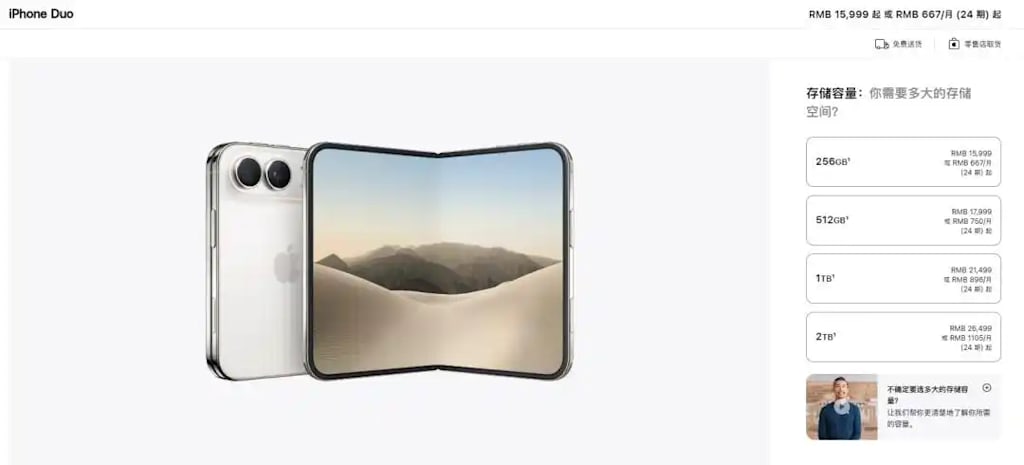
Open the iPhone Duo. Run a finger across the center. You feel a faint ridge. You tilt the screen. For a moment, a thin line catches the light. Then it vanishes.
That vanishing act is the story.
Apple’s first foldable doesn’t have a magic screen. It has a clever optical trick. The crease is still there. The company just made it harder for your eye to find.
Two people, two truths
At launch, reviewers described the same phone in opposite ways.
A Wall Street Journal reporter said you can feel the crease but barely see it. The Verge said you can hardly feel it with a finger. A tech blogger said that when the screen is dark, the crease is obvious.
All three are right.
The physical depth hasn’t changed. What changed is the chance your eye catches it under a given light.
Apple never claimed zero crease. The product page says the display “minimizes the visibility of the crease.” Visibility is an optical problem. Apple optimized the optics.
Why a tiny dent becomes a bright line
A crease is a depression tens of microns deep. Your fingertip notices it. Your eye usually wouldn’t, if the screen were matte.
But glossy screens reflect light like a mirror. A tiny change in angle shifts the reflection. Under the right light, the crease becomes a bright or dark line. The contrast is high because mirror-like reflection concentrates energy in a narrow angle.
Think of a shallow dent in glossy black car paint. The dent is tiny. Under a streetlight, it turns into a glaring spot. The dent didn’t deepen. The reflection made it visible.
What nano-texture does
Apple’s nano-texture glass was first used on high-end monitors. It etches the glass at a nanoscale to scatter light.
On the iPhone Duo, it takes the concentrated reflection from the crease and spreads it out. A laser pointer spot becomes a desk lamp halo. The energy is still there. The hot spot is gone.
Reviewers say the crease is nearly invisible from normal angles. You have to look from the side to catch it.
There is a cost. Matte screens reduce contrast and can make blacks look gray. Apple’s earlier nano-texture iPad Pro drew complaints about slightly softer text. On a phone, most people won’t notice at normal distance. But the trade-off is real.
The hidden engineering below the glass
Nano-texture only handles what you see. Under the surface, Apple is fighting stress.
A foldable screen is a stack: cover glass, optically clear adhesive, touch layer, OLED, support film. When it bends, each layer stretches, compresses, or slides. If they were glued rigidly, the stress would tear them apart.
Apple’s adhesive lets the layers slide like pages in a book. Some shear stress stays in the glue instead of reaching the OLED.
Researchers are testing adhesives with a crosslink-density gradient. One side is soft to absorb compression. The other is firm to hold tension. The goal is to keep the stack together after hundreds of thousands of folds.
The hinge matters too. The iPhone Duo uses more than 100 parts, plus a titanium panel and structural ribs. It supports the center of the screen when open.
Samsung and OPPO use similar ideas. Samsung’s Fold8 has a titanium plate. OPPO’s Find N6 uses 3D-printed hinge parts to improve flatness.
Everyone is close. No one is done.
Samsung calls its approach Flex Titanium. It showed a crease-free OLED panel at CES 2026.
OPPO markets an “imperceptible crease” and passed 600,000 folding tests.
Xiaomi mass-produced double-layer ultra-thin glass with a crease depth under 30 microns.
Apple’s result is in the same league. Some reviewers say it is slightly better than Samsung. User forums say it is about the same. Apple has not leapfrogged the industry. It has joined the top tier with a different trick.
Four reasons the crease may never fully disappear
First, the neutral layer. When a stack bends, one plane is neither stretched nor compressed. Ideally, that plane sits exactly on the OLED. But every layer has a different thickness and stiffness. Keeping the neutral layer in place gets harder as screens get thinner.
Second, ultra-thin glass. It must be thin enough to bend and thick enough to survive drops. Etching the fold area thinner creates a height difference. Filling it back in adds cost and hurts yield.
Third, the adhesive. Soft glue creeps and delaminates. Hard glue passes stress to the OLED. Gradient adhesives are promising, but they are not yet cheap or reliable enough for mass production.
Fourth, fatigue. Every fold adds stress. Materials eventually deform. Microcracks form. Today’s foldables are rated for at least 100,000 folds. Real-world use may still show a crease after two years. The crease is not a bug to fix. It is a physical property to manage.
What this means for you
If you buy an iPhone Duo, you will feel the crease. You may see it at certain angles. You will not see it most of the time.
That is the deal Apple is offering. It is not a seamless screen. It is a screen that hides its seam well.
The foldable industry is moving from mechanical brute force to stress engineering. Better glue, thinner glass, smarter hinges, and optical coatings all matter. No single breakthrough will erase the crease. The winning companies will be the ones that make you forget it.
Apple has taken a solid step. The crease is still there. You just have to look harder.
About the Creator
Jin
Writer of reamstories
https://reamstories.com/jin
Enjoyed the story? Support the Creator.
Subscribe for free to receive all their stories in your feed. You could also become a paid subscriber, letting them know you appreciate their work.
Comments
There are no comments for this story
Be the first to respond and start the conversation.