
Apple’s Hardware Chief Says Your iPhone Screen Protector Makes His Skin Crawl. Here’s What He’s Really Saying.
It’s not a ban. It’s a clash between engineering pride and the very real fear of a $329 repair bill.
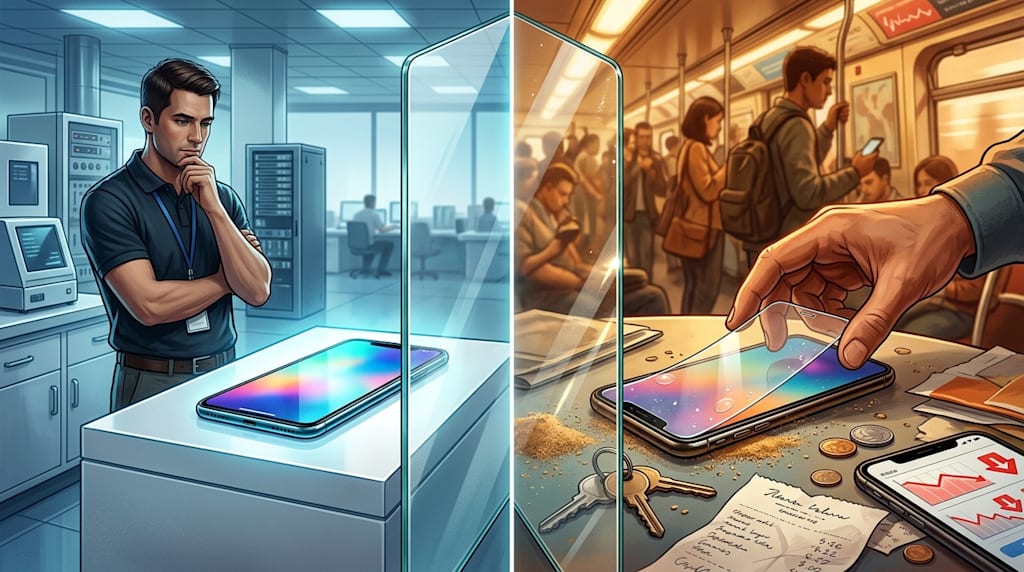
One screen protector, two worlds: Apple’s “skin crawl” and the user’s “what if”
TechRadar interviewed Tom Marieb, Apple’s VP of Product Integrity in Hardware Engineering, about the iPhone Duo’s hinge and Ceramic Shield 2. The interview contained one very shareable line:
“Personally, when I see someone put a screen protector on their iPhone, it makes my skin crawl, because we work so hard to make beautiful front screens.”
The Chinese internet quickly trimmed it to: Apple’s hardware chief gets uncomfortable whenever he sees an iPhone with a screen protector.
Now there was a headline, an emotion, and a camp. Apple fans felt offended. The screen-protector crowd felt lectured. The naked-phone crowd felt someone had finally taken their side. But the second half of the original was cut off. Marieb immediately went on to talk about scratch resistance, wear resistance, coating R&D, and how Ceramic Shield 2 tries to balance the two.
His meaning was not complicated: We put a lot of effort into making the screen good, so when users still put a protector on it, I personally feel uncomfortable. That tells us users worry about scratches and wear, so we need to make the screen more scratch-resistant and more wear-resistant.
This is not company policy. Apple has not banned screen protectors. Apple’s own retail channels sell screen protectors. The personal aesthetic of an engineering executive and the company’s accessory business are two separate ledgers.
The sentence still matters. It is like a probe that touches a long-standing mismatch between manufacturers and users.
The engineer’s screen is a work
In an Apple engineer’s eyes, the glass on the front of an iPhone does much more than cover the display. It handles display, touch, color, brightness, anti-reflection, oleophobic coating, edge curvature, and the body’s sense of unity. The damping, smoothness, and fingerprint residue when a finger slides across it have all been tuned over and over.
The state they pursue is for users to look directly at the screen and touch it directly. No middle layer, no bubbles, no sharp edges, no brightness loss from a privacy film, no graininess from a matte film. Engineers spend years making the screen thinner, brighter, and harder. A user covers it with one sheet, and all that effort is separated.
Marieb’s “skin crawl” is this kind of aesthetic discomfort. It is like a chef watching a diner pour an entire bottle of soy sauce over a dish, or a furniture maker watching a buyer put a plastic tablecloth over a solid wood table. He is not expressing hatred of the user. He is expressing heartache over the work.
The user’s phone is an asset
Users do not live inside an engineering prototype. They face a thing that costs thousands, has to last two or three years, and involves repair and resale value. A phone is not a painting hanging on a wall. It goes into pockets, sits on desks, gets squeezed onto subways, scans codes, pays, takes photos, and hurts when dropped.
Many people know how much an original screen replacement costs. AppleCare+ costs extra. When a second-hand platform inspects a phone, scratches on the screen mean deductions. One sentence from a buyer, “there are scratches,” and the price goes down.
Under this structure, using a screen protector is accounting.
Between tens of dollars and thousands, users choose the former. Between naked-phone feel and a screen-repair bill, users choose insurance.
In the manufacturer’s eyes, the phone is an experiential work. In the user’s eyes, the phone is a risk asset. Both logics hold. They simply have different objectives.
Durability has two definitions
When manufacturers say durable, they usually mean drop-resistant, scratch-resistant, wear-resistant, stable performance over long use, and controllable material aging. That is engineering language. When users say durable, they usually mean no cracked screen, no scratches, no paint loss, no visible aging, and a good price at resale. That is asset language.
In materials science, scratch resistance and wear resistance often conflict. Higher hardness may mean more brittleness. Better wear resistance may mean easier scratching by sharp objects. Marieb admitted they could have made it more scratch-resistant, but wear resistance would have been worse. What they pursued was a balance over long-term use. That is an honest engineering statement.
But the world users face is uncontrolled. A grain of sand in a pocket may be harder than the screen glass. Keys, coins, desks, subway handrails, and drop angles are all variables. Manufacturers test under controlled conditions. Users face a chaotic life.
Manufacturers cannot promise zero scratches. Users understood, so they added a layer that can be scratched.
A screen protector is loss aversion made physical
Many people mock the screen-protector crowd: You bought a phone worth thousands, and you can’t afford a screen? That sentence ignores the asymmetry of risk.
A screen replacement may cost as much as dozens or even a hundred screen protectors. A protector costs tens. A replacement costs thousands. People’s fear of loss is far greater than their joy of gain. A screen protector does more than prevent scratches. Privacy films protect privacy. Matte films improve game feel. Blue-light films provide psychological comfort. Anti-fingerprint films fight oil. Custom films express taste. Screen protectors are a huge accessory market and a way for users to redefine their phones.
The manufacturer says: We designed it. Just use it as it is. The user says: No, I want to change it into something that fits me.
Behind this is a tug-of-war over control. Apple is known for controlling the experience, from chips to system to retail stores, pursuing a closed loop. A screen protector is a small breach in that loop. You cannot control the grain of sand in my pocket. I can patch it with a film.
A screen protector is a vote of no confidence
If screen repairs were cheap enough, repair were convenient enough, and resale value were not affected by scratches, demand for screen protectors would fall. The reality is that screen repairs are still expensive. AppleCare+ costs extra. The right-to-repair movement is still fighting. The second-hand market is still picky about appearance.
Under this structure, screen protectors are the result of users voting with their feet. It is a vote of no confidence: I am not sure your screen can survive my life, so I am buying cheap insurance first.
If manufacturers dislike screen protectors, the most effective move is not to complain. Lower repair costs. Improve repairability. Make durability verifiable. Stop making screen replacement feel like a small car crash. Technology solves part of the problem. Trust solves the other part.
Apple’s dual role
There is another overlooked fact: Apple’s own retail channels sell screen protectors and cases. At the company level, it profits from the accessory business. At the engineering level, it wants users to enjoy the naked-phone experience. The two goals coexist, and the tension is obvious.
Marieb’s personal feeling represents the engineer’s idealism. Apple’s retail strategy represents commercial realism. One says, “Don’t put one on. The original screen is beautiful.” The other says, “Put one on. We have Belkin here.” Different goals inside a large company often coexist this way.
Similar tensions exist in many industries. Camera makers do not want you to use cheap UV filters. Carmakers do not want you to put seat covers on. Furniture makers do not want you to spread tablecloths. Engineers create the ideal state. Users use it in reality.
Why the media loves this topic
Because it spreads too easily. The formula is simple: executive + everyday user behavior + emotional word = opposition.
“Skin crawl” was translated as “uncomfortable,” “goosebumps,” and “disgust.” Then the R&D motive after “because” was omitted. In the original, the engineering explanation about the conflict between scratch resistance and wear resistance, and about Ceramic Shield 2’s balance, is far less shareable than “Apple executive dislikes your screen protector.”
So clickbait completed another harvest of emotion. The Zhihu question bot not including the original text further amplified the split. It does not need facts. It only needs a hook. Zhang Xuefeng’s remarks about journalism studies are verified again in this case: the logic of traffic often grinds journalism into the dirt.
Why users don’t dare to skip one
“Apple’s hardware chief gets uncomfortable when he sees a screen protector” does not reflect a conflict of “Apple vs. users.” The conflict sits between the manufacturer’s engineering idealism and the user’s risk rationality.
Manufacturers live in the future. They believe technology will advance, materials will get better, screens will get harder, and users will eventually no longer need protectors. Users live in the present. They believe in redundancy, in insurance, in the idea that a few dozen dollars can prevent a loss of thousands.
Manufacturers want to educate the market: Trust our design. Users want to protect themselves: Trust my experience.
Manufacturers pursue the best state. Users pursue the least bad outcome.
A screen protector separates the screen from the air. It also separates the manufacturer’s confidence from the user’s anxiety.
As long as the screen-repair quote makes people gasp, screen protectors will keep being stuck onto screens. Bubbles can be smoothed out. Bills cannot.
About the Creator
Jin
Writer of reamstories
https://reamstories.com/jin
Enjoyed the story? Support the Creator.
Subscribe for free to receive all their stories in your feed. You could also become a paid subscriber, letting them know you appreciate their work.
Comments
There are no comments for this story
Be the first to respond and start the conversation.