
Apple's Chinese Chip Dilemma
Three players, two systems, one high-stakes bargaining game — and no clean way out.
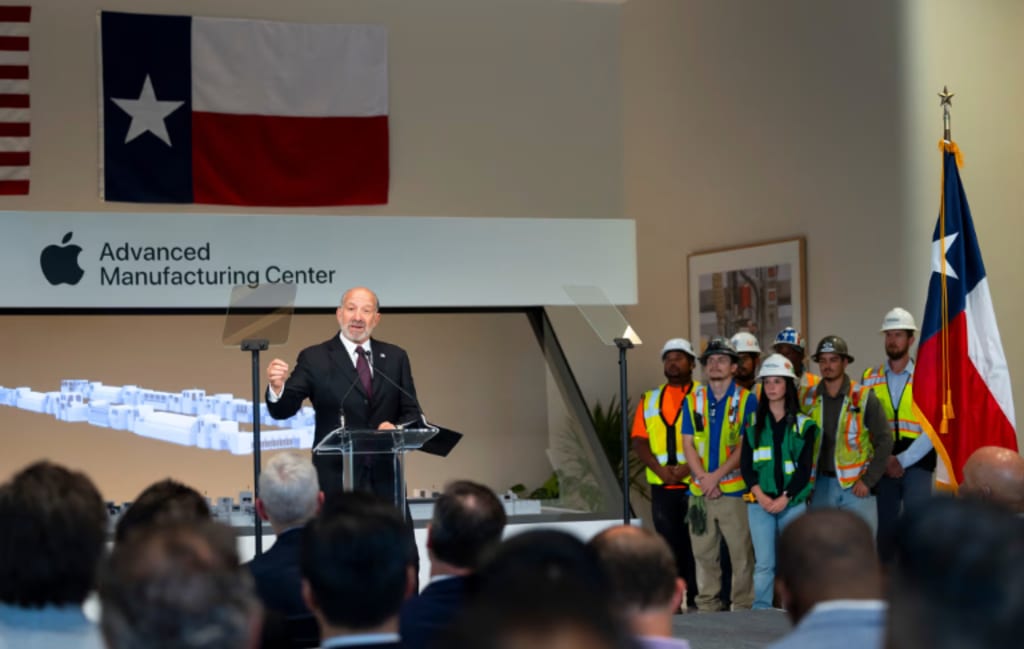
Apple COO Jeff Williams told an audience in Houston that the company must consider "all viable options." That same week, Commerce Secretary Howard Lutnick stood in the same city and said the administration has "told them directly."
Williams was signaling to Samsung and SK Hynix. Lutnick was signaling to Apple. The unspoken names between them are CXMT and YMTC.
AI data centers now consume over 60% of global memory supply, up from just over 20% two years ago. Apple's iPhones and MacBooks wait behind the hyperscalers. Samsung, SK Hynix, and Micron prioritize higher-margin enterprise SSDs and high-bandwidth memory. Consumer electronics get the leftover capacity, rising prices, and extended lead times.
Apple needs a pricing lever. Leaking talks with CXMT does not require a signed contract. Samsung's quotes soften regardless. That is Cook's supply-chain instinct—a decade old. CXMT needs a branding lever. Apple is the most demanding buyer in consumer electronics. Entry into Apple's testing pipeline functions as a quality certificate. Lenovo, Acer, and HP's procurement teams see that validation and offer three extra points at negotiation. Neither side treats this outreach as a genuine partnership. Each takes what it needs.
Lutnick chose Apple's Houston factory as his venue. The location carried its own message. Apple had just promised domestic production expansion at that plant in exchange for tariff relief. Lutnick stood on that floor and stated the administration does not support buying Chinese chips. The subtext: tariff savings cannot end up on YMTC's balance sheet.
He said the memory shortage must be solved through "other means." He did not specify what. Apple's legal team knows that purchasing standard off-the-shelf chips—without custom tooling or shared product specifications—theoretically avoids a Commerce Department license. That is the only narrow door. Lutnick immediately added, "We've told them directly." The translation: the door exists, but tariff reviews and public-relations ambushes wait outside.
Micron does not need to speak. It is an existing Apple supplier, the largest U.S.-based memory chip company, and a core beneficiary of the CHIPS Act and the manufacturing-reshoring push. If CXMT enters Apple's supply chain, Micron loses both orders and its policy leverage as "America's only major memory player." Micron does not pressure Apple directly. It files a "risk assessment of Chinese memory chips to U.S. supply-chain security" with the Commerce Department's dedicated desk. Lutnick handles the rest.
Place this alongside another category of goods. ChaCha sunflower seeds are sanctioned in the U.S. Synear frozen dumplings are also reviewed. Neither product has anything to do with chips or national security. Both share a single trait: their country of origin is China. If sunflower seeds and dumplings face scrutiny, memory chips—physical data carriers—stand no chance of being left alone. This is a political inevitability, not a business judgment.
Before 2016, globalization followed the logic of lowest cost. After 2016, it became a country-of-origin litmus test. Apple sits exactly in the crack between those two rules.
Cooperation will not drop to zero, but it will operate within strict constraints. Apple can place standard CXMT or YMTC products into devices sold in the mainland China market. That path does not violate current U.S. technology export controls, as memory chips are standardized enough to avoid custom-development information exchange. That remains the limit. Apple will not put Chinese memory chips into global iPhone production lines. That is political risk aversion, not a business decision.
CXMT and YMTC already know this. Their new capacity expansions launched this year target the domestic server market, homegrown PC brands, and industrial storage, not Apple. The Apple rumor improves their valuations but does not alter capacity-planning direction.
The final outcome of this round will not appear on Apple's procurement list. It sits in the ballot boxes for the 2026 U.S. midterm elections. It sits on YMTC's domestic etching-equipment timeline. One side races for a political window—to deliver manufacturing-reshoring promises before the elections. The other races for equipment localization rates—to strip core links off the dependency list before the next sanctions round lands. Apple is a coordinate. From this coordinate, it measures not business profit, but the friction coefficient between two systems. That coefficient is rising and will not come down soon.
About the Creator
Jin
Writer of reamstories
https://reamstories.com/jin
Enjoyed the story? Support the Creator.
Subscribe for free to receive all their stories in your feed. You could also become a paid subscriber, letting them know you appreciate their work.
Comments
There are no comments for this story
Be the first to respond and start the conversation.