
Anthropic’s Coding Boom Has a Ceiling. Science Has a Waiting List.
A 22x sales multiple assumes a fast handoff from software to research. Labs, budgets, and purchase orders move on a slower clock.
In Q3 2026, Anthropic reported $16.8 billion in revenue, up 46.1% quarter over quarter, with adjusted profit and positive cash flow for the second consecutive quarter. Those numbers were repeated several times on the earnings call. The same materials contained another number: month-over-month growth had fallen to about 3.4%, against a prior compound monthly rate of roughly 33%. Extrapolate that slope, and year-end annualized revenue lands near $89 billion, below the market’s earlier expectation of more than $100 billion.
This is more than a one-quarter wobble. It raises two questions. Can Coding keep its near-vertical slope? Can STEM Research connect during the valuation digestion period? A 27x to 30x PS multiple prices a handoff with no gap. There is a gap.
1. Coding runs on repetition, and repetition has a ceiling
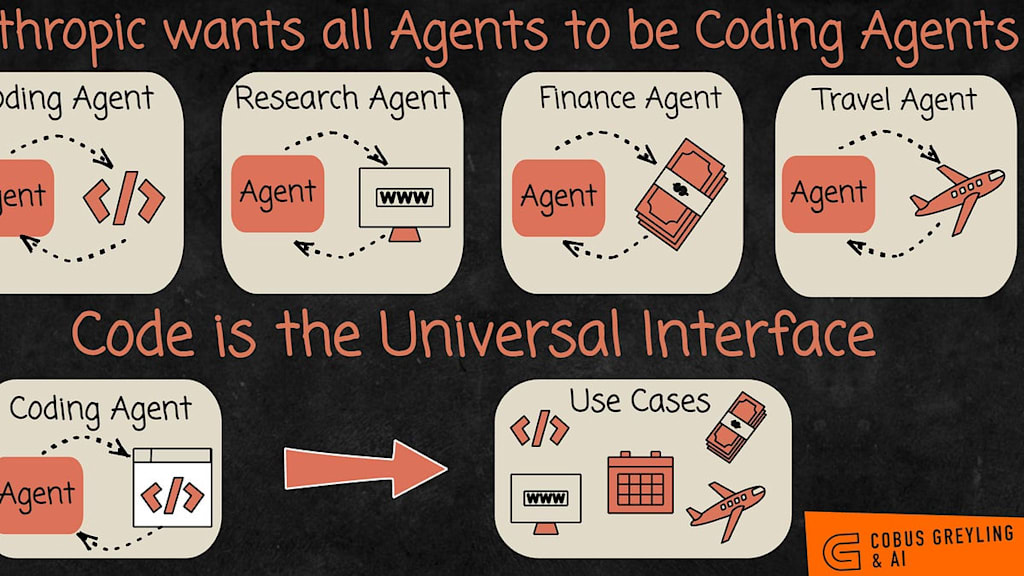
Anthropic’s revenue mix shows the problem. More than 65% of ARR comes from programming scenarios. Between 75% and 85% comes from usage-based API business. Consumer subscriptions are about 5%. Claude Code had annualized revenue near $2.5 billion in early 2026. By mid-year, tracked ARR briefly exceeded $15 billion, then fell back. That path shows how sensitive Coding products are to a penetration sprint. Early adopters tried what they could. Once the product enters mainstream engineering organizations, procurement cycles and budget discipline set the rhythm.
Coding can support token billing because three conditions hold at once: feedback is short, tasks are standardizable, and demand is repetitive. Compilation, testing, and debugging finish in seconds to minutes. Engineering tasks break into patterned subproblems. Software production scale is set by society’s demand for digital systems. Those conditions anchor a total token volume. Software engineering work sets that total. A model that writes harder code does not raise the ceiling.
“95% of code written by AI” will not open the ceiling by itself. It may narrow the growth slope. More than 90% of code at ByteDance’s TRAE team is written by AI, and token use on AI Coding grew more than fivefold in a year. The gap between initial acceptance and final merge is large. Generated code gets replaced in review and refactoring. An engineering manager sees two lines on the API bill: usage rising, merged output lagging. Once marginal review cost eats the efficiency gain, the organization tightens usage.
Hoping to make Coding as hard as solving the Navier-Stokes equations dodges the issue. Research-grade extreme tasks exist. A single task can consume trillions of tokens. They are not daily building. High-frequency business dynamics run on tasks that happen every day, look roughly the same, and need a little intelligence each time. The ceiling on code volume is set by the density of standardized, repeatable tasks in the economy.
Token prices keep falling. Silicon Data’s LLM token spending index fell from $2.05 per million tokens in May 2026 to $0.97 by late August, a drop of more than 50%. JPMorgan predicts another 40% plus decline over 12 months. On OpenRouter, August token usage rose about 47% month over month while dollar spending rose about 7%. Usage and revenue are decoupling. For a company with nearly 80% of revenue from APIs, a stronger model does not offset that trend.
2. STEM can show capability. STEM payment is slower.
Anthropic’s STEM work has concrete outputs. Claude found quantum circuit designs better than published bests, with some gains above an order of magnitude. In FeMoco ground-state energy estimation, it cut the Toffoli gate estimate from about 50 trillion to about 340 million, a reduction of roughly 150,000x. Claude designed and delivered 1,320 novel proteins. Two independent wet labs validated them: 354 bound in the physical world, and 14 of 15 high-difficulty targets were hit, twice the usual industry hit rate.
These results show single-point deep substitution. AI produces order-of-magnitude gains on specific tasks. The economic shape is high unit price, low frequency, and project work. Coding runs on mid-to-low unit price, high frequency, and continuous billing.
The first constraint is physical validation. In chemistry, biology, and materials, the validator is a wet experiment or a large instrument. Feedback takes days, weeks, or months. Claude can plan and analyze between experiments, but payment rhythm is anchored to lab throughput. A lab advances a limited number of batches per week. High-value inference calls are limited in the same way. Liquid-handling robots have schedules. Cryo-EM machines have queues. Animal facilities have ethics cycles. A single call can be large. Call frequency is set by physical time constants.
The second constraint is the budget channel. AI for Science faces a budget question: where the money comes from, which line item pays, and who signs. Tool and subscription models sit inside customer IT budgets. When a pharma company tightens, upsell feels it. Schrödinger’s commercial NDR fell from 113% to 100%. Milestone money sits in the back end. In 2025, upfront payments in AI collaborations were only 3% of total value. One missed milestone can hit a valuation. Research institutions convert slowly. Much research AI use still runs on free tiers or out-of-pocket payment. The institutional channel is immature. A purchase order moves in quarters. API calls move in milliseconds.
The third constraint is market size mismatch. Corporate R&D reached $1.5 trillion in 2025. Global R&D is expected to reach $3.4 trillion in 2026. Most of that money goes to people, lab materials, equipment depreciation, and clinical trials. AI companies can carve out the budget for cognitive labor that models replace or augment. The narrow AI for Science software and solutions market was about $4.5 billion in 2025 and is expected to reach $26.2 billion by 2032. That is orders of magnitude away from $3.4 trillion. The budget lines are different.
3. The second curve is a set of stairs
STEM Research revenue will likely come as a set of stairs: lab automation in life sciences, algorithm optimization for quantum and materials, and agentification of corporate R&D workflows. Each stair moves inside its own validation and procurement cycle. Together they can build a revenue base over the medium term. They cannot fill an equally steep gap in the same window where Coding slows.
XtalPi reported RMB 265 million in 2025 AI for Science smart solutions revenue and RMB 538 million in drug discovery solutions revenue. Drug discovery has the strongest willingness to pay, and AI-driven R&D services can produce revenue and positive operating profit. The curve is stair-stepped and driven by project delivery. Coding is continuous and driven by usage frequency. After one project, the next needs a new start, a new budget, and a new queue.
Anthropic sees this. Coding has boundaries. Research reaches farther. Farther is not faster. Research organization changes on a slower clock. Procurement, funding inertia, and adaptation to usage billing create friction at the payment point. Smarter models do not remove that friction.
4. Valuation prices the lower bound of payment frequency
Anthropic’s May 2026 Series H post-money valuation was $96.5 billion. Against the annualized revenue expectation at the time, PS was about 18x to 19x. At the $2 trillion IPO target, with year-end annualized revenue near $100 billion, PS returns to about 20x. Using the $89 billion Q3 trend line, PS is about 22x to 23x. The multiple is not cheap. Its core assumption is specific: Coding’s base cannot shrink in absolute revenue while growth slows, and the second curve must show traceable acceleration during valuation digestion.
The data support two readings. Optimistic: net dollar retention reaches 500%, enterprise stickiness is strong, API gross margin exceeds 80%, and scale effects are real. Cautious: Meta and Microsoft are moving internal workloads to their own tools, Anthropic pulled back distillation revenue, and falling token prices make “usage rises, revenue does not” a persistent pattern.
Track a narrow indicator: non-Coding ARR in life sciences and enterprise R&D, then quantum and materials, over the next four to six quarters. Can it become independently disclosed, accelerating institutional paid revenue? Three supporting numbers: whether non-Coding revenue gets its own line; the upfront ratio and milestone miss rate in institutional contracts; and monthly token call frequency per lab against experiment throughput. If that increment does not appear in the first few quarters after the IPO, the 20x plus PS still prices Coding inertia. Coding inertia is losing the near-vertical slope it once had.
The “Fields Medal intelligence is worth $2 trillion” sarcasm lands because valuation prices the lower bound set by willingness to pay and payment frequency. Anthropic’s research capability can push that lower bound higher. The speed is constrained by lab throughput, budget cycles, and the 90% back-loaded portion of milestone payments. Those variables do not accelerate because models get smarter. They need organizational change, and organizational change does not run on quarters.
In the next quarterly report, look for the non-Coding revenue line. If it is missing, look at the API bill and the gap between usage and dollar spending.
About the Creator
Jin
Writer of reamstories
https://reamstories.com/jin
Enjoyed the story? Support the Creator.
Subscribe for free to receive all their stories in your feed. You could also become a paid subscriber, letting them know you appreciate their work.
Comments
There are no comments for this story
Be the first to respond and start the conversation.