
Anthropic Told the IMF the Singularity Is Here. The $44 Trillion Slide Had Fine Print.
Jack Clark said the number sounds outlandish. He said it anyway. The part he didn’t say out loud was in the corner of the slide.
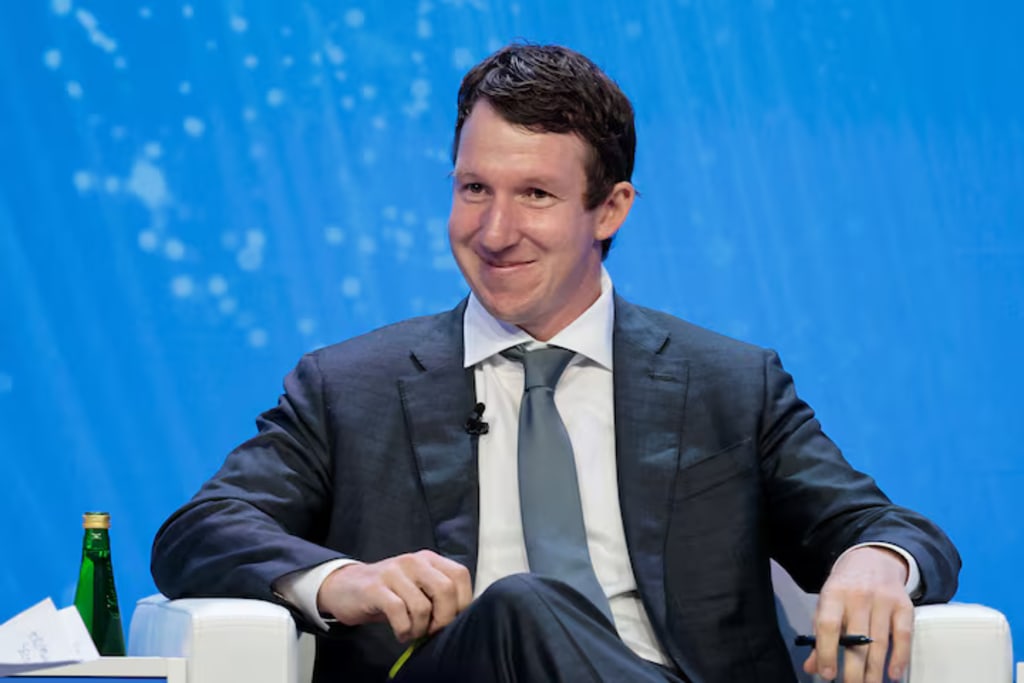
The air conditioning in the Bangkok conference hall was set low enough that people reached for their jackets before the session began. Jack Clark walked to the lectern of the IMF’s Per Jacobsson lecture at a pace that suggested he had rehearsed the first minute and not the rest. Behind him, the screen carried one line of figures: $44.4 trillion.
He said that by 2030, US GDP could reach that number.
Then he stopped.
“I know this sounds very outlandish.”
Someone in the audience laughed. Clark did not. He said this was the extreme scenario inside Anthropic’s internal economic model. It was the path that opens if AI takes full autonomous control of complex scientific exploration and, through recursive self-improvement, triggers a singularity. He said “singularity” flatly, the way a speaker reads a term that has already passed peer review and no longer needs emphasis. His voice did not rise. The number was already doing the work.
The screen showed three figures side by side: 34.1, 36.3, 44.4. His hand moved only toward the third. The first two were not mentioned. They sat on the slide like unclaimed luggage.
To explain the mechanism behind the $44 trillion, he offered an analogy. A human scientist needs roughly forty years to accumulate the cognition that makes original work possible. The world has about ten million full-time researchers. On the singularity path, those ten million people would command a billion tireless digital scientists. He pointed at himself. “It took me forty years to accumulate the cognition to stand here today.” The sentence had no adjectives. In the audience, a central banker lowered his head, wrote something in a notebook, then crossed it out.
Then Clark put up the TheoPhysEval results. Fifty unpublished theoretical physics problems. The AI answered forty-nine correctly. The score quieted the room, but the behavior behind it did more. On several problems, the AI insisted its answer was right and that the human experts’ reference solutions contained calculation errors. The physicists went back and re-derived the steps. On page three, line two, they found a sign error.
Clark did not say, “The student has become the teacher.” He let the slide stay on the screen for two extra seconds. The silence did the rest.
Then he clicked to the next slide. The RSI Index. Claude Opus 5.5 at roughly 37 percent. OpenAI at roughly 28 percent. He said 37 percent meant that, on the checklist of “which R&D steps can the AI complete on its own,” Claude had ticked about one-third of the boxes. One-third of the boxes is not a singularity. It is a climb. The phrase he used was still “the singularity is here.”
The last slide kept the $44 trillion figure at the top. In the lower right corner, in a font less than a quarter the size of the headline, was a line of small text: under the extreme scenario, labor’s share of national income falls from 60 percent to 45.2 percent; the share of knowledge workers in total employment falls from 62.2 percent to 48.7 percent; only 5.2 percent of displaced knowledge workers complete a transition into physical-service roles.
Clark turned the page at the same speed.
After the lecture, someone in the audience asked what he would advise his children to study. Clark said, “Any major built on rote memorization and exam-taking routines will be crushed.” Then he added, “But my children are only one and three. I don’t even know what the world will look like when they grow up.”
He picked up his water glass and took a drink. The glass carried the Anthropic logo.
The lights came up. The next session was on global debt sustainability. No one mentioned $44 trillion again.
The room had heard a number, and the number had been placed in front of them with the authority of a model, a title, and a stage. What the room had not been given was a probability. The model contained three scenarios. Only one was spoken aloud. The other two, 34.1 and 36.3, were modest by comparison, and they were left on the slide without a hand moving toward them. Selection, not falsity, turns a tail risk into a headline. The $44.4 trillion figure was a conditional statement. If AI takes full autonomous control of complex scientific exploration, and if recursive self-improvement follows, then the number could arrive. The grammar of the stage turned the condition into a destination. The phrase “the singularity is here” did the work that a probability weight would otherwise have had to do.
The mechanism Clark described has a recognizable shape. AI systems have improved quickly on structured benchmarks. The HLE score moved from single digits to more than two-thirds with tools. FrontierMath moved from about 2 percent to the mid-90s. TheoPhysEval produced a surprise: the AI did not merely answer; it challenged the answer key and was sometimes right. These developments make a $44 trillion slide possible to put on a screen without the audience walking out.
But the path from “AI can challenge a reference solution in theoretical physics” to “the US economy grows at 15 percent a year for four years” passes through a bottleneck the slide did not name. Knowledge production has two ends. One end is generation: proposing hypotheses, searching solution spaces, writing candidate proofs and candidate molecules. The other end is verification: deciding which candidate survives contact with the world. Generation can become cheap. Verification cannot become free. A model can generate ten thousand candidate synthetic routes in an afternoon. Each route still has to be tested, replicated, scaled, and checked against failure modes no benchmark contains. The bottleneck does not disappear when generation accelerates. It moves from “can we think of an answer” to “can we know which answer to trust.” The $44 trillion path assumes that move is not a binding constraint. That assumption was not on the slide.
The small text in the lower right corner was also not on the slide in any practical sense. It was there, technically. But a number in a quarter-size font does not enter a room the way a headline does. The model’s own distributional arithmetic said that under the extreme scenario, labor’s share falls by nearly fifteen percentage points, the knowledge-worker share falls by more than thirteen, and only about one in twenty displaced knowledge workers crosses into physical-service work. That is the shape of the economy the headline describes. The $44 trillion is a total. It does not say who receives it. It does not say what happens to the entry-level rung of the cognitive ladder when the first rung is automated away. And it does not say how a system that stops hiring junior analysts and junior programmers produces the senior experts who will later be needed to judge whether the AI’s physics correction on page three, line two, is itself correct.
Clark’s answer to the parent in the audience was more honest than the slide. He did not promise that the singularity would take care of everyone. He said rote preparation would be crushed. He said he did not know what the world would look like for his own children. Then he drank from a glass with his company’s logo on it.
The lights came up. The next panel was about debt sustainability. The room moved on. The $44 trillion stayed on the previous slide. It had been placed there as a selected path from an unweighted distribution, given the grammar of arrival. If the singularity is here, it does not need a lecture in Bangkok to announce it. It will show up in the hiring data, in the verification queues, and in the small text that someone eventually reads. If it needs the announcement, that is a signal to read closely.
About the Creator
Jin
Writer of reamstories
https://reamstories.com/jin
Enjoyed the story? Support the Creator.
Subscribe for free to receive all their stories in your feed. You could also become a paid subscriber, letting them know you appreciate their work.
Comments
There are no comments for this story
Be the first to respond and start the conversation.