
Anthropic Said It Was a Technical Problem. Then Shopify’s CEO Posted One Tweet.
A year of GitHub requests did nothing. A threat to leave did.
One Year and One Month
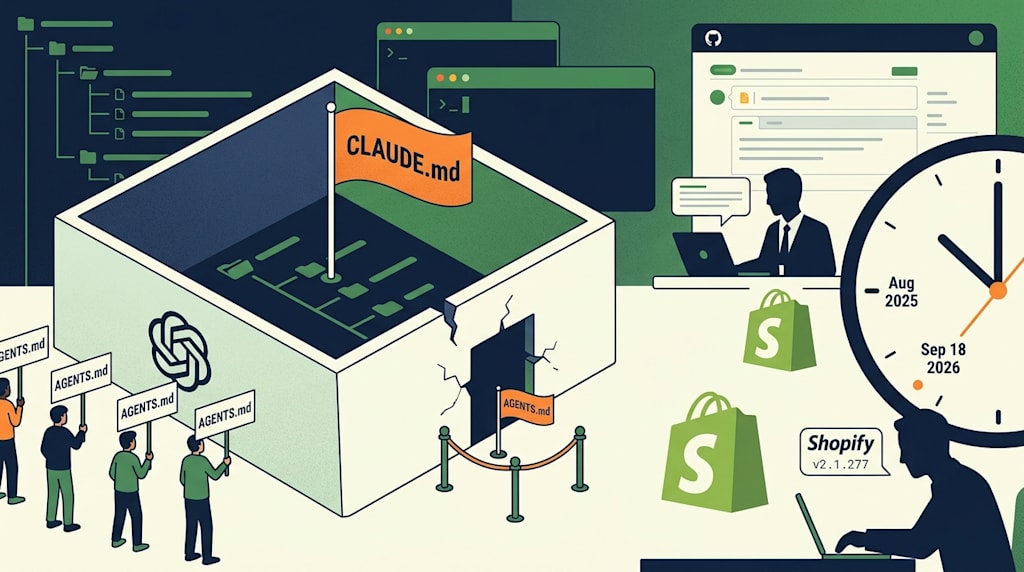
In August 2025, someone opened an issue in the Claude Code GitHub repository: Can it support AGENTS.md?
At the time, AGENTS.md was spreading through open-source projects. More than 60,000 had adopted it as a common format for project-level instructions. Codex, Cursor, Copilot, and Claude Code could all read the same file, so developers would not have to maintain separate rules for each tool.
Anthropic did not reply.
In August 2026, a year later, the question returned. Shopify CEO Tobi Lütke posted on X that Shopify was considering banning Claude Code company-wide.
His reason was specific. Teams were using Codex, Cursor, and Claude Code together. AGENTS.md and CLAUDE.md ran in parallel. Different agents developed different understandings of the same project. He called the extra maintenance cost a “complexity tax.”
For a product with more than $2.5 billion in annualized revenue, losing an enterprise customer like Shopify is not a small matter.
On September 18, 2026, Claude Code added AGENTS.md read support in version v2.1.277.
One year and one month had passed since the community first asked. Less than one month had passed since Tobi’s post.
“A Technical Problem”
Before the support went live, Thariq from the Claude Code team posted an explanation. Different models have specific preferences for how the system prompt is organized, he said. Claude’s performance depends on its dedicated context structure. Sticking with CLAUDE.md was meant to optimize performance.
In translation: We do not want to support it, but we are calling it a technical difficulty.
Developers did not buy this. To implement AGENTS.md compatibility, the simplest solution is one line in CLAUDE.md:
text
@AGENTS.mdThat imports the common rules. Finer priority merging is config parsing. For a company that builds its own large models and launched MCP and Agent Skills, this is not a technical challenge.
Anthropic promotes open standards elsewhere. MCP is its flagship effort. Agent Skills is another. It is at the forefront of functional protocols. At the project-level configuration layer, the one developers touch every day, it stayed closed.
When Thariq said “technical problem,” developers heard the subtext: We can do it. We do not want to.
The Turning Point
What changed Anthropic’s mind was not tens of thousands of likes. It was not repeated complaints from developers.
It was Tobi Lütke’s post.
Shopify is not an ordinary user. Claude Code is an enterprise product. Much of Anthropic’s commercial ambition rests on B2B customers. Losing a flagship customer like Shopify means lost revenue. It also means reputational damage. If Shopify would abandon Claude Code over compatibility, other enterprises would notice.
Less than a month after Tobi’s post, support went live.
Community voices can be loud. A major customer’s revenue threat changes decisions.
Supported, But Not Fully
Anthropic did not adopt open standards. It made a defensive compromise.
Claude Code’s support for AGENTS.md comes with restrictions:
Fallback only. Only when a project has no CLAUDE.md will it read AGENTS.md. If CLAUDE.md exists, AGENTS.md is ignored.
Manual enablement. Users must change settings in /config. It is not enabled by default.
Channel restrictions. Users who access Claude Code through Bedrock, Vertex, and Foundry still cannot use this feature.
Anthropic’s logic is clear. It can support the standard while keeping CLAUDE.md first. As long as a project has CLAUDE.md, the brand imprint remains and control over the project-level entry point is not weakened.
CLAUDE.md Is Not a File
Many people see CLAUDE.md as an ordinary configuration file. On Anthropic’s commercial chessboard, it is more.
CLAUDE.md is a project-level entry point. It sits in the root directory of code repositories, in every developer’s editor, and in the context of every commit. It is a flag in the most visible part of a project. It says: Claude Code is used here.
The exposure is subtle. It is also effective. Teams get used to seeing CLAUDE.md. New members learn on day one that the project uses Claude. Enterprise procurement decision-makers find that many projects already use Claude Code configuration. Anthropic has entered enterprise technology selection at the project level.
These files may also become training data. A large number of CLAUDE.md files shows a growing Claude user base. It also gives the model data on how to collaborate with Claude.
CLAUDE.md is not just a file. It is a brand imprint and a moat around Anthropic’s product. It anchors the commercial strategy.
The Standards War
Anthropic appears open about MCP and Agent Skills. It promotes them as industry standards. On AGENTS.md, it chose closure.
Is this a double standard? From a commercial perspective, no.
MCP is led by Anthropic. Opening it expands Anthropic’s influence and makes the industry revolve around its protocol. AGENTS.md is community-driven. Anthropic does not lead it. Fully adopting AGENTS.md would mean giving up CLAUDE.md’s priority and control over the project-level entry point.
Anthropic’s choice fits commercial logic: standards it leads are open; standards led by others get caution.
The issue is control over the project-level protocol, not technical feasibility. Whoever controls that protocol controls the entry point to AI coding tools. Anthropic does not want to hand that over.
Three Things for Developers
First, do not rely on a single agent’s proprietary configuration. If your project uses multiple AI coding tools, put common rules in AGENTS.md. Then import or reference them through each tool’s own configuration file. Claude Code currently reads AGENTS.md only when there is no CLAUDE.md. You can use symlinks or import statements to keep the two consistent.
Second, configuration fragmentation is a cost. When multiple agents coexist, project root directories get messy. Teams need configuration conventions: what rules go where, who maintains them, and how to avoid conflicts between agents.
Third, do not believe public-relations language about “technical problems.” At commercial companies, technical decisions are never purely technical. When a company says “it is technically impossible,” it often means “we do not want to do it commercially.” A greater commercial interest or a greater commercial threat can change their minds.
The Adult World
Claude Code’s shift on AGENTS.md, from “resolutely not using it” to “limited support,” shows how commercial decisions work.
The community appealed for a year. One post from Shopify’s CEO did more. A pile of technical excuses did less than a revenue threat. The eventual support still came with restrictions. Anthropic still guards its moat.
This is not about right or wrong. It is about business. Anthropic does not fail to understand technology; it understands business too well. It knows CLAUDE.md serves as a brand imprint and a project-level entry point. It also acts as a lever in enterprise procurement.
It also knows that as long as it can delay, it should delay; as long as it can restrict, it should restrict.
The business world is cruel. When major customers vote with their feet, and when the “complexity tax” gets high enough, even a solid moat opens a door.
Commercial revenue influences Claude Code’s decisions. Developers can see that clearly. They can keep using open standards and fight for more choices.
A configuration file is never just a configuration file. It is a flag and an entry point. It is also where the standards war begins.
About the Creator
Jin
Writer of reamstories
https://reamstories.com/jin
Enjoyed the story? Support the Creator.
Subscribe for free to receive all their stories in your feed. You could also become a paid subscriber, letting them know you appreciate their work.
Comments
There are no comments for this story
Be the first to respond and start the conversation.