
Anthropic Just Signed an $11.6 Billion Deal. Akamai’s Own Filing Tells a Messier Story
The headline number is a ceiling, not a check. Between CPU capacity, stock warrants, and $5.5 billion in upfront spending, the question is what remains after the invoices clear.
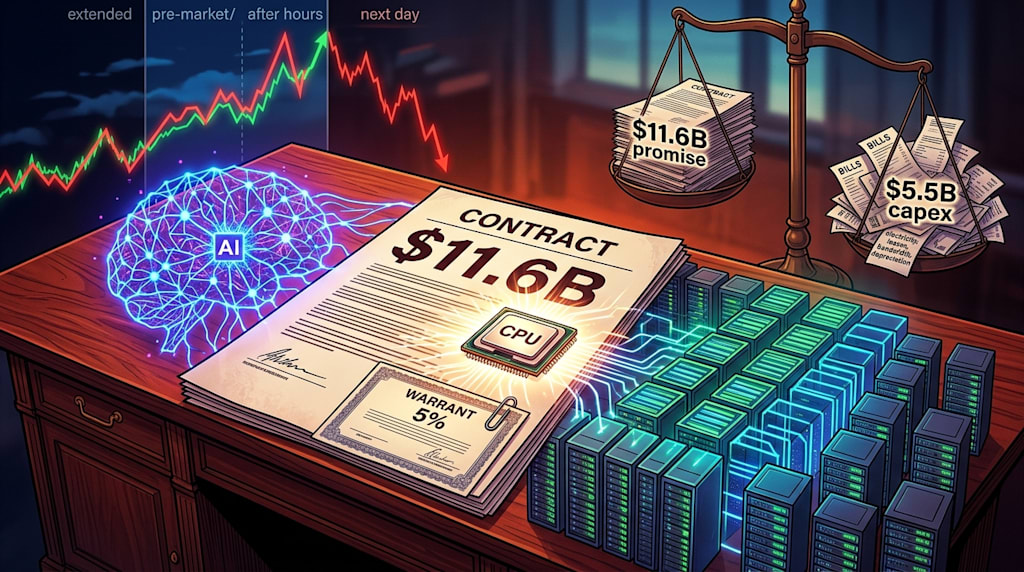
After the closing bell on September 24, 2026, Akamai Technologies disclosed that Anthropic had signed a seven-year cloud services agreement with a base commitment of $11.6 billion. The deal included an option for another $9 billion, bringing the potential total to roughly $20 billion. Akamai’s stock rose more than 17% in after-hours trading. The next day, it opened higher, then slid. By the close, it was down nearly 11% from its intraday high.
The headline number is not a guaranteed check. Akamai’s 8-K filing states that Anthropic’s payments depend on Akamai meeting specific delivery and service availability requirements. The agreement includes customary termination clauses. If Anthropic commits an uncured default, Akamai can walk away. The $11.6 billion is a ceiling, not a floor.
Akamai’s investor presentation lays out the cash curve. In the fourth quarter of 2026, Akamai expects to spend about $1.7 billion in capital expenditures with no related revenue. In 2027, another $3.1 billion. Revenue begins late in the second quarter of 2027, reaching $150 million to $300 million for the year. By the end of 2028, annualized run-rate revenue is expected to approach $1.7 billion. More than 87% of the capital spending is scheduled before the end of 2027. By then, cumulative recognized revenue will be a small fraction of the headline commitment.
Subtract the estimated $5.5 billion in capital expenditures from the $11.6 billion contract value, and roughly $6.1 billion remains. That pool must absorb electricity, data center leases, network bandwidth, support staff, equipment maintenance, depreciation, and financing costs. The margin is thinner than the headline suggests.
The warrant is the unusual part. Akamai issued Anthropic warrants to buy B-series preferred stock at $111.33 per share, convertible into about 7.7 million common shares, up to 5% of Akamai’s outstanding common stock. The vesting is tiered. About 2% is tied to the $11.6 billion base commitment. The remaining 3% unlocks if the agreement expands by $9 billion. Each additional $3 billion in purchases vests about 1% of the shares.
Akamai CEO Tom Leighton said in an interview that this was the first time the company had agreed to such a warrant arrangement in a cloud deal. He called it “a serious step.” The structure sets a price on commitment itself. Demand commitment has become a balance-sheet asset. This contract publicly sets the exchange rate: roughly 1% of the supplier’s equity for every $3 billion in purchase commitments. Anthropic accepted equity instead of a discount. Akamai gave up equity instead of cutting price. Both sides are betting on the other’s future.
The deal is almost entirely CPU. Akamai will provide CPU compute to support Anthropic’s growing CPU workloads. Leighton confirmed this on the investor call. Analysts expect Anthropic to use the capacity for AI inference and business workloads, not for training its Claude models. The choice points to a shift in AI compute demand. As AI moves from chatbots to agents that execute tasks, the compute mix changes. Agents spend up to 90% of their execution time on non-GPU work, according to Akamai. CPU roles are expanding from data movers to task orchestrators. Twelve days before the deal, Anthropic CEO Dario Amodei published a long essay calling for the industry to slow down frontier model iteration. The deal points to a different kind of acceleration: inference capacity. Training is not the target here. Akamai’s edge network, thousands of distributed nodes, fits fragmented, throughput-sensitive CPU workloads. The marginal cost is lower than centralized hyperscale architecture. Akamai is moving from a digital pipe to a compute infrastructure provider.
The deal also raises questions about circular AI transactions. Cloud providers, hardware companies, and AI startups buy from each other and invest in each other. The warrant arrangement blurs the line between buyer and seller. Leighton’s response is candid: the warrant “helps tie the two companies closely together.” That is true. It also means a pure commercial contract is no longer enough to lock in a key customer. Suppliers need equity to deepen the bond. Customers need commitments to secure priority access to long-term capacity. That exchange makes the signal of AI demand harder to read. Bloomberg noted that such structures make it harder for investors to assess the growth rate of the AI industry. When supplier revenue growth partly comes from equity swaps with customers, the contract numbers need a discount.
For Akamai, the deal changes the business model. The company built its business on CDN and cybersecurity, asset-light, software-orchestrated, stable gross margins. After buying Linode for $900 million in 2022, it moved toward cloud. This contract pushes it further. Akamai will spend about $5.5 billion in capital expenditures, more than six times its full-year 2025 capital spending. The money is not going directly to chip vendors. It is used to lock in high-bandwidth memory and other supply chain components and to deploy dedicated distributed compute clusters. Akamai is becoming an IDC-like operator with heavy upfront capital costs.
The balance sheet now implicitly guarantees Anthropic’s compute demand. If Anthropic’s CPU workload growth falls short, or if large language model architecture shifts abruptly, Akamai faces depreciation pressure and deteriorating free cash flow. William Blair analysts predict “significantly negative free cash flow” in 2026 and 2027. But the bet has strategic logic. $5.5 billion in capital expenditure buys seven years of take-or-pay revenue. Capital efficiency is about one-third of industry norms, but revenue visibility is high. For a company moving from CDN to cloud, a seven-year contract with a leading AI company is more than short-term financial return. It is a bet that its cloud business can carry the company.
The $11.6 billion is a promise. The $5.5 billion is a bill. The $6.1 billion in between must cover electricity, leases, bandwidth, salaries, maintenance, depreciation, and financing. The deal will be judged in the cash that remains after the infrastructure is built and the invoices are paid. The after-hours pop and the headline number will not decide it.
About the Creator
Jin
Writer of reamstories
https://reamstories.com/jin
Enjoyed the story? Support the Creator.
Subscribe for free to receive all their stories in your feed. You could also become a paid subscriber, letting them know you appreciate their work.
Comments
There are no comments for this story
Be the first to respond and start the conversation.