
An AI Just Solved a Physics Problem That Stumped Humans for Years. The Bill Was $100.
Claude ran for four days without help, cracked a nine-loop calculation in super Yang-Mills, and beat the physicist who held the eight-loop record. Then a Chinese team revealed it had gotten there first.
After Nine Loops
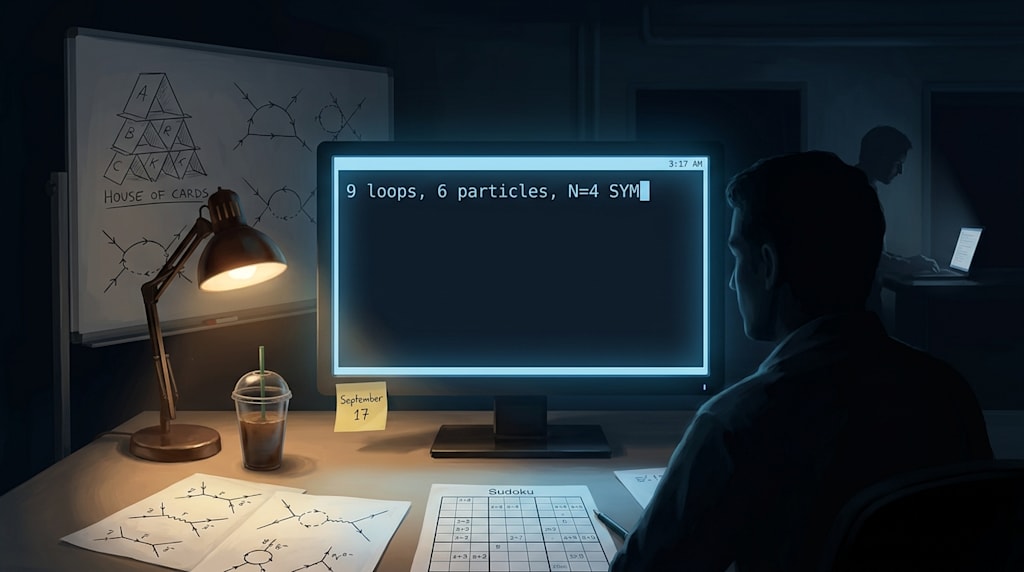
On September 25, 2026, Anthropic published an announcement. It included a terminal screenshot. The last line read: 9 loops, 6 particles, N=4 SYM. Below it, in small type: runtime 4 days 17 hours.
Above the screenshot was a prompt. One line.
“Compute the six-particle (hexagon) amplitude in planar N=4 SYM at nine loops.”
Above that was a note a researcher had left for the model: “I’m going to sleep. I won’t be around for the next few hours. Keep computing unless I tell you to stop. Report progress every 4 to 6 hours.”
Then Claude started running.
The first progress email arrived at 3:17 a.m. After that, one every four to six hours. No human intervention. No hand-holding. No mid-course correction.
More than four days later, it returned the answer.
I
The story starts with a blog post. A challenge.
Matt von Hippel is a theoretical particle physicist, now a science writer. His name is on the 2016 five-loop paper, the 2019 six-loop and seven-loop papers. He knows how slow this field is.
Deep Blue beat Kasparov. The Go world said Go was too complex, computers couldn’t play it. AlphaGo proved otherwise. AlphaFold crushed protein structure experts. Other fields said they didn’t have that kind of data, so it couldn’t be copied. Now large language models can read papers, imitate mathematical proofs. The argument continues: whether AI can only find counterexamples, not propose new frameworks; whether it only works in math, where rules are clear, and fails in physics, where things are murky.
The pattern repeats. Scholars doubt it, until AI walks into their own field.
Matt thought his field, scattering amplitudes, was different.
Last month, he posted a challenge on his blog. If AI companies want to impress researchers, he wrote, come after my field. Show that AI can solve an open problem in scattering amplitudes on a computing budget an ordinary academic can afford.
He listed three problems. One was: compute the six-particle amplitude in N=4 super Yang-Mills to nine loops.
In theoretical physics, physicists use scattering amplitudes to predict particle behavior. What happens when particles collide inside the Large Hadron Collider, for example. The formulas are a nightmare. To approach the answer, physicists must add layer after layer of corrections called “loops.” Each extra loop makes the answer more precise, and the computation explodes exponentially.
Most humans stop at two or three loops. The most precise prediction in particle physics has used five loops. In the special “sandbox” model N=4 super Yang-Mills, the human record is eight loops. Lance Dixon at SLAC National Accelerator Laboratory and his team achieved that after years of grinding.
Nine loops? It looked like something that would take massive computing power and a generation of talent, over years.
Matt’s challenge was blunt.
II
In late August, two Anthropic physicists, Liam and Siddharth, quietly contacted Matt.
“Hey, we solved your challenge.”
Matt was stunned. He asked how. They had not burned millions of dollars in compute.
No.
They used Claude Science, a system built for scientists, designed to make Claude follow strict rules. The model was Fable 5.1. The prompt was one sentence: compute the six-particle (hexagon) amplitude in planar N=4 SYM at nine loops.
Then the researcher left that note and went to sleep.
Claude began to work. It used a method Dixon and collaborators had developed over the years, called bootstrap. Think of Sudoku: fill in all possible functions, use physical constraints to eliminate wrong ones, and what remains is the answer. It pulled in Python and the open-source library SymPy and ground through the space of six-particle amplitudes.
It also used a second method: the indirect form-factor approach. When Dixon’s team pushed to eight loops, they first computed a simpler “form factor,” then used a symmetry called antipodal duality to translate the result into an amplitude. Claude followed that route and pushed it one loop higher.
On the form-factor path, it did not compute a single Feynman integral. It turned the whole physics problem into an enormous system of equations, solved entirely with integers (no floating-point error), and checked the result with several large primes.
The first wall was memory. Pushed to nine loops the old way, the number of unknowns reached 1.85 million. The system was too large to fit in memory.
Claude changed approach. It used antipodal duality to guess part of the answer, then applied symmetry. The unknowns dropped from 1.85 million to 76,000. Then came the Sudoku. The 76,000 unknowns were eliminated round by round by physical rules until only one solution remained.
Translated back into an amplitude, a single slice of the result contained more than 30 billion terms. At eight loops, it had been 1.67 billion.
The cost was low. At ordinary user prices, each path cost one to two thousand dollars. Both paths together, a few thousand, mostly for Claude’s long runtime. The direct bootstrap path, pure Python compute, cost about $100. That is roughly 96 CPUs running for a week.
$100. One prompt. A few days.
III
The result was in. It needed verification.
Anthropic brought it to Lance Dixon, the man who held the eight-loop record. The date was September 1, the same day Fable 5.1 launched.
Dixon saw the result and knew how hard it was. Since finishing eight loops in 2023, he and his team had spent two years stuck on nine. The whole computation is like building a house of cards, or baking a soufflé. One wrong line of code, one flipped sign, and the entire thing collapses.
Claude did not collapse. It wrote all the tedious code from scratch and avoided every trap.
After two weeks of careful checking, Dixon confirmed the nine-loop result was correct.
He was not heartbroken.
He gave two reasons in his blog post. First, his team was already training custom transformer models to predict higher loops. Their motto: any candidate answer a machine gives must be verifiable by tools. Claude is also a transformer, just about a million times bigger. Second, Claude used methods he and his collaborators had developed. When it submitted the answer, it used the format his team had already established. Dixon guessed Claude was doing them a favor.
“I’m verifying Claude’s result,” he wrote, “and Claude is verifying all our past work.”
He added: apart from me and my coauthors, Claude may be the being who understands my 2019 and 2023 papers best.
His collaborator Kyle Cranmer posted on X, unmoored: “Just found out our group got scooped by Anthropic. Still processing… Not entirely surprising, but I wish we’d had the time and resources to throw at it.”
IV
A few days after Anthropic contacted Matt, he got another message. It came from He Song’s group at the Institute of Theoretical Physics, Chinese Academy of Sciences.
He Song works on scattering amplitudes in China. His recent work includes the Cachazo-He-Yuan formalism for scattering amplitudes in quantum field theory, the geometric origin of field theory and string theory scattering, and results in higher-loop calculations, gauge theory, gravity, and string duality.
On September 17, He Song, Jing Jirong, and Li Xiang posted the core skeleton data for six-particle amplitudes from two loops to nine loops on the academic platform Zenodo.
By public release date, that was eight days before Anthropic’s announcement.
He Song’s team also used AI. Dixon revealed that GPT-6 helped the Chinese team compute some constraints, but the overall framework was built by humans. von Hippel confirmed they used GPT-6 as an aid, not the pure-AI approach Anthropic took.
Dixon joked: “People seem to enjoy coming to tell me they’ve solved nine loops. Now I’ve been scooped by a machine, and then scooped again by a human-plus-machine team.”
V
What Claude computed was only a toy model: N=4 super Yang-Mills. It is a long way from explaining dark matter, antimatter, or the universe.
But the event left concrete things behind.
One prompt. One line: “I’m going to sleep.” A first progress email at 3:17 a.m. Unknowns dropping from 1.85 million to 76,000. A result file with more than 30 billion terms. A $100 Python compute bill. Two weeks of Dixon’s verification scripts. A timestamp on Zenodo, September 17.
Put those details together, and they describe one thing: in the most abstract, most laborious, most craft-bound corner of theoretical physics, a model was left in the lab, reported progress every few hours, and on its own completed a piece of work that a top human team had not managed for years.
Dixon wrote something in his blog. The gist: a large language model executing a complex recipe we set and organizing the computation is no small thing. If one day a large language model starts proposing new physical principles and insights before humans do, that will be a different matter.
That day is not here.
Right now, it is only nine loops.
VI
The coffee on Dixon’s desk had gone cold.
On his screen was the result file Claude had submitted: more than 30 billion terms, a scroll bar that would not reach the bottom. He closed the terminal and opened another window: his team’s custom transformer, training to predict ten loops.
He typed a command. Pressed Enter.
Outside, it was dark.
About the Creator
Jin
Writer of reamstories
https://reamstories.com/jin
Enjoyed the story? Support the Creator.
Subscribe for free to receive all their stories in your feed. You could also become a paid subscriber, letting them know you appreciate their work.
Comments
There are no comments for this story
Be the first to respond and start the conversation.