
America's Hardware Stores Are Reinventing Themselves for the DIY and Smart Home Era
How Home Improvement Trends, Digital Transformation, and Consumer Demand Are Driving the United States Hardware Stores Market Toward $83 Billion by 2033

For decades, hardware stores have been a cornerstone of American communities. Whether helping homeowners tackle weekend projects, supporting professional contractors on large-scale construction jobs, or providing emergency repair supplies during unexpected situations, these stores remain essential to daily life across the United States.
Today, however, the hardware retail industry is undergoing one of its most significant transformations. The rise of e-commerce, growing interest in smart homes, increasing renovation activity, and a thriving do-it-yourself (DIY) culture are reshaping how Americans purchase tools, building materials, and home improvement products.
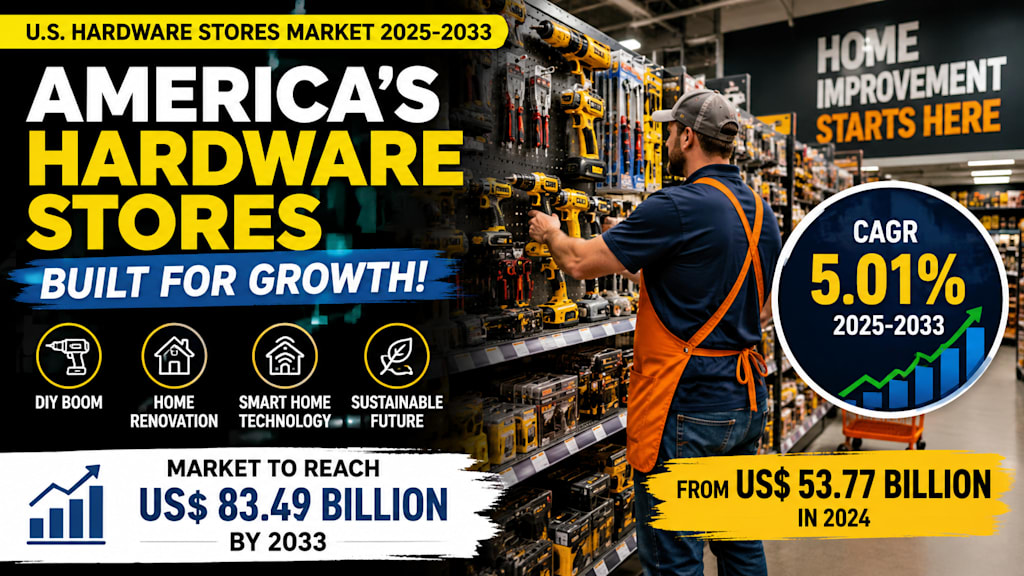
According to Renub Research, the United States Hardware Stores Market is projected to grow from US$ 53.77 Billion in 2024 to US$ 83.49 Billion by 2033, expanding at a CAGR of 5.01% between 2025 and 2033. This steady growth reflects the industry's ability to adapt to changing consumer preferences while maintaining its vital role in the nation's housing and construction ecosystem.
Download Free Sample Report:
The Enduring Importance of Hardware Stores
Hardware stores occupy a unique position within the American retail landscape. Unlike many retail segments that have struggled against online competition, hardware retailers continue to offer value through expertise, product availability, and customer service.
Consumers often visit hardware stores not only to purchase products but also to seek advice. Whether it's selecting the right paint, understanding electrical requirements, or choosing tools for a renovation project, knowledgeable staff members remain one of the industry's strongest competitive advantages.
Major national chains such as Home Depot, Lowe's, Ace Hardware, and Menards continue to expand their offerings while local and independent hardware stores differentiate themselves through personalized service and strong community relationships.
The combination of convenience, expertise, and product variety ensures hardware stores remain highly relevant in an increasingly digital world.
The DIY Revolution Continues to Fuel Growth
One of the most powerful drivers of hardware store demand is the growing DIY movement.
Over the past decade, millions of Americans have embraced home improvement projects as a way to save money, personalize living spaces, and develop practical skills. Social media platforms such as YouTube, TikTok, Pinterest, and Instagram have made DIY education more accessible than ever.
Homeowners can now learn everything from installing shelves and painting rooms to building outdoor furniture and upgrading landscaping through online tutorials.
This cultural shift has generated strong demand for:
Power tools
Hand tools
Paint products
Fasteners
Wood materials
Plumbing supplies
Electrical components
Garden equipment
Retailers have responded by offering educational workshops, project guides, and bundled product solutions designed specifically for beginner DIY enthusiasts.
As younger generations enter homeownership and continue embracing hands-on projects, the DIY trend is expected to remain a major growth catalyst throughout the forecast period.
Home Renovation Spending Remains Strong
The American housing market has experienced significant changes over the last several years. While new home construction remains important, many homeowners are choosing to invest in renovating existing properties.
Kitchen upgrades, bathroom remodeling, flooring replacement, outdoor living spaces, and energy-efficiency improvements have become increasingly common.
Several factors contribute to this trend:
Rising home values
Aging housing infrastructure
Remote work arrangements
Desire for personalized living spaces
Focus on energy efficiency
During and after the pandemic, homeowners spent more time indoors and became increasingly aware of opportunities to improve comfort and functionality.
As a result, hardware stores have experienced consistent demand for building materials, paints, fixtures, lighting systems, and renovation-related supplies.
Retailers that provide project-planning assistance and financing options are particularly well-positioned to benefit from this ongoing remodeling boom.
Smart Homes Are Creating New Revenue Opportunities
Technology is becoming an increasingly important part of the hardware retail business.
Consumers are investing heavily in connected home devices, including:
Smart thermostats
Video doorbells
Security cameras
Smart locks
Automated lighting systems
Energy monitoring solutions
The popularity of these products reflects growing consumer interest in convenience, security, and sustainability.
Hardware retailers have expanded their product portfolios to accommodate this demand, frequently partnering with leading technology brands to offer integrated smart-home ecosystems.
In-store demonstrations, installation services, and technical support are helping bridge the knowledge gap for consumers who may be unfamiliar with connected technologies.
As smart homes become more mainstream, hardware stores are evolving into technology retail destinations as well as traditional building supply providers.
Sustainability Is Influencing Consumer Choices
Environmental awareness is increasingly shaping purchasing decisions across multiple industries, and hardware retail is no exception.
Consumers are seeking products that help reduce environmental impact while improving efficiency.
Popular sustainable offerings include:
Energy-efficient lighting
Water-saving fixtures
Eco-friendly paints
Recycled building materials
Solar-powered outdoor products
Sustainable gardening solutions
Manufacturers and retailers are investing heavily in green product innovation to meet these changing expectations.
Government incentives promoting energy-efficient upgrades are further encouraging homeowners to adopt environmentally responsible solutions, creating additional opportunities for hardware retailers nationwide.
E-Commerce Challenges Traditional Retail Models
Despite positive growth prospects, the hardware store industry faces several significant challenges.
One of the most pressing concerns is increasing competition from online marketplaces.
Major digital retailers such as Amazon and Walmart offer extensive product selections, competitive pricing, and rapid delivery services that appeal to convenience-focused consumers.
Traditional hardware stores must therefore balance physical retail strengths with digital capabilities.
Leading retailers are investing in:
Mobile applications
Online ordering systems
Buy-online-pickup-in-store services
Same-day delivery
Inventory visibility tools
Personalized digital marketing
The future of hardware retail will likely depend on successful integration of both physical and digital shopping experiences.
Businesses that embrace omnichannel strategies are expected to gain a substantial competitive advantage.
Housing Market Conditions Remain a Critical Factor
Hardware store performance remains closely linked to broader housing market trends.
When housing activity slows, demand for renovation products and building materials can decline.
Several economic variables influence the market:
Interest rates
Mortgage availability
Inflation
Consumer confidence
Construction activity
Higher borrowing costs can discourage home purchases and delay remodeling projects, impacting retail sales.
To reduce dependence on housing cycles, many retailers are expanding into adjacent product categories and targeting a broader customer base that includes professional contractors, industrial buyers, and institutional customers.
This diversification strategy helps create resilience during periods of economic uncertainty.
State-Level Market Opportunities
California
California remains one of the nation's largest hardware store markets due to its substantial population, active construction sector, and strong home improvement culture.
The state's focus on sustainability and energy efficiency further drives demand for environmentally friendly products.
Retailers frequently adapt inventory to regional needs, including earthquake preparedness products and water-conservation solutions.
Texas
Texas continues to be a major growth engine for the hardware industry.
Rapid population growth, urban expansion, and extensive residential development support strong demand for tools, construction materials, and outdoor equipment.
The state's agricultural and ranching sectors also generate demand for specialized hardware and maintenance products.
New York
New York presents a unique market characterized by both dense urban environments and suburban communities.
Hardware retailers in metropolitan areas often focus on products tailored to apartment living, renovation projects, and older building infrastructure.
Independent stores continue to thrive by emphasizing customer relationships and local expertise.
The Competitive Landscape
The U.S. hardware retail market features a diverse mix of national chains and regional operators.
Key industry participants include:
Home Depot
Lowe's Companies
Menards
Ace Hardware
True Value Hardware
84 Lumber
Handy Andy Home Improvement Centers
Hippo Hardware and Trading Company
Orchard Supply Hardware
Harbor Freight Tools
These companies compete through pricing, product assortment, customer service, logistics capabilities, and digital innovation.
As competition intensifies, investments in technology, supply chain optimization, and customer experience are becoming increasingly important.
10 Recent Industry Developments
1. Lowe's Expanded NFL Partnership
Lowe's extended its multi-year partnership with the NFL, strengthening brand visibility through national campaigns and fan engagement initiatives.
2. Home Depot Enhanced Pro Services
Home Depot expanded offerings targeted toward professional contractors, including delivery solutions and project management support.
3. Ace Hardware Increased Local Fulfillment Capabilities
Ace Hardware strengthened local delivery and same-day fulfillment programs to improve customer convenience.
4. Harbor Freight Expanded Store Footprint
Harbor Freight continued opening new retail locations across multiple states to reach underserved markets.
5. Smart Home Product Expansion
Major hardware retailers increased shelf space dedicated to connected home technologies and automation solutions.
6. Sustainability Product Growth
Retailers expanded inventories of eco-friendly paints, energy-efficient fixtures, and environmentally responsible building materials.
7. Omnichannel Investments Accelerated
Leading chains improved online ordering, inventory tracking, and curbside pickup capabilities.
8. Contractor Loyalty Programs Expanded
Retailers introduced enhanced rewards and benefits programs aimed at professional customers.
9. Supply Chain Modernization Initiatives
Companies invested in logistics networks and distribution centers to improve product availability.
10. AI and Data Analytics Adoption Increased
Hardware retailers began utilizing advanced analytics and AI-driven inventory management tools to improve operational efficiency.
What the Future Holds
The future of the United States hardware store market appears highly promising.
While e-commerce competition and housing market fluctuations present challenges, strong fundamentals continue to support long-term growth.
Several trends are expected to shape the next decade:
Expansion of smart home technologies
Continued DIY participation
Increased renovation spending
Sustainability-focused purchasing
Advanced digital retail experiences
Greater integration of AI and automation
Retailers that successfully combine digital innovation with exceptional in-store service will likely emerge as industry leaders.
Final Thoughts
Hardware stores have evolved far beyond simple suppliers of nails, hammers, and building materials. They have become essential partners in homeownership, renovation, technology adoption, and sustainable living.
As Americans continue investing in their homes and embracing smarter, more efficient lifestyles, hardware retailers are uniquely positioned to capitalize on these trends. Supported by rising renovation activity, expanding smart home adoption, and a thriving DIY culture, the industry is expected to maintain steady momentum throughout the coming decade.
With the United States Hardware Stores Market projected to reach US$ 83.49 Billion by 2033, the sector remains one of the most resilient and adaptable segments within American retail—proving that even in a digital age, the neighborhood hardware store still has a powerful role to play.
About the Creator
Enjoyed the story? Support the Creator.
Subscribe for free to receive all their stories in your feed.
Comments
There are no comments for this story
Be the first to respond and start the conversation.