
AMD Spent $8.2 Billion on Fei-Fei Li’s Startup. The Real Story Is Why.
World Labs builds AI that understands 3D space. AMD builds the chips. Now they’re the same company.
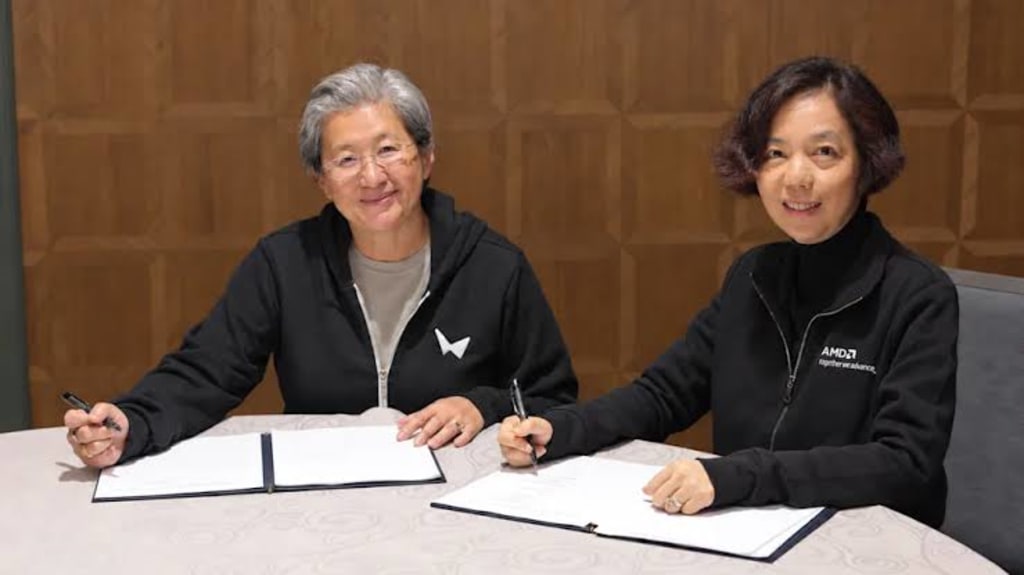
On September 28, 2026, AMD said it would buy World Labs, the spatial intelligence company founded by Fei-Fei Li, in an all-stock deal valued at about $8.2 billion. When the deal closes, Li will become AMD’s executive vice president and chief scientist. She will report to AMD chair and CEO Lisa Su.
The price makes it AMD’s second-largest acquisition, behind its roughly $50 billion purchase of Xilinx. The strategic point is different. AMD is buying a team that builds world models, which could tell the chipmaker what future AI systems need from hardware.
1. The CES keynote set up the deal
January 2026, Las Vegas.
Lisa Su brought Fei-Fei Li onto the CES keynote stage. Li showed Marble running on AMD’s MI325X. After optimization, it ran more than four times faster. The demo used photos of AMD’s Silicon Valley office. A few 2D images became a navigable 3D environment that kept the real geometry and changed the design style.
Li said onstage that she could not wait to see what it did on MI450.
At the time, it sounded like a polite line. Nine months later, it looks like a signal.
Lisa Su was an early investor in World Labs. AMD Ventures joined the Series B in September 2024, when the company was valued at about $1.3 billion after the round. In 2025, the two sides began working together on model training and inference optimization for AMD GPUs. In February 2026, World Labs raised a $1 billion Series C. AMD Ventures invested again. Nvidia, Autodesk, Fidelity, and Emerson Collective also joined. Autodesk disclosed a $200 million investment.
AMD and Nvidia were both on the cap table. Seven months later, AMD bought the company.
2. What World Labs built
World Labs started in 2024. It is based in San Francisco and has about 70 employees. The co-founders are Fei-Fei Li, Justin Johnson, Ben Mildenhall, and Christoph Lassner. In July 2026, it acquired the team behind SceniX, a robotics simulation company.
The company works on spatial intelligence. Its goal is to help AI understand 3D space, object relationships, and physical rules.
Its first product, Marble, launched in November 2025. A user can input text, images, or video. Marble generates a persistent 3D world that can be navigated and edited. The output can be exported into game, film, and design workflows. In January 2026, World Labs opened the World API so developers could add the capability to their own apps.
On September 1, 2026, the company released Atlas, a next-generation world model. Atlas is omni-modal and pretrained from scratch. It handles text, images, video, and 3D data in one system. Its key technical move is that it does not need many input images to reconstruct a scene. Like a language model predicting the next word, it predicts the next view from a single 2D image.
That gives AI a spatial skill. It can see an object and infer what will be visible when the camera moves.
These systems need heavy compute. Spatial reconstruction and physical simulation demand much more memory bandwidth than language models. Atlas improves as training compute grows. Li said in an interview that the company’s compute needs rose as its ambitions grew.
She needed hardware built for those workloads, not hardware bought off the shelf.
3. What AMD gets
In a Bloomberg interview, Lisa Su explained the logic. AI is still early. Hardware, software, systems, and models interact closely. The more AMD understands the full stack, the better the chips and systems it can build.
Traditional chip roadmaps assume general matrix operations and throughput. World Labs has different needs. Spatial reconstruction, physical simulation, and next-view prediction stress memory bandwidth, latency, and compute units in ways language models do not.
With World Labs inside AMD, the chip team can see those needs earlier. Where computation is slow, where data cannot move, and which designs need to change can be found with the model team in the room.
Citi analysts gave three reasons for the deal: top AI talent, a deeper understanding of frontier model compute needs, and a strategic position in physical AI. Analyst Patrick Moorhead put it more directly: “This is a talent and model-insight acquisition, not a revenue-growth acquisition. AMD is buying the developers who will run models on its future chips.”
Lisa Su said in the acquisition statement: “Building the next generation of AI computing platforms requires a deep understanding of how models will evolve.”
AMD is no longer only a chip company.
4. Nvidia is in the same race
Nvidia holds about 81% of the AI chip market. AMD holds about 7%. AMD cannot close that gap on hardware specs alone in the short term. Lisa Su chose a different route: move early in physical AI, where no company has locked up the market.
Nvidia is already there. In the second half of 2024, it released Cosmos, a world foundation model it describes as a development platform for physical AI. Cosmos can generate physically plausible synthetic data from text or video, including friction, collisions, and fluid effects. Nvidia also built a stack of Omniverse, Cosmos, and Isaac Sim, which links simulation, training, and deployment. In September 2026, Nvidia bought Hugging Face for about $13 billion.
AMD’s public models had covered text and video. It had no world model for physical-world understanding. Buying World Labs gives it a way in.
World models are a major focus for AI research after large language models. CCID Consulting estimates the global world model market will reach $15.23 billion by 2030. Morgan Stanley predicts that by 2035, industries enabled by world models will reach $10 trillion. Yann LeCun left Meta last year to start a world model company.
Physical AI covers robotics, autonomous driving, industrial digital twins, film, and VR content. Training a world model that is physically realistic and generalizable may need far more video data and GPU capacity than today’s large language models.
The company that understands those compute needs first can shape the next generation of AI chips. That is the position Lisa Su is buying.
5. From a dry-cleaning shop to ImageNet
Fei-Fei Li was born in Beijing in 1976 and grew up in Chengdu, Sichuan. She attended Chengdu No. 7 High School. In 1992, at 16, she moved to New Jersey with her parents and less than $20. She worked in restaurants, helped run the family dry-cleaning shop, learned English, and finished high school. She went to Princeton, earned a bachelor’s in physics, and received a PhD in electrical engineering from Caltech in 2005.
In 2009, AI was in a long winter. Many researchers were pessimistic about neural networks. Li and her team released ImageNet, a visual database with more than 15 million labeled images across 22,000 categories.
Peers were skeptical. The datasets were too small, and algorithms struggled to recognize the same cat across poses and lighting. Li believed better datasets would lead to better decisions. ImageNet, neural network algorithms, and GPU implementation helped make AlexNet possible in 2012. Deep learning then became the default approach.
Over the next 15 years, she was a Stanford tenured professor, a VP at Google and chief scientist of Google Cloud AI/ML, and founding director of Stanford HAI. Her work kept returning to one goal: getting AI to solve real-world problems.
In 2024, she left Stanford and founded World Labs. “The path with the deepest and broadest potential for positive impact was to start a company and tackle the boldest technical problems,” she wrote in her public letter.
She quoted Tennyson’s “Ulysses”: “Come, my friends, / ‘Tis not too late to seek a newer world.”
6. After the deal
AMD has been buying companies at a faster pace. It paid $4.4 billion for ZT Systems in 2025 and $665 million for Silo AI in 2024. On the supply side, AMD signed a 6-gigawatt GPU deal with OpenAI and an agreement with Anthropic for up to 2 gigawatts of MI450-series GPUs. AMD also committed up to $5 billion in strategic equity investment in Anthropic. It reached a multi-billion-dollar chip supply deal with Meta that lets Meta hold up to 10% of AMD.
Lisa Su’s plan is clear. AMD wants to sell more than chips.
Fei-Fei Li gets compute and freedom at the hardware layer. Lisa Su gets advance knowledge of what next-generation AI models will need from chips.
The deal is expected to close by the end of 2026, subject to regulatory approval. The $8.2 billion is only the start. The technical results will determine how much efficiency the combination creates.
Li wrote at the end of her public letter: “Without dedicated hardware investment, AI’s efficiency will remain constrained.” After working with Lisa Su, she called the two companies “a natural fit.”
That fit is now a deal.
About the Creator
Jin
Writer of reamstories
https://reamstories.com/jin
Enjoyed the story? Support the Creator.
Subscribe for free to receive all their stories in your feed. You could also become a paid subscriber, letting them know you appreciate their work.
Comments
There are no comments for this story
Be the first to respond and start the conversation.