
Alexandr Wang Didn’t Sleep. Meta Dropped Two AI Models at 2 A.M.
Muse Wonder Full tied Claude Sonnet 5.5, beat every OpenAI model on one list, and runs on a gigawatt data center. Here is the full breakdown.
Alexandr Wang did not sleep.
He replied to a tweet on X. The team was fixing quota errors, he said, and would reset quotas after the fix. The post went up at 1:47 a.m. Pacific. Meta had released Muse Wonder and Muse Wonder Full three hours earlier.
Two models, two entry points.
Muse Wonder runs on the API. Input costs $4 per million tokens. Output costs $20 per million. Cached input costs $0.20. The context window is 1 million tokens. Long context costs no extra. The pricing goes straight after Claude Code and Codex.
Muse Wonder Full is not on a standalone API. It comes only through a Muse Code subscription. Power Usage costs $50 per month. Maximum Usage costs $200. They give 20x and 80x base usage.
Meta has split releases into standard and full versions before. This split follows the same pattern: standard goes to developers and API users, full is tied to the subscription. The personal assistant Muse will also connect to Wonder, first for subscribers.
Early users hit quota errors. Wang said the team was fixing them and would reset quotas. He gave no timeline.
Six weeks, eight points, ten tests ahead of the predecessor
On the Artificial Analysis Intelligence Index, Muse Wonder Full scored 56. It tied Claude Sonnet 5.5. It fell below Opus 5.5 at 58 and rose above GPT-6 Astra at 53. Standard Wonder scored 52.
Six weeks earlier, Muse Spark 1.3 launched at 48 on that index.
Eight points in six weeks. All ten tests beat Spark 1.3. Six landed in the top three. Two took first.
Scientific reasoning CritPt: Full scored 33%, first on AA's list for that run. Professional document GDP.pdf: 33%, tied for first. Professional knowledge work GDPval-AA v2.1: 1857 Elo, second. Knowledge work AA-Briefcase, business process automation AutomationBench-AA, and scientific coding SciCode: three third places.
Terminal-Bench 4.0 asks the model to read files, type commands, and handle errors. Spark finished 33% of tasks. Full finished 57%, up 24 points.
The Vals AI composite list covers finance, coding, law, and tax. Wonder Full scored 64.57. It ranked fifth and beat every OpenAI model on the list.
Long coding tasks: SWE-Marathon leads Opus by 11 points
The clearest lead shows up in long coding tasks.
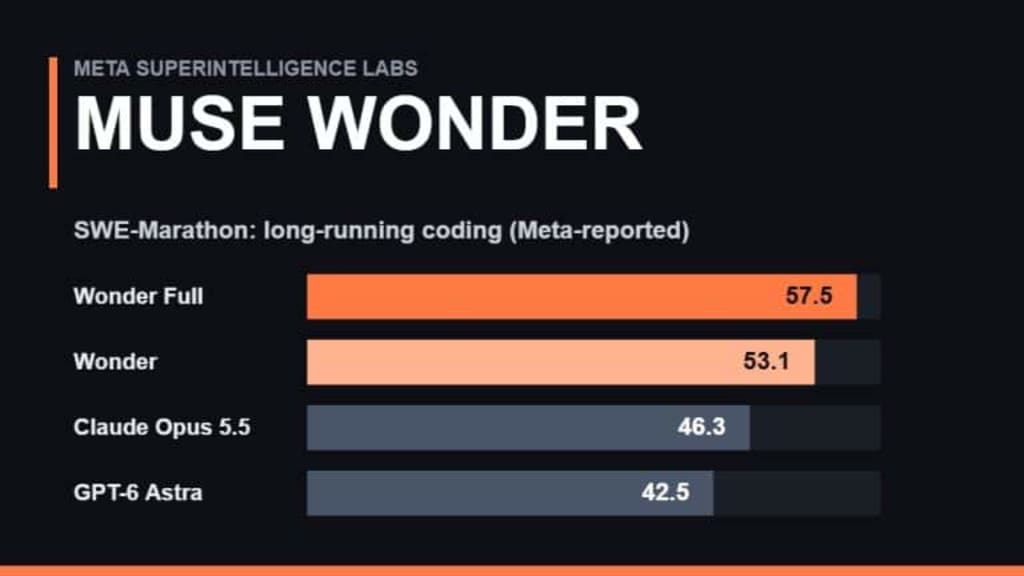
SWE-Marathon asks the model to finish a software project over time: read requirements, edit multiple files, run tests, find the cause after errors, and keep going.
Full scored 57.5%. Opus 5.5 scored 46.3%. Astra scored 42.5%. That is a lead of 11.2 and 15 points. Standard Wonder scored 53.1%, also above Opus and Astra.
DeepSWE v1.1 has 113 tasks across 91 code repositories and five programming languages. Full scored 79.0%. Wonder scored 78.8%. Opus scored 74.2%. Astra scored 74.1%.
On the AA Coding Agents Index, Muse Code with Full scored 68. It tied Claude Code with Sonnet and beat Opus at 66. The older Muse Code with Spark 1.3 scored 54. Full adds 14 points. Standard Wonder scored 63.
Two metrics still lag. On ProgramBench for from-scratch coding, Full scored 59.0. Astra scored 52.5. Opus scored 70.5. On terminal coding, Full scored 57.1. Astra scored 59.1. Opus scored 59.6.
VulnPR-100 gave Wonder 1.0 100 code changes with known vulnerabilities, one hour each. It found 46, tied with GPT-6 Astra. The run cost $284.88, or $6.19 per vulnerability.
Developer tests: finding bugs and making games
Conductor developer Charlie Holtz put Wonder into his codebase. Muse found a security vulnerability other agents had missed. He pointed to its design, visualization, CLI speed, and voice mode. He said Meta is now at the frontier.
Developer Yair ran a same-prompt test. He had Wonder and Opus 5.5 both make a first-person 3D game. Claude Code with Opus 5.5 took 11 minutes 40 seconds. Muse Code with standard Wonder took 3 minutes 42 seconds.
Two features: Active Memory and Active Focus
Meta stressed two abilities: Active Memory and Active Focus.
Active Memory keeps important information across conversations. Active Focus lets the model switch methods when blocked, check after mistakes, and change plans when new requirements arrive.
The base specs:
1 million token reasoning context
Native omnimodal input: text, high-resolution images, long video, continuous audio
Training with many different, long-duration tasks
Meta raised inference-time compute step by step. Both generations improved on unfamiliar tasks. When they scored close on tasks covered in post-training, Full still did better on tasks not covered.
Professional work: law 3.1x, finance above Opus, math efficiency up
Fourteen tests cover law, finance, memory, and sustained execution. Full beat Opus 5.5 on 8 and beat GPT-6 Astra on 11.
Law Harvey LAB-AA: Full 13.1, Opus 4.2, a 3.1x gap. Finance: Full 59.1, Opus 58.6, Astra 53.5. Math proof ProofBench: Full solved 94, 36 more than its predecessor. Opus solved 100. Astra solved 99. Output tokens fell from 4.5 million to 2.7 million, down 40%. App score stayed near 86%. Average steps dropped from 120 to 62.
Knowledge question hallucination rate: Full 23%, Astra 51%, Opus 59%. This counts wrong answers among questions not answered correctly. Full's knowledge index was 30, below Astra's 43 and Opus's 46.
Behind the launch: gigawatt Prometheus and a 14-month rebuild
Muse Wonder was trained at the gigawatt-scale Prometheus data center.
Fourteen months ago, Meta began rebuilding its AI infrastructure and R&D model. Prometheus is in Ohio. It runs at 1 GW and holds about 1.3 million NVIDIA H100 GPUs. It uses island mode, builds its own power generation, and relies on tent-style construction to shorten the build cycle.
Meta expanded pretraining and reinforcement learning there. Pretraining builds a broad base. Reinforcement learning adjusts model behavior based on task feedback.
Pricing and competition
Standard Wonder uses pay-per-use pricing: $4 per million input tokens, $20 per million output tokens, and $0.20 for cached input. The context window is 1 million tokens. Long context costs no extra.
Full is available only in the Muse Code subscription. Power Usage costs $50 per month. Maximum Usage costs $200 per month. They give 20x and 80x base usage. There is no standalone API yet.
The personal assistant Muse will connect to Wonder, first for subscribers.
Meta is leaning on long coding tasks and active memory. Its pricing and entry points go after Claude Code and Codex. Terminal coding and knowledge breadth still lag. Subscription stability, independent benchmark replication, and developer migration cost remain open questions.
Under Wang's tweet, someone asked when quotas would reset. He did not reply.
About the Creator
Jin
Writer of reamstories
https://reamstories.com/jin
Enjoyed the story? Support the Creator.
Subscribe for free to receive all their stories in your feed. You could also become a paid subscriber, letting them know you appreciate their work.
Comments
There are no comments for this story
Be the first to respond and start the conversation.