
AI’s Canvas Era Is Ending. Workflows Are Moving Under the Floor.
Coze, n8n, and Dify lost heat because hand-drawn branches cannot keep up with reasoning models. The next stack needs fewer lines and better tools.
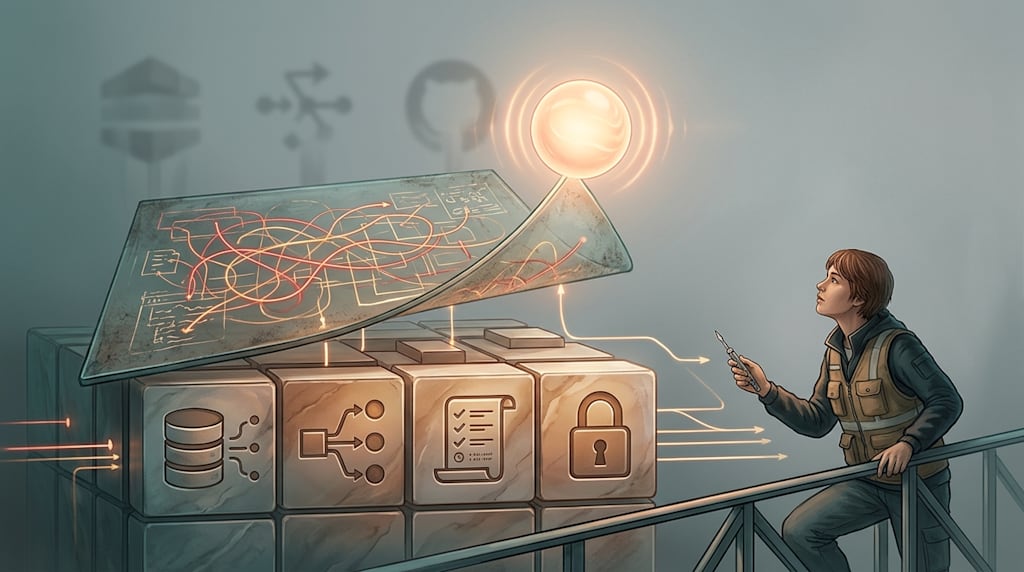
Coze, Dify, and n8n are no longer the default screenshot of AI adoption. Tighter free quotas, higher API bills, and more cautious enterprise buying explain part of the drop. A structural problem explains more. Teams stuffed models into boxes designed for fixed business rules, then used human-drawn lines to simulate judgment. That approach narrows quickly.
The word “workflow” needs a split. A workflow is a way to break work into steps you can compose and audit. A canvas with drag-and-drop nodes is one interface for building workflows. The interface is what lost favor. The architecture did not.
So the canvas era is ending. Workflows are moving down the stack. They stop being the product and become the plumbing.
Three criticisms of workflow platforms circulate. Two hold. One overreaches.
“Using the most expensive tokens to do the most rigid work” holds. Asking a model to answer Yes or No just to trigger a branch wastes money and time. Fixed branches belong in code. Open inputs cannot be enumerated with a hundred nodes. That criticism lands.
“Three nodes are a demo; thirty nodes are a disaster” also holds, but it describes platform maturity. Once a flow reaches thirty nodes, teams need breakpoint tests, version control, rollback, and structured logs. Early canvas products did not provide those. That is a product gap, not proof that workflow architecture fails.
“No-code falls between two stools” is a sharp observation with a fast conclusion. Business users stall when JSON parsing, auth, and circuit breaking appear. Engineers leave when Git, CI, and local observability are missing. Abolishing workflows is the wrong fix. Push them into the developer toolchain instead, with narrow interfaces for business users and code-level control for engineers.
Reasoning models changed the planning layer. A strong model can decompose a goal, inspect an error, change a parameter, and retry. Once that happens inside the model, pre-drawn connections lose value. They can even constrain the model.
Planning is not execution. A model can decide to query an order. It should not decide whether a refund skips finance review. It should not invent retry limits for a payment API. It should not choose who gets notified after a ticket escalates. Those decisions need deterministic tools, clear permissions, and complete logs. The model can choose a route. The route still has to run on rails.
This matters most in enterprise work. Refund settlement, permission changes, ticket escalation, and approval routing cannot depend on a model taking three steps today and five tomorrow. Compliance will ask why an operation was approved. “The model thought it was fine” is not an audit trail. Determinism is how systems assign responsibility, not a sign of fear.
The next stack separates four layers.
Planning moves from human flowcharts to model-driven planning. People provide goals, constraints, and tools. The model chooses the path.
Execution stays deterministic. Tools, functions, and subflows need clear boundaries and structured logs, with retries and permissions under control. The model may call them. It may not bypass them.
Protocols standardize. MCP and similar protocols let models call capabilities from the OS, IDE, browser, or intranet. The orchestration platform stops being the host. The environment becomes the base.
Interaction changes. Code comes first. The canvas becomes a debug and audit view. People still need a picture of what the system did. They no longer need to draw every branch before it runs.
Architects should do three things. Polish tools until a model can call them safely. Build observability into every tool call so dynamic planning can be replayed and audited. Turn safety limits into code-level constraints so a model cannot route around finance review or permission checks.
High-level languages did not kill assembly. They pushed it into the compiler backend. Goal-driven systems will not kill workflows. They will push workflows into the execution base.
Discard the habit of treating a finished diagram as finished intelligence. Keep the word workflow. A flowchart is fine. Believing the diagram does the thinking is not. A connection line is fine. Using connection lines to replace model judgment is not.
Give fixed rules to native code. Give open goals to the model. Give audit and boundaries to the engineering system. Let workflows become quiet infrastructure. They should support intelligence from below, not stand in front of it.
About the Creator
Jin
Writer of reamstories
https://reamstories.com/jin
Enjoyed the story? Support the Creator.
Subscribe for free to receive all their stories in your feed. You could also become a paid subscriber, letting them know you appreciate their work.
Comments
There are no comments for this story
Be the first to respond and start the conversation.