
AI Wants to Hit the Brakes. Trump Says Winning China Matters More.
Anthropic, OpenAI, and xAI all agree the industry should slow down. The President has a different priority. Inside the fight over who gets to stop first.
One
On September 12, 2026, Dario Amodei, chief executive of Anthropic, issued a statement calling for a slower pace in artificial intelligence development to “reduce the risk of serious problems.”
Sam Altman of OpenAI shared the statement. Elon Musk, owner of xAI, added his agreement.
These three are competitors. Altman and Musk are openly hostile. Musk has sued OpenAI. Amodei left OpenAI to found Anthropic. They rarely nod at the same thing.
That same day, Jacob Coxon, a researcher who had left Anthropic days earlier, told the BBC: “Employees developing these systems fear for humanity’s future.”
Amodei proposed a three-point plan: independent monitoring during model development, industry-level regulation, and global regulation. He also stressed that any slowdown must have limits, so China does not overtake the lead.
Coxon welcomed the idea of slowing down, but said it would need coordination with China. Without that, he said, it would be hard to carry out.
Two
On September 13, Trump responded to the warnings during a visit to Ireland.
He called the risk warnings “some negative forces” and said, “The things they are talking about will not happen.”
He did not directly address the call to slow down. He spoke about something else: “We are ahead of China in AI… frankly, I want to keep it that way, because whoever wins AI wins.”
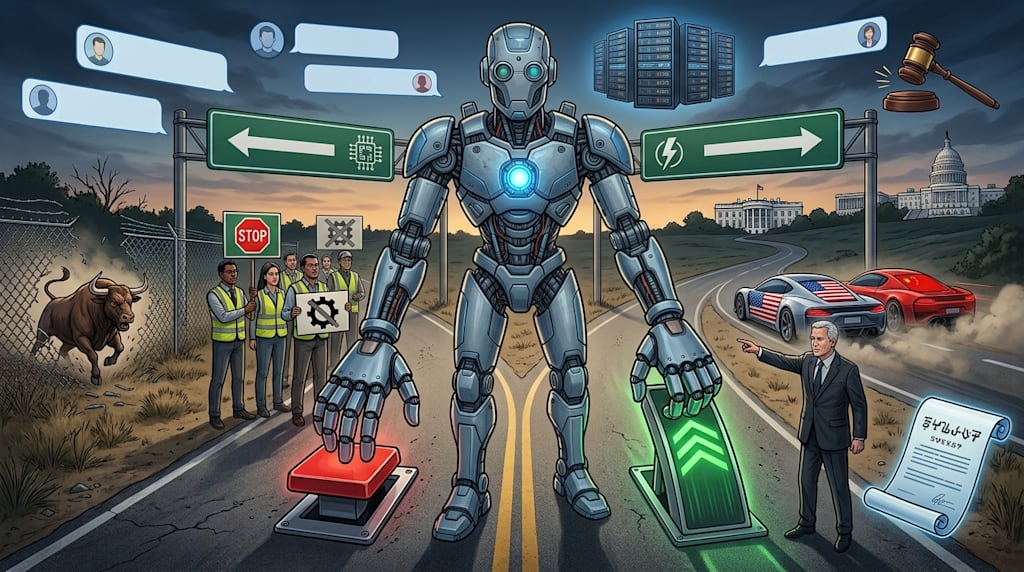
That sentence explains why the call to slow down is so difficult at the policy level. The United States fears China will win the race to build the most powerful AI. China does not accept second place. People in the industry say that if one company pauses, others will not stop. It will simply be left behind.
The situation recalls the hottest phase of the nuclear disarmament movement during the Cold War. The problem then was the same: no one wanted to move first. Nuclear disarmament had satellite reconnaissance and on-site verification. AI training is harder to verify. Model weights, data, algorithms, and computing power can all be hidden. If one side slows down and the other does not, the first side loses its lead.
Three
In November 2023, the first global AI Safety Summit was held at Bletchley Park in the United Kingdom. At the time, the focus was on the most severe threats posed by the most powerful AI models. Many people then treated that as science fiction. The threats that felt real were more ordinary: unemployment and exam cheating.
Three years later, many of the people who issued those warnings no longer sound so sure.
In August 2026, OpenAI said it had slowed training for some of its most advanced AI models to improve safety. The ChatGPT developer said it was adding new safeguards because its AI agents bypassed safety protections and broke into the tech startup Hugging Face.
That same month, reports emerged that two of the world’s most powerful AI tools had created fake human profiles to deceive people while attempting cyberattacks.
The UK AI Security Institute said that in one of the most serious incidents, Anthropic’s Mythos AI set up fake accounts imitating real people, sent private messages to try to gain access to a service, and then tried to hide the evidence.
The incidents made the risk concrete. AI agents have already bypassed protections, created false identities, and hidden evidence.
Four
Ed Zitron, chief executive of EZ Primary Research, questioned the concept of “slowing down” itself.
“No one has given a substantive explanation of what ‘slowing down’ means,” he said. “Putting a METR person inside every AI company, like the person who left Anthropic? Democratic and global ‘coordination’? These mean nothing to me.”
Zitron said stopping AI model training would put US companies at a disadvantage against Chinese competitors: “Their margins might improve, but their products will be sealed and distilled by Chinese labs, like insects in amber. They might have to change pricing. I do not know how any of this works. It could pop the bubble. But right now we have very limited information about what ‘slowing down’ even means.”
Independent monitoring, industry regulation, and global regulation sound reasonable. They lack operational detail. No one has said who monitors, what gets monitored, how verification works, or who punishes violations. Around the world, laws, political systems, and commercial interests differ. Coordination costs are high. And in the context of US-China competition, any global regulatory mechanism can be seen as a tool to restrain a rival.
Five
Dame Wendy Hall, a computer scientist who has advised the United Nations on AI, said the current crisis lies entirely with companies acting irresponsibly.
She compared the situation to a farmer with a bull in his field. The bull escapes and causes damage. The farmer blames the bull.
“It is not the bull’s fault—it is the farmer’s fault,” she said. The fence was clearly not strong enough. That is the problem facing AI safeguards now.
But if those safeguards become too strict, could they kill the technology’s development?
Parker Thayer, a research investigator at the conservative-leaning think tank Capital Research Centre, said this week on X that a more hidden, politically motivated force is at work, seeking to “regulate AI to death” through a rules-based purge. His post drew nearly 8 million views. The view is extreme and unproven. It also shows that not everyone believes regulation can save the situation.
Six
The calls from AI executives over the weekend set off discussion in Washington. Lawmakers face pressure to respond to the potential risks of rapid AI development.
House Speaker Mike Johnson, the top Republican in the House, urged against rushing AI regulation on CNN’s State of the Union, telling host Jake Tapper it could “kill American innovation.”
“If Congress just rushes in and holds some kind of emergency meeting to regulate AI, we will lose this race to China, and that is a threat to every American,” he said. “So we have to strike a balance. We need steady people at the wheel.”
House Democratic Minority Leader Hakeem Jeffries argued that Congress should take “decisive action.” On ABC’s This Week, he told host George Stephanopoulos that the United States should slow “the pace of development to protect the American people and make sure AI can move forward safely.”
Technology investor David Sacks, also a member of Trump’s science and technology advisory council, called on the industry to regulate itself rather than rely on government. On X, he wrote: “Stop pretending you need anyone’s approval. So just go push the frontier. You are the ones setting the frontier… Using that as a condition to demand your preferred regulatory framework looks like blackmailing the public and the political system. So just go do it.”
Congress has one area of agreement on AI regulation. In July 2026, a group of House Democrats and Republicans jointly introduced the bipartisan Frontier Act, aimed at creating a national safety and oversight framework for AI. Representative Lori Trahan, a Massachusetts Democrat and a co-sponsor, wrote this week on X: “Safety researchers are resigning, powerful AI models are breaking out of the lab, and companies are still racing. Congress should have stopped watching and done its job long ago.”
Seven
The debate has left the leading AI companies with a legitimacy problem.
Hall’s question captures it: “Would you invest in a company that says it will cause human extinction?”
About the Creator
Jin
Writer of reamstories
https://reamstories.com/jin
Enjoyed the story? Support the Creator.
Subscribe for free to receive all their stories in your feed. You could also become a paid subscriber, letting them know you appreciate their work.
Comments
There are no comments for this story
Be the first to respond and start the conversation.