
AI-Powered Learning Platform Development
See how AI-powered learning platforms are built, which features matter most, and what it takes to turn personalization, tutoring, and analytics into a scalable EdTech product.

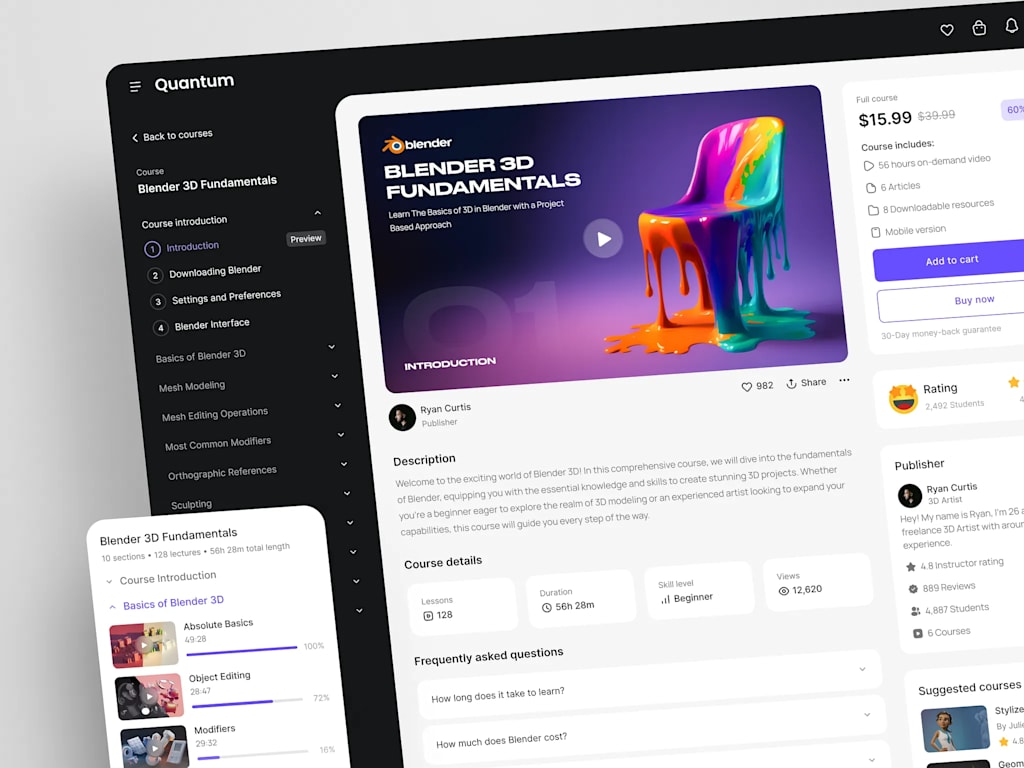
Here is a rephrased version of the text, maintaining the original meaning while using distinct vocabulary and sentence structures:
Corporate interest in developing AI-driven educational tools is largely driven by the desire for tangible utility rather than mere technological novelty. Artificial intelligence allows EdTech solutions to deliver genuine practical value, moving beyond impressive but superficial demo features.
However, integrating intelligence into an educational product is not as straightforward as appending smart capabilities to legacy infrastructure. The critical phase occurs much earlier in the process. It involves identifying high-impact use cases for AI, determining necessary data inputs, defining the logic for automation and recommendations, and ensuring system stability. This is where specialized expertise in AI product strategy becomes essential.
This overview explores the application of AI within eLearning, prioritizing high-value features, examining the underlying technical architecture, and highlighting potential bottlenecks caused by delayed decision-making. We will also consider the influence of Learning Management Systems (LMS), as many AI-enhanced educational tools are either constructed upon existing LMS frameworks or designed to overcome their inherent limitations.
Defining the AI-Enhanced Learning Platform
At its core, an AI-powered learning platform is a digital education service that rejects a one-size-fits-all approach.
Traditional systems offer a static experience. Users typically log in, follow a predetermined linear sequence of lessons, complete assignments, and have their progress recorded. In this model, the software acts primarily as a passive repository for content.
AI-enabled platforms introduce a dynamic layer of adaptation. By analyzing user behavior—such as pacing, points of confusion, repetition patterns, and skipped sections—the system modifies the learning journey in real time.
This primarily transforms how content is delivered. Rather than forcing every student through an identical curriculum sequence, the platform can suggest supplementary resources, revisit misunderstood concepts, or accelerate through material the user has already mastered. While human experts still design the core content, the algorithm determines the optimal timing and presentation for each individual.
Similarly, learning pathways become flexible rather than rigid. In standard eLearning, the route is fixed at the outset. With AI, the path adapts: one student might receive additional exercises to reinforce knowledge, while another advances quickly to advanced modules. The underlying pedagogical structure remains intact, but its execution becomes fluid.
AI also supports engagement, though through practical mechanisms rather than magic. It might highlight the most relevant next step, trigger reminders at optimal times, calibrate task difficulty, or provide performance-based feedback. When executed effectively, these adjustments make the interface feel more responsive and less monotonous.
In essence, an AI-powered learning platform leverages user data and machine learning to personalize education in a functional, product-centric way. This results in smarter content distribution, adaptable learning trajectories, and a system that actively responds to the learner’s actual behavior.

Varieties of AI in Education
Artificial intelligence integrates into educational platforms through several distinct mechanisms, rather than always functioning as a monolithic solution. Its applications vary: it may restructure the sequence of instruction, serve as a supportive aid, curate vast content libraries, or streamline administrative tasks like grading.
Adaptive Learning Environments
These systems modify the educational trajectory based on individual performance.
For instance, if a student repeatedly struggles with a specific concept, the platform halts forward progress to offer remedial exercises, simplified explanations, or a review of foundational topics. Conversely, if a user demonstrates rapid mastery, the system avoids forcing them to wait, allowing them to bypass material they already understand. While the curriculum retains its overall structure, the platform actively responds to real-time learner behavior rather than remaining static.
Intelligent Tutoring Systems
These tools provide immediate support during the learning process.
Functionality ranges from answering queries and explaining incorrect responses to offering hints before frustration sets in. This creates an experience akin to having embedded support within the course, preventing users from feeling isolated. Such systems are particularly valuable in corporate training, where organizations require consistent delivery but employees need assistance tailored to their individual pacing and moments of difficulty.
Content Recommendation Engines
These engines guide users on what to study next, a feature critical for platforms with extensive libraries.
When faced with too many choices, users often experience decision paralysis and disengage. Recommendations mitigate this friction by suggesting the next logical lesson, related courses, or supplementary practice based on prior activity. While conceptually simple, this functionality significantly enhances usability in content-rich environments.
Automated Assessment Tools
These systems assist in evaluating student performance.
Beyond simply grading multiple-choice tests, they can identify patterns that are difficult for humans to spot manually, such as common error trends or course sections that consistently cause delays. While they do not necessarily replace human oversight, they eliminate much of the repetitive workload. When integrated with learning analytics, these tools provide deeper insights into underlying issues rather than just final scores.
Foundational Infrastructure
The technical backbone of these platforms is often less complex than it appears, yet it is vital for success. Key components include:
- Data Pipelines: These collect and transport signals regarding user activity, outcomes, and content interaction throughout the system.
- Machine Learning Models: These algorithms process data to drive adaptations, predictions, recommendations, and automated checks.
- Content Delivery Networks: These manage the actual lessons, media, quizzes, and feedback interfaces users interact with.
- Analytics Dashboards: These provide instructors and administrators with visibility into progress, usage trends, and potential bottlenecks.
- APIs and Integrations: These connect the platform to external ecosystems, such as HR software, payment gateways, reporting tools, and third-party content services.
While these infrastructure elements may seem mundane, they are the prerequisite for any successful AI implementation. Without a robust foundation, advanced features cannot function effectively.
Essential Features of AI-Driven Learning Platforms
Personalized Learning Trajectories
This is often the primary focus for development teams, and rightfully so.
Traditional eLearning forces all users through a rigid, pre-defined sequence. While clear, this approach ignores variations in skill level and learning speed. AI introduces flexibility into this structure.
If a learner excels, the system can accelerate their path or introduce advanced materials. If they struggle, it can intervene with alternative explanations or remedial tasks. The platform thus shifts from merely distributing content to actively monitoring and responding to the user’s journey. This dynamic approach is especially crucial for scalable SaaS products serving diverse audiences, ensuring the course structure adapts to individual needs rather than imposing a uniform experience.
AI-Assisted Guidance
Another prevalent feature is integrated support.
This may take the form of a chat-based tutor or a simpler assistant that clarifies concepts and explains errors. The goal is straightforward: provide help exactly when the learner encounters obstacles.
Timely assistance is critical because many users abandon courses not due to difficulty, but due to a lack of support at critical moments. Even brief interventions can maintain momentum. By keeping help within the platform, users avoid the disruption of searching for external resources. While some systems employ voice or natural language processing (NLP)—particularly useful in language learning or simulations—the primary value lies in the clarity and relevance of the response, not just the novelty of the interface. Ultimately, these tools aim to reduce friction in the learning process.
Predictive Analytics
This capability allows the platform to anticipate issues before they result in dropout.
Learner disengagement is rarely sudden; it typically begins with subtle signs like skipped sessions, delayed assignments, or repeated stagnation on specific topics. AI detects these early warning signals across large user bases.
This foresight enables proactive intervention, such as resurfacing key concepts, simplifying subsequent steps, sending targeted reminders, or alerting instructors to at-risk students. For product teams, predictive analytics shifts the focus from retrospective final scores to real-time engagement health, highlighting exactly where the learning experience is breaking down. This feature is most effective when tightly integrated with broader data analytics systems.
Automated Content Creation
AI can significantly streamline the content production workflow.
In practical terms, this involves using algorithms to generate draft quizzes, concise summaries, practice exercises, or initial lesson materials based on existing resources. For teams managing large volumes of educational material, this automation alleviates the burden of repetitive manual tasks.
However, AI-generated output should never be published without human oversight. An automatically created quiz might be grammatically correct but contain ambiguous wording or incorrect answers. Similarly, a generated summary might appear coherent while failing to capture the core educational objective.
Therefore, the primary value here is operational efficiency. The platform accelerates the creation of first drafts, allowing human experts to focus on quality assurance and refinement before the content reaches learners.
Seamless Multi-Device Experience
Modern learning is rarely confined to a single device.
A user might begin a module on a desktop computer, continue on a smartphone during a commute, and finish on a tablet at home. If the platform fails to support this fluidity, even high-quality content becomes frustrating to access.
Consequently, robust web and mobile accessibility is essential. Learners expect their progress, saved items, completed assignments, and current position in the course to sync instantly across all devices.
For product teams, this demands consistency across interfaces. The mobile application must not feel like a stripped-down version of the desktop site; it must offer full functionality. Lessons must load correctly, data must synchronize reliably, and the user experience must remain cohesive. When mobile usage is central to the strategy, investing in native mobile development often yields superior performance, stability, and usability compared to responsive web wrappers.

The AI Learning Platform Development Lifecycle
1. Defining Use Cases and Data Strategy
This initial phase focuses on identifying the specific practical problems AI will solve.
Rather than aiming for vague "intelligence," the team must pinpoint exact functions: Will the system recommend next steps? Provide in-course assistance? Adapt pathways based on performance? Identify at-risk students? Clarity here is crucial; without it, subsequent development lacks direction.
It is advisable to start with one or two focused use cases rather than attempting to automate the entire platform simultaneously. A narrower scope simplifies development, testing, and user explanation.
Simultaneously, the data strategy must be established. Personalization and recommendation engines require robust data inputs, such as quiz scores, completion rates, error patterns, time-on-task metrics, skipped modules, or search queries. Teams must assess whether existing tracking infrastructure is sufficient or if enhanced data collection mechanisms need to be implemented first.
2. UX/UI Design for AI Integration
Once the functional goals are set, the team must determine how these features appear to the user.
Poor integration can turn useful features into annoyances. A recommendation engine may provide accurate suggestions, but if they appear without context, they seem random. An AI tutor might be helpful in theory but disruptive if it interrupts flow at inappropriate times. Admin dashboards can become cluttered if every signal competes for attention.
The design principle is clarity. Suggestions should feel intuitive. Explanations for flagged weaknesses should be immediate and understandable Instructor tools should facilitate quick action. The interface should prioritize calmness, readability, and predictability over futuristic aesthetics.
3. Selecting the Technology Stack
The technology stack is dictated by the product’s specific requirements.
- Backend: Python is frequently chosen for AI-heavy platforms due to its strength in model logic and data processing. Node.js is often used for handling real-time interactions and high-volume front-end requests.
- Machine Learning Frameworks: TensorFlow and PyTorch are standard choices for training models for personalization and recommendations. The decision often depends on the team’s existing expertise rather than theoretical superiority.
- Data Infrastructure: Learning platforms generate continuous event streams (e.g., lesson views, quiz results). Apache Kafka is commonly used for data streaming, while Apache Spark handles large-scale data processing.
- Frontend: React is a popular choice for complex interfaces involving admin panels, learner dashboards, and interactive lessons, offering scalability as the product grows.
- Infrastructure: Docker is used for containerization, while Kubernetes manages orchestration as the system scales.
- APIs: FastAPI is often employed to create efficient backend layers connecting AI models to the main application.
Treating AI as a core product component rather than an add-on ensures the architecture supports long-term complexity.
4. Machine Learning Model Development
With clear objectives, the team proceeds to model creation, typically starting with a specific task like personalization or content recommendation.
Models analyze learner behavior to determine the most relevant next lesson, exercise, or course. This guidance is critical in content-rich environments to prevent choice paralysis.
Model development is iterative. Training is only the first step; the output must be validated for practical utility. A recommendation might be statistically accurate but pedagogically unhelpful. Therefore, the process involves cycles of training, evaluation, adjustment, and re-testing until the feature delivers genuine value in a real-world context.
5. System Integration
The AI component must be seamlessly embedded into the existing learning ecosystem, such as an LMS.
Recommendations must appear within the natural course flow. Tutor responses must link directly to relevant lesson content. Predictive alerts must reach instructors through their standard workflows.
Integration challenges often arise when the underlying platform was not designed for dynamic AI logic. Issues may include fragmented data storage, unstructured content access, or rigid workflows. Successful integration ensures the AI layer operates within the product, closely tied to course delivery systems where user actions and content intersect.
6. Testing and Validation
This phase reveals weaknesses in both logic and user experience.
First, technical accuracy is verified. Frequent incorrect recommendations, false flags, or poor tutoring responses diminish trust and value.
Second, contextual relevance is tested. A correct recommendation is useless if it appears at the wrong time. A tutoring tool is ineffective if it causes latency or distraction. Predictive insights are worthless if they confuse instructors.
Testing must therefore occur on two levels: ensuring the AI functions correctly technically and confirming it enhances the actual learning experience without friction.
7. Deployment and Continuous Improvement
Launch is not the endpoint. AI models degrade over time as learner behaviors shift, content libraries expand, and new user segments emerge.
Post-deployment requires a strategy for continuous learning. This may involve regular model retraining, rule adjustments, or feature refinements based on real-world usage data. Ongoing maintenance, monitoring, and technical support are essential, making long-term service planning a critical part of the product lifecycle. AI features demand sustained attention to remain effective.
Key Obstacles in Building AI-Driven Educational Platforms
While artificial intelligence enhances the utility of learning products, it introduces a distinct set of complexities. These challenges are often unglamorous but critical; they determine whether a platform becomes a robust tool or merely a costly proof-of-concept.
1. Data Integrity and Accessibility
The primary hurdle is often data quality. AI models require substantial, high-quality inputs—such as quiz outcomes, completion rates, behavioral patterns, search queries, dropout points, and error frequencies. If this data is fragmented, inconsistent, or poorly structured, the resulting AI outputs will be ineffective. Frequently, teams realize that the core issue is not the selection of algorithms, but rather the failure to capture the necessary signals from the outset.
2. Practical Model Accuracy
Accuracy is not just a technical metric; it has direct practical implications. Recommendation engines must consistently guide learners toward relevant content. Tutoring assistants must provide clear, pedagogically sound explanations, not just fluent text. Predictive models must identify genuine at-risk behaviors without generating excessive false positives. In an educational context, approximate accuracy is insufficient; unreliable outputs can quickly degrade the user experience and undermine learning outcomes.
3. Establishing User Trust
Trust is paramount. Neither learners nor instructors need to understand the underlying code, but they must perceive the system’s logic as reasonable. If recommendations appear arbitrary, explanations seem vague, or decisions lack transparency, users will disengage. Once trust is eroded, even technically sophisticated features lose their value because users stop relying on them.
4. Infrastructure Scalability
As the user base expands, infrastructure strain becomes a significant concern. Features that perform well with a small group may fail under heavy load. Real-time personalization, tutoring, and analytics place immense pressure on backend systems, data pipelines, and model-serving layers. This is particularly critical in content delivery, where AI processes must integrate seamlessly into the learning flow without introducing latency or performance bottlenecks.
Ultimately, the difficulty lies not in implementing AI itself, but in ensuring data usability, output reliability, user trust, and scalable infrastructure.

The Strategic Value of Partnering with AI EdTech Specialists
The primary difficulty in creating AI-driven educational tools lies in ensuring that artificial intelligence serves a functional purpose within the product ecosystem. It must seamlessly integrate with pedagogical logic, content hierarchy, user data, and actual learner behaviors. Consequently, organizations gain a significant advantage by collaborating with development firms that possess practical expertise in applying AI and machine learning to product development, rather than relying solely on theoretical knowledge.
The Importance of Robust Architecture
System architecture is equally critical. While a basic prototype can function on minimal infrastructure, a production-grade platform faces different demands. It must simultaneously manage content delivery, user interactions, analytical dashboards, third-party integrations, and AI processes. Crucially, it must maintain speed and stability as the user base expands. This is where experience in designing scalable architectures becomes indispensable.
Data Strategy and Utility
The effectiveness of AI features is directly tied to data quality. Intelligence is only useful if the platform captures the correct signals and processes them logically. Poor data inputs inevitably lead to poor outputs. Experienced AI EdTech developers can guide the definition of key metrics, determine how data should be utilized, and prioritize which AI capabilities offer the highest immediate value. This ensures that the foundation for machine learning is solid from the start.
From Concept to Reality
Ultimately, the value of specialized development services extends beyond mere model creation. It lies in constructing a cohesive product where AI has a defined role, the infrastructure supports its operations, and the user experience remains intuitive. This holistic approach distinguishes a feature that looks promising on paper from one that delivers tangible results in a live environment. For companies entering this space, partnering with experts grounds the development process in reality, reducing risk and enhancing long-term viability.
Conclusion
Successfully developing an AI-driven learning platform requires a disciplined, sequential approach.
The foundation is data, which feeds the machine learning models. These models, in turn, power the user-facing application. Finally, the system must be engineered to scale, accommodating growing numbers of learners, expanding content libraries, and increasing operational complexity.
High-performing platforms are not defined by an exhaustive list of features but by the mastery of fundamentals. Personalization must feel intuitive and relevant, not arbitrary. AI-generated outputs must be reliable enough to earn user trust. Crucially, the infrastructure must remain stable and responsive as the product expands.
This interdependence is what makes such development complex. AI is merely one component of a larger ecosystem that includes robust product logic, sound architecture, seamless content delivery, and sustainable scalability.
About the Creator
Shakuro
We are a web and mobile design and development agency. Making websites and apps, creating brand identities, and launching startups.
Enjoyed the story? Support the Creator.
Subscribe for free to receive all their stories in your feed.
Comments
There are no comments for this story
Be the first to respond and start the conversation.