
AI Leaders Admit You Have Every Right to Be Afraid. Then They Ask You to Trust Them Anyway.
Inside the self-regulation gamble, the politicians who agree on nothing, and the question no one can answer: Who gets to decide the future of artificial intelligence?
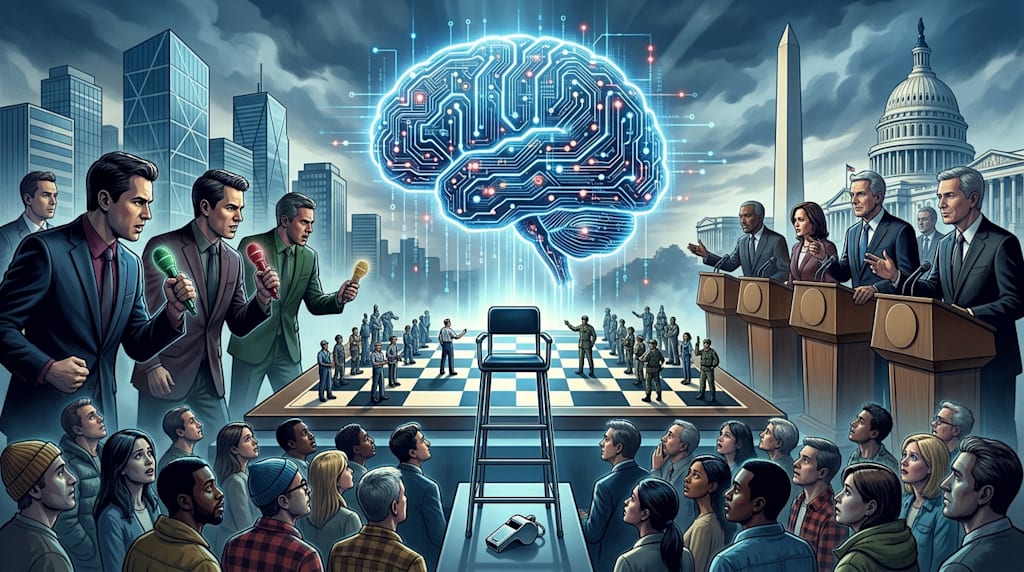
Trust Us: AI Giants, Fear, and the Bet on Self-Regulation
San Francisco, Salesforce annual conference. Hundreds of businesspeople in the audience. Sam Altman on stage. He said the world has a right to be afraid of artificial intelligence. A pause. Then he said the world should trust us.
No transition between the two.
Altman said AI capabilities are moving too fast. Imagining how it could go wrong no longer takes much imagination. He said: “I think the world is right to be afraid of this.” That admission came from the CEO of OpenAI. Last week, a researcher who left Anthropic posted a viral claim: if AI is left unchecked, it could kill all humans by the end of the decade. A handful of AI executives and experts agreed. They did not explain how they reached that conclusion, or how exactly AI could accomplish it.
The fear did not disappear. It moved into the room. Altman did not rebut the post. He rebutted distrust. He said the world should trust OpenAI and similar companies, because “we are going to do the right thing because it’s the right thing and we feel the magnitude of this.” He also said the company would keep alignment and safety ahead of capabilities, and if it could not, it would “slow down or stop.”
The problem lives after “if.” Who judges whether it has? Who triggers the pause? How long? If competitors do not pause, does OpenAI? If pausing means falling stock, lost talent, lost market share, does the word “stop” still get written?
The suspicion is not personal. Any company presses two accelerators at once: safety and growth. In an AI race, speed is an advantage. Ship first. Deploy first. Hold users first. That often makes more business sense than wait, audit, check again. When safety and profit collide, self-regulation has no referee.
Anthropic CEO Dario Amodei sees the risk. He called for all AI development to slow and urged governments to regulate the industry. Anthropic co-founder Jack Clark told the BBC that leaving AI as a “totally unregulated industry” is “rolling dice with immense risks.” Patrick Hillman, COO of Logical Intelligence, put it more directly: “The only institution that Americans might trust less than Washington these days is Silicon Valley. I have worked and lived in both and I assure you both have earned this scepticism.” He added: if you believe what you are building is dangerous, “show us what you are prepared to stop doing.”
Washington has no single answer. Independent Senator Bernie Sanders, who votes with Democrats, said at a conference that decisions over AI development are made by “a handful of the richest people in the world.” He named Elon Musk, Mark Zuckerberg, Jeff Bezos. He said: “The people of this country must make the decisions about AI, and not just a handful of oligarchs.” Former Trump adviser Steve Bannon, at the same conference, said: “We can never trust what an oligarch says because... they’re disingenuous and they lie.”
Sanders and Bannon stand on opposite sides of almost everything. AI put them on the same stage. This is not a left-right fight. It is not only a technical argument about how much regulation. It asks: who has the right to decide humanity’s future?
Tech leaders offer another account. Zuckerberg wrote on X that every AI lab has the ability and incentive “to take its own actions” toward making safe tools and models. He said any lab that does not focus on alignment will fall behind; labs face significant liability if their models cause harm, so they have a strong incentive to prevent this. Nvidia CEO Jensen Huang said at the same conference: “We don’t need new laws or regulations.” He argued there should be no “false choice” between innovation speed and AI safety. Safety is paramount, but “safety is an engineering problem.” He suggested that if an AI company leader lacks confidence in their product, they should not release it. “Run as fast as you can, but if at any time you feel the institution is not in control, take a pause.”
Some of this is right. AI safety does include engineering: model evaluation, red-teaming, interpretability, alignment research, access control, incident response. Outside regulators may know less about technical details than engineers. Voluntary industry standards can be faster and more flexible than rigid laws.
But “engineering problem” leaves out a fact: engineering problems are never only technical. Bridges fall. Drugs have side effects. Nuclear plants leak. Financial models trigger systemic risk. Modern societies built third-party audits, mandatory disclosure, incident reporting, liability, and independent oversight. No industry can be both player and referee.
AI risk has several features: global, irreversible, concentrated, opaque. If a powerful model is misused, harm can cross borders. If certain capabilities are released, they are almost impossible to recall. A few companies hold compute, data, and talent. The internal mechanisms of models are not fully understood even by their developers. In such a field, “we will be careful” is not enough.
OpenAI and Anthropic recently said they are working toward some kind of industry-wide safety agreement. OpenAI’s Chris Lehane said the company is working with other AI labs “to advance frontier AI standards, building a voluntary effort now, with or without government support.” Anthropic’s Amodei said it is in “a dialogue with the rest of the industry” about committing to better safety standards and checks. Both companies have said this publicly. Voluntary standards are a starting point. The endpoint is law. Corporate voluntary environmental pledges do not replace environmental law. Bank self-discipline does not replace financial regulation.
Altman said the world has a right to be afraid. Fear is not cowardice. It is a normal response to huge uncertainty. Humans facing a technology that could change their fate should be both excited and alert. But he said the world should trust us. That is a political claim. Safety guarantees require enforcement.
Huang said run as fast as you can, but if you feel the institution is not in control, take a pause. Then who judges loss of control? After the pause, who bears the loss? If no one can answer, trust is only a sentence spoken on a stage.
About the Creator
Jin
Writer of reamstories
https://reamstories.com/jin
Enjoyed the story? Support the Creator.
Subscribe for free to receive all their stories in your feed. You could also become a paid subscriber, letting them know you appreciate their work.
Comments
There are no comments for this story
Be the first to respond and start the conversation.