
AI Knows the Answer. Your Doctor Knows the Pain.
What your doctor knows that your AI never will.
I am a dentist.
Over the years, I've learned one thing: this job isn't about what I can answer. It's about knowing when to shut up.
AI arrived. It's faster than me. More thorough. Better memory. Ask it "how to treat periodontitis," and in three seconds it pulls up more papers than I could read in ten years. The treatment plan it spits out is more textbook‑perfect than anything I scribble on a chart.
By the numbers, I should be scared.
But every morning, I push open the clinic door. There's a person in the chair who hasn't slept all night. One hand grips the armrest. The other rubs a frayed edge of their shirt, over and over.
That person is why AI can't walk through this door.
Not because AI isn't smart enough. Because it has no hands. No eyes. No heart that stays awake because someone else is in pain.
First door: Refraining.
AI solves problems. That's what it's built for. Feed it symptoms, get a plan. It always does something. Its logic is simple: no idling, no unanswered prompt.
A doctor's real skill often looks like doing nothing.
A tiny cavity that's not growing. A wisdom tooth sitting quietly. A mild gum pocket with no symptoms. My job is to hold my own hand back and say: "Let's watch it. Let's not touch it."
That "monitor" order looks empty. But it carries weight: knowing how disease moves on its own, trusting the body to heal itself, foreseeing the damage that over‑treatment can cause.
AI can't say "monitor." Because "monitor" has no timeline, no metric, no audit trail. It can only hand you options that say "treat this now." Its world has no consequences. It never cleans up the mess after a wrong call.
I do.
Second door: Translating.
The chart says "irreversible pulpitis." Six cold words. AI reads those six words and generates a complete root‑canal protocol, accurate to the millimeter.
But the patient speaks a different language.
He says: "Doctor, this tooth bounced me out of bed. Cold water feels like an electric shock. Last night I was banging my head against the wall."
I translate "bounced" and "electric" and "banging" into pressure inside the pulp, inflammatory chemicals, misfiring nerves. Then I translate the root‑canal steps back into something he can hold: "I'll take the nerve out. It won't bother you anymore."
That two‑way translation isn't transcription. It's re‑narration. He trusts me not because he read my diagnosis. He trusts me because he felt that I understood the nights packed into that one word: pain.
AI "understands" by rearranging words. I understand because when the emergency call comes at 2 AM, my own jaw still throbs.
Third door: Bearing.
AI hands you an answer and leaves.
I can't leave.
The extraction that won't stop bleeding? I handle it. The implant that's failing? I handle it. The patient sitting in the waiting room, regretting their braces, anxious and second‑guessing? I handle that too.
Every nod I give. Every handpiece I pick up. Every signature on a consent form. The outcomes—good, bad, expected, not—all land on me.
The heaviest part of this job isn't knowledge. It's responsibility.
AI has no license. No malpractice insurance. No 3 AM moment sitting on the edge of the bed asking "Did I do the right thing?" Its answers cost nothing, so they're always light.
Mine carry weight in every syllable.
Fourth door: Seeing.
AI reads data: age, gender, complaint, X‑ray density.
It doesn't know that this person got a layoff call in the parking lot before walking in. It doesn't know that this elderly woman came today because her husband died last week and there's no one at home to talk to. It doesn't know that this young man flinches at the needle because, at seven years old, a dentist held him down and drilled without enough numbing.
None of this is in the chart.
But all of it runs underneath: affecting how they cooperate, how much pain they feel, how fast they heal. Even how long the anesthetic takes—an anxious patient needs more and waits longer.
AI doesn't need to know this. It treats disease.
But disease never lives in a vacuum. It lives inside a person. And that person's today, yesterday, last month, childhood—all of it shows up in the dental chair.
I see those traces. Then I adjust: slower speech. Gentler needle. Sometimes crossing an unnecessary test off the bill.
No algorithm can calculate that adjustment. It lives in the one glance I give him.
Fifth door: Touch.
AI can read every slice of a CBCT scan. It can trace the inferior alveolar nerve with perfect clarity. But it will never know—when my explorer hooks onto subgingival calculus—whether that gritty feedback under my fingertip is stone or bone.
When I excavate decay, the bur tells me: sticky or hard? That borderline decides whether I stop or go deeper.
During root canal prep, that "just‑right" elastic give at the tip—no image can show it.
The mouth is a dark, bloody black box. Often, diagnosis isn't seen. It's felt.
These hands have been with me for more than twenty years. The calluses. The wrist angle. The precise pressure between index and middle finger holding an instrument. None of this fits into data. None of it can be trained in a model.
AI has no body. It will always stand outside this door.
Sixth door: Improvisation.
AI's plans are linear: A to B to C. Clean. Predictable.
Living tissue betrays you.
During crown prep, the adjacent tooth blows open. I lift the handpiece and see a bleeding dot that wasn't on the X‑ray, wasn't in any plan.
The endodontic file snaps with a click at the apical third. I pull it out—only half. The other half stays inside.
After the injection, the patient goes pale, pulse racing. Not an allergy. A vasovagal response. Pure fear.
At that moment, AI has no standard answer. Textbooks don't cover these "what‑ifs."
You have one second to switch tracks. Exposed pulp: direct cap or root canal? Broken file: fish it out or seal it in? Pale patient: lay the chair flat, give oxygen, or call a code?
This isn't knowledge stacked on knowledge. It's improvisation under pressure.
AI can't even see the fire. Its world has no emergencies—only inputs and outputs. My world has, every second, something that falls outside the input.
So: AI gives correct answers. What does a doctor give?
I think the answer is this: not the correct answer. The right trust.
The patient walks in, takes off their shoes, lies back, and hands over the most vulnerable part of their body. They're not buying a printed treatment plan.
They're buying this: when all the standard answers fail, someone still thinks for them. Makes the call. Takes the blame. Loses sleep over their pain.
AI travels the information road. Flat. Straight. Standard.
The doctor walks the human road. Muddy. Winding. Full of uncertain turns.
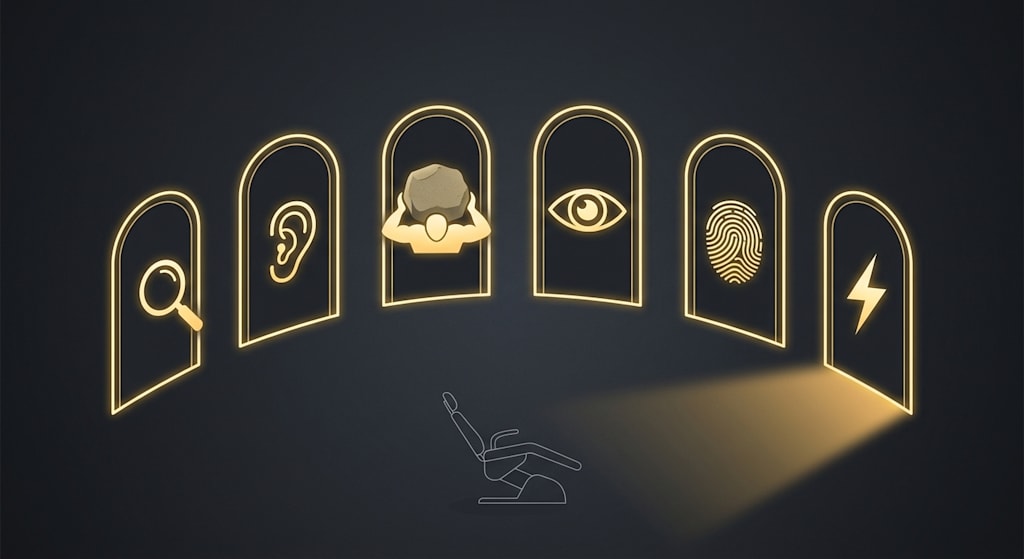
These six doors—refraining, translating, bearing, seeing, touching, improvising—every one of them shut.
The key belongs only in living hands.
That afternoon, after the last patient left, I took off my mask. Sat down. Drank a sip of water.
Outside, dusk. My phone lit up: a push notification from some AI app. "Toothache? Get a reference answer in three seconds."
I turned the screen off. Stood up. Put the used instruments in the ultrasonic cleaner.
Six patients tomorrow.
Their pain—AI doesn't know it.
I do.
About the Creator
Jin
Writer of reamstories
https://reamstories.com/jin
Enjoyed the story? Support the Creator.
Subscribe for free to receive all their stories in your feed. You could also become a paid subscriber, letting them know you appreciate their work.
Comments
There are no comments for this story
Be the first to respond and start the conversation.