
AI Just Started Running a Telescope: Here’s What That Means for Science
At China’s StarWhisper Telescope, an agent plans observations, spots early supernova candidates, and waits for a human to hit confirm. The future of research isn’t fully automated. It’s quieter, stranger, and already here.
Agent walks into the telescope: the research execution layer is being rewritten
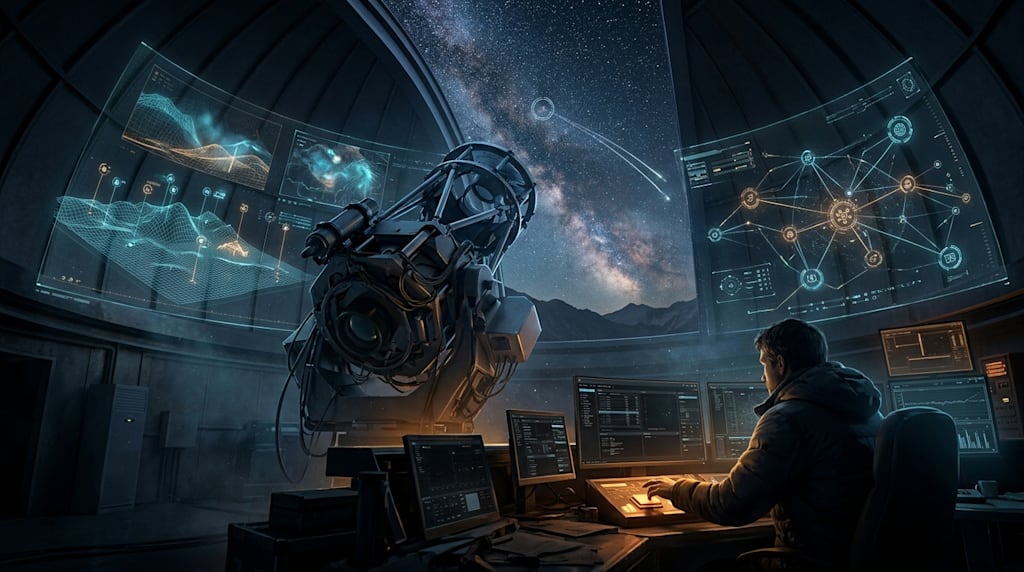
At night at the Xinglong Observing Station, before the dome opens, weather sensors report first. Cloud cover, humidity, wind speed, and lunar phase enter the environmental model. The status of key telescope components and sensors is organized into standardized context through MCP interfaces. The agent uses this information to run the observation plan through the digital simulation system: target priority, observable windows, exposure parameters, scheduling conflicts, and data return paths. After the plan passes, it waits for a human to confirm. The dome opens. Starlight falls onto the focal plane.
In this workflow, the agent does not pose questions for astronomers or explain the universe for them. It connects the scientific model, environmental model, telescope control system, and simulation environment. It senses, calls tools, verifies, and iterates. The recent work of the National Astronomical Observatories’ StarWhisper Telescope team matters here. It was selected for Stanford’s AI Index Report 2026 and was jointly developed by the NAOC Milky Way 3D Structure Group and the Xinglong Observing Station. The team built a digital simulation system for large-aperture research-grade telescopes. This system gives agents an experimental environment for observation planning and control strategy validation. The work received guidance from the Chinese Academy of Sciences’ “Panshi” large model team and technical support from the Qwen large model and Qwen office tool environment.
One detail stands out. With large-model-assisted development, the team completed the core simulation environment in a short time. The overall development cost is expected to stay on the order of a thousand yuan. Work that once took months to complete, including research software and simulation systems, was compressed into days. This changes the development model for research software and scientific facility simulation systems.
The agent framework now connects to the “Sitian” Pathfinder and the “Sitian” prototype. Since the connection, the agent has flagged eight very early supernova candidates. Two triggered follow-up observations when weather allowed. A candidate is not a confirmation. Eight is an early signal. Even so, the agent has entered a real research execution workflow and left testable traces on the facility.
Why astronomical observation fits agent deployment
For an agent to gain a firm footing in research, scenario selection matters. Astronomical observation has several conditions.
First, goals are clear. Discovering early supernova candidates, arranging follow-up observations, and adjusting plans based on weather and equipment status all have clear inputs, constraints, and outputs.
Second, the process is complex but decomposable. Target priority, observable windows, weather, equipment status, exposure parameters, scheduling conflicts, and data return all have interfaces and states. Each can be monitored and called.
Third, results are testable. Whether something was observed, whether equipment executed as planned, and whether a candidate source is later confirmed all have hard standards. In this closed loop, the agent is easy to constrain and easy to improve.
Work like the StarWhisper Telescope connects several previously scattered modules into one system. The scientific model determines what to look at. The environmental model determines whether observation is possible and how to proceed. The telescope control system executes. The simulation system handles trial and error in advance. The agent plans, calls tools, and iterates between them. MCP interfaces standardize the status of key telescope components, sensors, and observation environment information. This lets the agent monitor and call different tools and devices. The simulation system provides a low-risk sandbox. Strategies run in the virtual environment first, then enter the real facility. Telescopes are expensive and scarce. The agent cannot try things at will. Simulate first, execute later. That sequence is the safety belt for an agent entering a research facility.
Three layers of change
Over a longer horizon, research agents will change research work on three levels.
The first layer is efficiency. Agents can organize data, search literature, write scripts, generate observation plans, check parameters, and schedule instruments. This layer is already happening. It mainly reduces time spent on repetitive work.
The second layer is process restructuring. In the past, research workflows were linked by hand: look at data, think of goals, apply for observation, wait for results, analyze, and apply again. Each step involved waiting, communication, and repeated operations. Once the agent connects models, databases, instruments, and simulation environments, these steps can become a more continuous loop. When a candidate source appears, the agent assesses priority and observability, triggers follow-up observations when weather permits, and adjusts the next round based on results. Researchers put more energy into problem design, evidence judgment, and interpretation.
The third layer is research infrastructure. In the future, the key question is not how smart a single agent is. The key question is whether there is a reusable network of research tools: data interfaces, instrument interfaces, simulation environments, evaluation systems, permission systems, and expert feedback mechanisms. The agent acts as dispatcher and executor inside that network. Whoever builds these foundations solidly will gain an efficiency advantage.
The StarWhisper Telescope practice sits between the first two layers and begins to touch the third. It uses large models to lower the cost of simulation system development, MCP to connect tools, the agent to link scientific models with real facilities, and closed-loop feedback to iterate. If this path works, it can be copied to other research facilities.
Four bottlenecks
The prospects are broad. The bottlenecks are also clear. An agent will not become a scientist just because large models get stronger. Four issues determine how fast deployment goes.
First, evaluation and feedback speed. Astronomical observation gives relatively fast feedback. Observe today, and results may come tomorrow. Drug design, materials screening, and social sciences give slow feedback. Agent self-iteration becomes difficult. Without automatic evaluators, an agent easily becomes a chatbot that can call tools. The core of a research agent is producing plans that can be verified, filtered, and iterated.
Second, the gap between simulation and reality. What works in simulation may fail on a real telescope or in a real laboratory. Environmental disturbances, equipment aging, sensor errors, and sudden weather changes can all invalidate a strategy. Facilities need online calibration, reliable design, and safety boundaries. Telescopes are expensive. Critical operations must keep a human in the loop. Permissions must be tiered.
Third, auditability and responsibility. Research requires reproducibility. The agent’s model version, prompts, tool calls, and decision basis must leave traces. Why a candidate source was triggered and why an observation was canceled must be explainable afterward. Research cannot accept black-box execution. As the agent goes deeper into the execution layer, auditing and accountability become more important.
Fourth, exploration and contingency. Agents are good at goal optimization. Research breakthroughs often come from anomalies and accidents. If the agent only optimizes predetermined goals, it may ignore anomalous signals. It needs a reserved exploration budget, anomaly detection, and room for unconventional discovery. Otherwise, it will turn research into an assembly line instead of a journey of discovery.
There are also issues with interface standards, data quality, operations and maintenance, and ethical norms. A development cost in the thousands of yuan is good news. The costs of operation, maintenance, validation, and personnel training cannot be ignored. A research agent is not a one-off project. It is long-term infrastructure.
Prospects: what to expect from research agents
Agents will land first in fields with clear processes, clear feedback, and mature toolchains: astronomical observation, automated experiments, high-throughput materials screening, drug design, weather simulation, and particle physics data processing. These fields share four features: goals can be defined, processes can be decomposed, results can be tested, and tools can be interfaced.
In the next five years, the first useful system will likely be a semi-automated research loop rather than a fully automated laboratory. Humans set goals. The agent runs the process. Simulation previews. Real facilities execute. Evaluators filter. Humans make final judgments. Researchers pose questions, set goals, design evaluation standards, interpret results, and make scientific judgments. The agent handles observation, execution, verification, and iteration.
Scientists are not being marginalized. As execution costs fall and iteration speeds up, scientific judgment, problem definition, and ethical responsibility become more important. What is scarce is no longer the ability to stay up all night tuning parameters. What is scarce is the ability to ask good questions, design good evaluation standards, and explain anomalies.
The StarWhisper Telescope demonstrates a replicable method. It uses large models to lower the development cost of simulation systems, MCP to connect tools, the agent to link scientific models with real facilities, and closed-loop feedback to iterate. It moves the agent from “can think” to “can do.” It leaves testable traces on real research facilities.
One night, the agent generates an observation plan. The simulation system approves it. A human clicks confirm. The dome opens. Starlight falls onto the focal plane. The candidate source number enters the queue. Weather sensors keep reading. The next day, data returns. The evaluator filters. A person opens the log to see which step needs changing. Research is turning from a workshop where people watch people into infrastructure that runs as a system. The change is quiet. The log is open. The next plan is already running.
About the Creator
Jin
Writer of reamstories
https://reamstories.com/jin
Enjoyed the story? Support the Creator.
Subscribe for free to receive all their stories in your feed. You could also become a paid subscriber, letting them know you appreciate their work.
Comments
There are no comments for this story
Be the first to respond and start the conversation.