
AI Just Broke an 87-Year-Old Math Conjecture. The Counterexample Is Simple Enough to Check by Hand.
For nearly a century, mathematicians tried to prove the Jacobian conjecture. An AI found three points that proved them wrong.
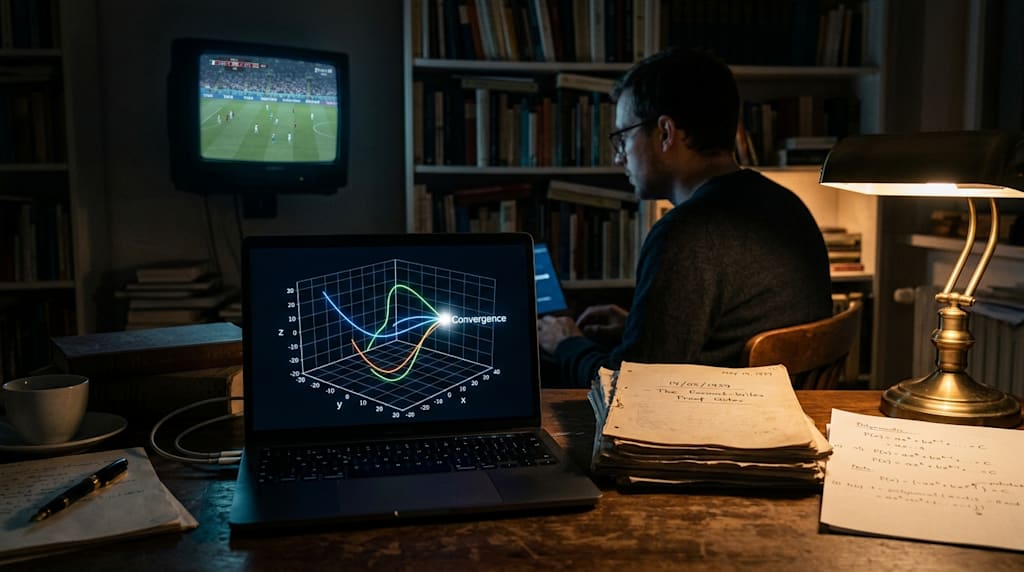
On July 20, 2026, Levent Alpöge posted a short message. No paper. No preprint. He wrote that the Jacobian conjecture is false. Then he thanked Claude Fable, the AI model that kept working during the World Cup final.
Abhishek Saha, a mathematician at Queen Mary University of London, called it the mathematical conjecture with the highest AI involvement he had seen. Professors and students checked the polynomials. The result held.
Eighty-seven years ended with a post.
The conjecture
Ott-Heinrich Keller proposed the Jacobian conjecture in 1939. Take a polynomial mapping. If its Jacobian determinant is always a nonzero constant, must the mapping be invertible everywhere?
Picture a rubber sheet. You can stretch and twist it. No tiny region can be flattened. Does that guarantee no two different points on the sheet end up in the same place?
The intuition says yes. For eighty-seven years, almost no one treated that intuition as a question.
Mathematicians worked on proof. Low dimensions held. Special cases held. Higher-order cases advanced. Those results made the conjecture feel true, just hard. Steve Smale put it on his list of eighteen problems for the 21st century. Zhang Yitang wrote his Purdue doctoral dissertation in this area. He used a lemma from his advisor. The lemma was later falsified. The proof chain broke. His academic path stalled for years.
The question
Alpöge did not ask AI to prove the conjecture. He asked whether it could find a counterexample.
That question was rare. When a conjecture looks obviously true, and many special cases support it, searching for a counterexample looks like a waste. People add bricks to the proof. They do not check whether the foundation is wrong.
AI has no career invested in the foundation.
The counterexample is three-dimensional. Its Jacobian determinant is always -2. That satisfies the conjecture's premise. The mapping is still not one-to-one. Three points, (0, 0, -1/4), (1, -3/2, 13/2), and (-1, 3/2, 13/2), all map to (-1/4, 0, 0).
Three positions become one. No inverse function exists.
The counterexample is small. A calculus student can take the partial derivatives and check it. Saha said verification is easy once the solution exists. He did not know what prompt produced it. Brute force would not work.
Terence Tao explained the geometry behind the counterexample. Lean 4 verified it by machine. The mathematical community accepted the result.
Why nobody saw it
The counterexample is simple. Why did eighty-seven years pass without anyone finding it?
Mathematical research rewards proof. It does not reward hunting for counterexamples to beloved conjectures. When generations of careers rest on the belief that a statement is true, questioning it becomes risky. A colleague may treat you as an outsider. You may lose years. You may find that your dissertation topic was built on a false premise.
AI has no such risk. It does not treat a conjecture as authority. It does not care how obvious a statement seems. It can search spaces too large for human patience and look in corners humans skip.
AI has joined mathematical discovery before. The difference here is what it found. It did not help prove a theorem. It showed that the question itself was wrong.
After the counterexample
When the counterexample appeared, a research direction emptied out. Papers, methods, and intuitions built on the Jacobian conjecture lost their base. Unfinished manuscripts and dissertation topics suddenly had no floor.
Mathematicians did not stay shocked for long. They verified the counterexample and formalized it. They redrew the conjecture's boundaries. The two-dimensional version remains open. One counterexample does not create a new branch of mathematics. Understanding the geometry and algebra behind it still takes human work.
AI did not replace mathematicians. It expanded the search. It moved through millions or billions of structures and reported that a century-old road was a dead end.
Zhang Yitang
Zhang Yitang's history surfaced again. In the 1980s, his doctoral work touched the Jacobian conjecture. He relied on a lemma from his advisor. The lemma was falsified. The proof failed. After graduation, he could not get a recommendation letter. He could not stay in academia. He drifted for years. Then his work on twin primes shocked the world.
A conjecture shapes more than a proof. It shapes careers, institutions, and what people believe is worth trying. For eighty-seven years, many people walked the road of proving the Jacobian conjecture. AI used one counterexample to show that the road may have started at a cliff.
This is not a story about failure. Mathematical research often sails a known sea. Mathematicians use intuition, experience, and training to pick a direction. That method has produced a great deal. It also creates habits. People try to prove what should be true. They rarely question what seems obviously true.
AI does not share those habits. It will sail into an empty-looking sea.
What remains
The two-dimensional Jacobian conjecture is still open. The counterexample limits the conjecture to higher dimensions. It does not solve the two-dimensional case.
AI's discovery still depended on human prompts, human direction, and human verification. It did not start from zero and understand mathematics. It searched at scale inside a human frame. Its ease came from computation, training, and human judgment.
Scientific discovery still runs on social machinery. Peer review, academic recognition, and theoretical integration will not vanish because AI intervened. A counterexample spreads fast. Rebuilding a branch of mathematics takes time.
July 20, 2026. A post with a string of polynomials. Three points mapped to one point.
Eighty-seven years of proof work changed direction there.
No slogan. No grand claim about the era of AI. A counterexample sits in public view. Anyone can check it. A student can open a computer, take derivatives, test the determinant, plug in the three points, and see them land in the same place.
Then the student can see something else. For eighty-seven years, no one looked in that corner.
AI looked. A human asked it to.
Humans still ask the questions, judge the answers, and decide what they mean. AI widens the ocean and exposes the reefs sooner. It keeps ignored corners from staying silent.
One counterexample diverted eighty-seven years of proof. In that diversion, a working pattern appears: humans ask, AI explores, humans verify. The work is shared.
The two-dimensional conjecture remains. It waits for a proof or another counterexample.
About the Creator
Jin
Writer of reamstories
https://reamstories.com/jin
Enjoyed the story? Support the Creator.
Subscribe for free to receive all their stories in your feed. You could also become a paid subscriber, letting them know you appreciate their work.
Comments
There are no comments for this story
Be the first to respond and start the conversation.