
AI Is Eating the Memory That Would Have Gone Into Your Next Phone
Global smartphone shipments fell 22% in Q3 2026, the largest drop on record. The cause sits in data centers, not in your pocket.
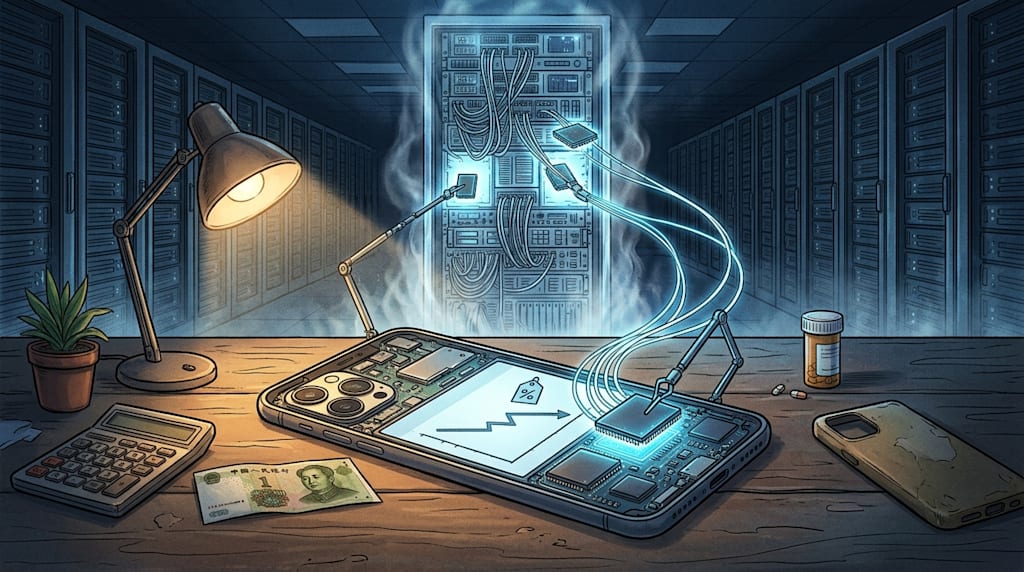
In Q3 2026, global smartphone shipments fell to 255.3 million units. That is a 22.0% drop from a year earlier. IDC calls it the largest quarterly decline on record.
Nabila Popal, IDC’s senior research director for worldwide devices, said: “The market downturn the industry had been anticipating finally materialized in the third quarter of this year. But this is not the worst of it. The available data suggest the market has not yet bottomed out.”
The industry expected trouble. It did not expect 22% to be the floor.
The problem does not start inside the phone industry.
The capacity went somewhere else
To understand why phones are not selling, start with where a chip went.
In 2026, global AI server shipments grew about 180% year over year. AI servers now account for 53% of total global storage demand. A single AI server carries 8 to 10 times the DRAM of a traditional server and about 3 times the NAND.
Samsung, SK Hynix, and Micron have moved 70% to 90% of their advanced capacity to HBM and server-grade DRAM. Mobile DRAM capacity and design resources have been pulled away in large volumes.
This is not just higher demand pushing prices up. The migration of capacity from mobile to servers shifts the supply curve for smartphone memory to the left. At any given price, less can be supplied to phones than before.
Memory chip costs have climbed about 350% year over year.
UBS estimates that by Q4 2026, memory will account for 35% of the BOM cost of high-end flagship phones and 56% of the BOM cost of low-end phones. In Q4 2025, those shares were 13% and 29%. Within a year, memory’s weight in the total device cost has nearly tripled. More than half of a low-end phone’s material cost now goes to storage.
Cost pass-through: from BOM to retail price
When costs rise, prices follow.
Since the start of 2026, global smartphone retail prices have risen about 20% cumulatively. Several research firms estimate that the global average selling price of smartphones will reach $581 in 2026, up 27.6% year over year.
The sharpest increases are at the low end. Low-end phones have a higher memory share in their BOM, at 56%. The same memory price increase hits low-end phones nearly twice as hard as high-end phones.
The thousand-yuan phone is in a tight spot. Costs that could be cut have long been cut. The profit margin that supply-chain advantages could squeeze has already bottomed out. When memory costs rise by 1,700 yuan, with a 12GB+256GB combination going from about 500 yuan to about 2,200 yuan, a budget phone has three options: raise prices and lose its price advantage, cut specs and lose competitiveness, or sell at a loss. None is easy.
High-end phones have more room. For a flagship priced above 6,000 yuan, memory’s cost share has risen from 10 to 15 percent up to 30 to 40 percent. Profit is heavily compressed, but the device does not become loss-making. High-end users are also far less price-sensitive than budget-phone buyers.
How demand responded
Phones are a necessity. A 22% shipment decline shows that even necessities can be suppressed by price increases.
Francisco Jeronimo, IDC’s vice president of worldwide devices, said: “The pressure has been transmitted from upstream vendors to end consumers. After retail prices moved higher, many users chose to keep their old phones and delay replacement.”
Shilpi Jain, a senior analyst at Counterpoint, added: consumers are holding onto their existing devices longer than expected, increasingly considering refurbished phones, and prioritizing high-value models.
The refurbished market matters here. When new-phone prices rise 20%, refurbished phones become more attractive. Some users who would have bought a new budget phone turn to a refurbished previous-generation flagship. Same budget, better screen, better camera, better build. That substitution effect drains demand from new low-end phones.
Longer replacement cycles also shrink the market. When consumers find that the phone in their hand can last a few more years with patches, new-phone demand gets postponed by choice.
Who is gaining share against the tide
The overall market shrank 22%. The brand-level split says more than the headline number.
Samsung held first place with a 22.6% share. Its shipments fell only 5.8% year over year. The Galaxy Z Fold8 series saw strong initial demand. The mid-range A series had relatively stable component supply. Samsung picked up space in emerging markets as some Chinese brands pulled back.
Apple followed with a 22.4% share, down only 4.0%. The iPhone 18 Pro performed better than its predecessor in China and India. Together, the two international giants hold 45% of the market, up about 8 percentage points from before.
Xiaomi’s shipments fell 29.2% year over year. That number needs context. Xiaomi reduced investment in low-price products and non-core overseas markets. It raised its average selling price and tightened shipment plans. Selling at an uneconomic margin during a memory crisis means the more you sell, the more you lose. Cutting shipments is the rational choice.
OPPO and vivo both fell more than 30%. OPPO consolidated the product portfolios and operations of its three brands to reduce overlap. Vivo prioritized its core markets in India and China while expanding its high-end series. Both are cutting unprofitable product lines and concentrating resources on core markets.
Huawei is the only top vendor to grow against the tide. Its Q3 share reached 21.1%, up 17.3% year over year. Huawei can suppress its previous premium to trade for sales volume. That capability comes from its unique supply chain and technical barriers. When other vendors are forced to raise prices, Huawei compresses profit margin to gain share.
Why this cycle is different
For the past two decades, memory price cycles were driven by the inventory rhythm of phones and PCs. They turned roughly every two to three years. Vendors expanded. Supply exceeded demand. Prices fell. Production was cut to clear inventory. Prices recovered. The cycle repeated.
The old cycles were driven by demand fluctuations in consumer electronics. Phones sold well. Memory demand rose. Vendors expanded. Capacity overshot. Prices fell. Phone costs dropped. Demand rose further. A self-adjusting loop.
The current driver is the explosive growth of AI compute. Nanya Technology expects the DRAM shortage to last until early 2028. If that judgment holds, the squeeze on end devices will run through the entire supply chain for years, not quarters.
AI’s demand for memory is not cyclical. Large-model training and inference require massive amounts of memory. The expansion of AI server clusters has only just begun. As long as AI compute demand keeps growing, memory capacity will keep tilting toward servers. Phones will keep facing tight supply.
The profits from higher prices flow upstream to semiconductors and other related suppliers. A large part of the higher price consumers pay for a phone is an indirect bill for the AI industry’s chip war.
Most people have not received AI dividends yet. They are first bearing a compute tax caused by upstream supply pressure.
What happens next
IDC expects market growth to remain constrained into 2027. Recovery is pushed back to at least 2028.
Major phone vendors are realizing that the industry’s cost structure has undergone a permanent shift. This is not a winter to wait out. The winter may not fully pass.
Some vendors, expecting component supply to tighten further next year, have already raised production plans. If end demand stays weak, inventory could pile up in 2027. That creates new downside risk to industry forecasts.
In an environment of high cost pressure, vendors need to balance R&D investment, hardware costs, and retail pricing. Only by turning AI capabilities into high-frequency, practical use cases can they unlock the huge installed base. Those AI features must not require even more memory and push costs higher still.
The loop is circular. Phone vendors are being pushed back by AI chip price increases. The selling point they are expected to use to persuade users to upgrade is AI features. AI features need more memory. More memory means higher cost. Higher cost means higher retail prices. Higher retail prices mean fewer buyers.
When that loop breaks depends on when memory supply loosens. Until then, patching up the old phone can last a few more years.
About the Creator
Jin
Writer of reamstories
https://reamstories.com/jin
Enjoyed the story? Support the Creator.
Subscribe for free to receive all their stories in your feed. You could also become a paid subscriber, letting them know you appreciate their work.
Comments
There are no comments for this story
Be the first to respond and start the conversation.