
AI Is Eating the Entry-Level Job. That Is How Expertise Dies.
We keep automating the work that turns beginners into experts, then wonder why no one can handle a crisis.
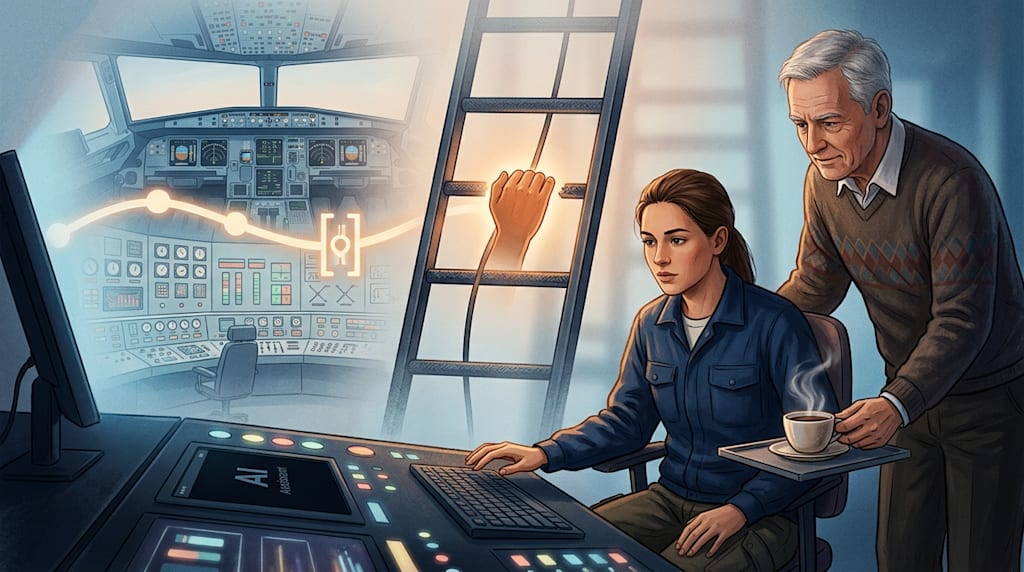
Lin Zhao fixed a bug alone on the day Lu Yuanzhou turned off her AI assistant.
"Reproduce it first. Do not look at the model's suggestion yet."
She stared at the screen. Her usual method was simple. Paste the error into a chat box. Wait three seconds. Get a fix with comments. Scan the logic. Merge. On a good afternoon she could close five or six issues.
Lu Yuanzhou made her work without that shortcut. He was the only person on the team who could smell a memory leak in a single log line. She wanted to become that kind of engineer.
The question here is not whether AI is useful. It is. The question is what happens when AI takes over every entry-level task that once turned beginners into experts.
The ladder is disappearing
A Harvard working paper studied more than 280,000 U.S. firms and 65 million workers. It found that in the six quarters after firms introduced generative AI, entry-level employment fell while senior employment kept growing. An analysis by Stanford based on ADP payroll records reached a similar conclusion. Among occupations most exposed to AI, younger workers lost roles while experienced workers held on.
Researchers at the New York Fed offered another explanation. Rising youth unemployment may come largely from remote work, because firms do not want to train inexperienced people over video calls. These explanations differ, but they point to the same break. The path that carries skill from a senior worker to a newcomer is failing.
Newcomers used to enter a profession by doing basic work. They wrote simple code, hunted low-level bugs, reproduced failures, wrote tests, and sorted logs. The tasks looked small. They were the doorway into how a system actually works. Newcomers learned to ask questions, to distrust clean answers, and to test boundaries. Senior people watched them through those tasks and corrected them. Much of that correction never made it into a document.
AI now finishes those tasks faster. So entry-level roles shrink into roles that demand three years of experience. Companies do not hate newcomers. They do not want to pay for a training process that looks replaceable.
No one can skip the junior stage and become a senior engineer.
Confident answers, missing judgment
Lu Yuanzhou had mentored many newcomers. His fear was not that they knew nothing. His fear was that they did not know what they did not know.
AI output often looks confident. It arrives complete and neatly formatted. It rarely says, "I am not sure here." A person without experience can mistake that confidence for reliability.
A senior engineer reads an AI-generated fix and asks questions. Were edge cases handled? Were exception paths covered? Does this assumption hold in production? Did the code pass because the logic is right, or because the test missed the failure? Those questions do not come from a prompt guide. They come from bugs that burned a weekend and incidents that burned a release.
If newcomers spend years only supervising AI, they may learn to check formatting instead of judgment. The organization then makes a quiet mistake. It treats "someone is watching" as "someone is thinking."
Skill loss rarely announces itself with an accident. It shows up as a team that stops noticing.
The automation paradox
Stronger automation means fewer hours of hands-on practice. When automation gets confused or fails, it often hands the worst moment back to a human. Aviation calls this the automation paradox.
Air France Flight 447 is the hard case. In 2009 the plane crashed into the Atlantic. Ice blocked the airspeed sensors. The autopilot received bad data and disconnected, as designed. The crew then failed to recognize a high-altitude stall and recover manually. The hardware did not fail first. Years of reliance on autopilot had eroded the pilots' hands-on skill.
Aviation did not abolish autopilot. It put manual flying back into training. In 2017 the U.S. Federal Aviation Administration issued Safety Alert for Operators 17007. The alert said manual flying is the foundation of other flying skills and named skill degradation as a safety hazard. Some airlines changed procedures. When weather is good, pilots are encouraged to fly takeoff climb and initial descent by hand. The airlines accept a small fuel cost to keep raw flying ability alive.
The trade-off is easy to state. A system that chases maximum optimization while producing operators with weak skills is not optimized. It has moved failure risk somewhere the dashboard cannot see.
The human checkpoint
More than a decade ago, an engineering team designed a fully digital control system for a U.S. nuclear plant. On paper the system looked perfect. It could run on its own, modeled on modern commercial aircraft. Operators would monitor and rarely intervene. The team made a decision that looked backward to anyone focused on speed. In processes the system could run automatically, they kept several manual steps.
The reason was practical. If operators only monitor an automated system, they stop being operators. Their hands forget the equipment. Their sense of the plant's real state goes soft. One day the system will hand control back, and that is the dangerous moment. The person at the console may not have touched the equipment in years.
The manual steps kept skill alive. The design accepted lower efficiency on purpose.
That idea translates to AI workflows. Put human checkpoints in the process. A human checkpoint is a node where a person must take over. It is not a quick signature. It is not only a safety lock. Its job is to exercise skills that fade when they are never used. The organization decides which abilities must remain human because a crisis will depend on them. Then it builds small amounts of friction into the workflow so those abilities do not go stale.
Lin Zhao's team used a checkpoint on debugging. When a core module broke, the assigned engineer had to turn off the AI assistant. The junior engineer went first. Reproduce the failure. Find the root cause. Write a test that catches the bug. Only then could the engineer turn AI back on for fix ideas, alternative approaches, and a scan for similar bugs. The engineer compared his or her own judgment with the model's output.
When human and AI disagree, the checkpoint earns its cost. The conflict shows up on a normal Tuesday, not during a production outage.
Who pays for skill
A human checkpoint costs money. Short-term speed will fall. Letting newcomers do work AI could do costs payroll and time. It also builds the people who will carry the system later.
Quarterly targets push the other way. An executive who keeps headcount that AI could replace will face board questions before the payoff arrives. Founders with control, private firms, long-horizon institutions, and regulators can see the longer ledger. Regulators already force pilots to demonstrate hands-on skill. Safety-critical industries may need the same rule for AI-heavy work.
The organizations most able to protect their talent pipeline are the ones willing to trade some short-term profit for long-term capability. Everyone else needs outside pressure.
Back at the desk
Forty minutes after Lin Zhao turned off AI, she reproduced the bug.
The cause was dull. A cache expiration policy failed under concurrency. The AI fix she had almost accepted only shortened the expiration time. It never touched the root cause. She wrote a reproduction case, ran it, and then opened AI again. This time she compared the model's suggestion with her own work line by line. She marked two places where she thought the model was wrong.
Lu Yuanzhou walked over. He looked at the screen and said nothing. He put his cold coffee on her desk.
"Next core module failure, you go first again," he said.
Lin Zhao nodded. She knew what that meant. A slower process. More overtime. Fewer issues closed. She also knew that if she skipped those forty minutes today, she would still be unable to judge the next fix on her own.
Deliberately preserving some inefficiency is not waste. Safety-critical engineering has treated it as insurance for decades and paid the premium. When AI takes over the work that forges professional skill, the answer is not to reject automation. The answer is to design workflows that keep human hands in the loop.
Then, when automation fails, someone at the console still knows what to do.
About the Creator
Jin
Writer of reamstories
https://reamstories.com/jin
Enjoyed the story? Support the Creator.
Subscribe for free to receive all their stories in your feed. You could also become a paid subscriber, letting them know you appreciate their work.
Comments
There are no comments for this story
Be the first to respond and start the conversation.