
AI in Education Market Poised for Explosive Growth as Personalized Learning Reshapes Global Classrooms
From intelligent tutoring systems to AI-powered career guidance, artificial intelligence is transforming how students learn and how institutions operate.

The global education sector is undergoing one of the most significant transformations in its history. At the center of this change is artificial intelligence (AI), a technology that is rapidly redefining how students learn, how teachers teach, and how educational institutions manage their operations.
What was once considered a futuristic concept is now becoming an everyday reality in classrooms, universities, and corporate training programs around the world. AI-powered learning platforms, virtual tutors, automated grading systems, and predictive analytics tools are helping educators deliver more personalized and efficient learning experiences than ever before.
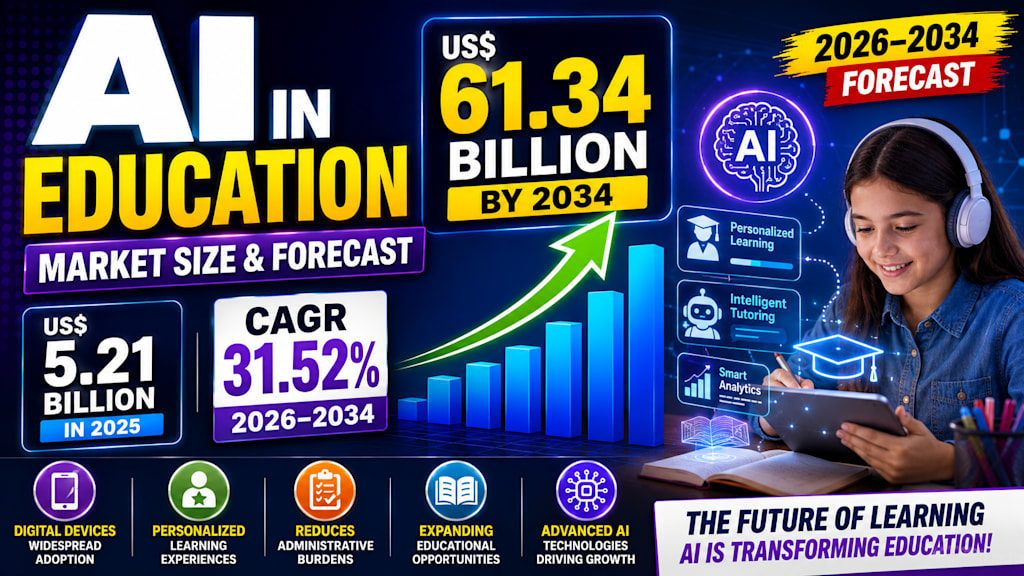
The momentum behind this transformation is reflected in market projections. According to industry estimates, the global AI in Education market is expected to grow from US$ 5.21 billion in 2025 to an impressive US$ 61.34 billion by 2034, representing a remarkable compound annual growth rate (CAGR) of 31.52% during the forecast period. Such extraordinary growth highlights the increasing importance of AI technologies in shaping the future of education.
As educational systems adapt to changing learner expectations, digital transformation, and workforce demands, AI is emerging as a powerful tool capable of making learning more accessible, engaging, and effective.
The Rise of Intelligent Learning
Traditional education has long relied on standardized teaching methods designed to serve large groups of students simultaneously. While effective in many respects, this approach often struggles to accommodate individual learning styles, strengths, and weaknesses.
Artificial intelligence offers a solution by enabling personalized learning experiences at scale.
Modern AI-powered educational platforms analyze student behavior, performance data, engagement patterns, and learning preferences. Based on this information, they can recommend customized lessons, adjust difficulty levels, and provide targeted feedback in real time.
Instead of moving through a fixed curriculum at the same pace, students can learn according to their individual needs. This personalized approach helps improve comprehension, retention, and overall academic performance.
For educators, AI provides valuable insights that can identify knowledge gaps early, allowing intervention before students fall behind. As a result, learning becomes more adaptive, responsive, and student-centered.
Why AI Is Becoming Essential in Education
Several powerful trends are driving the rapid adoption of AI technologies across educational institutions worldwide.
Personalized Learning Takes Center Stage
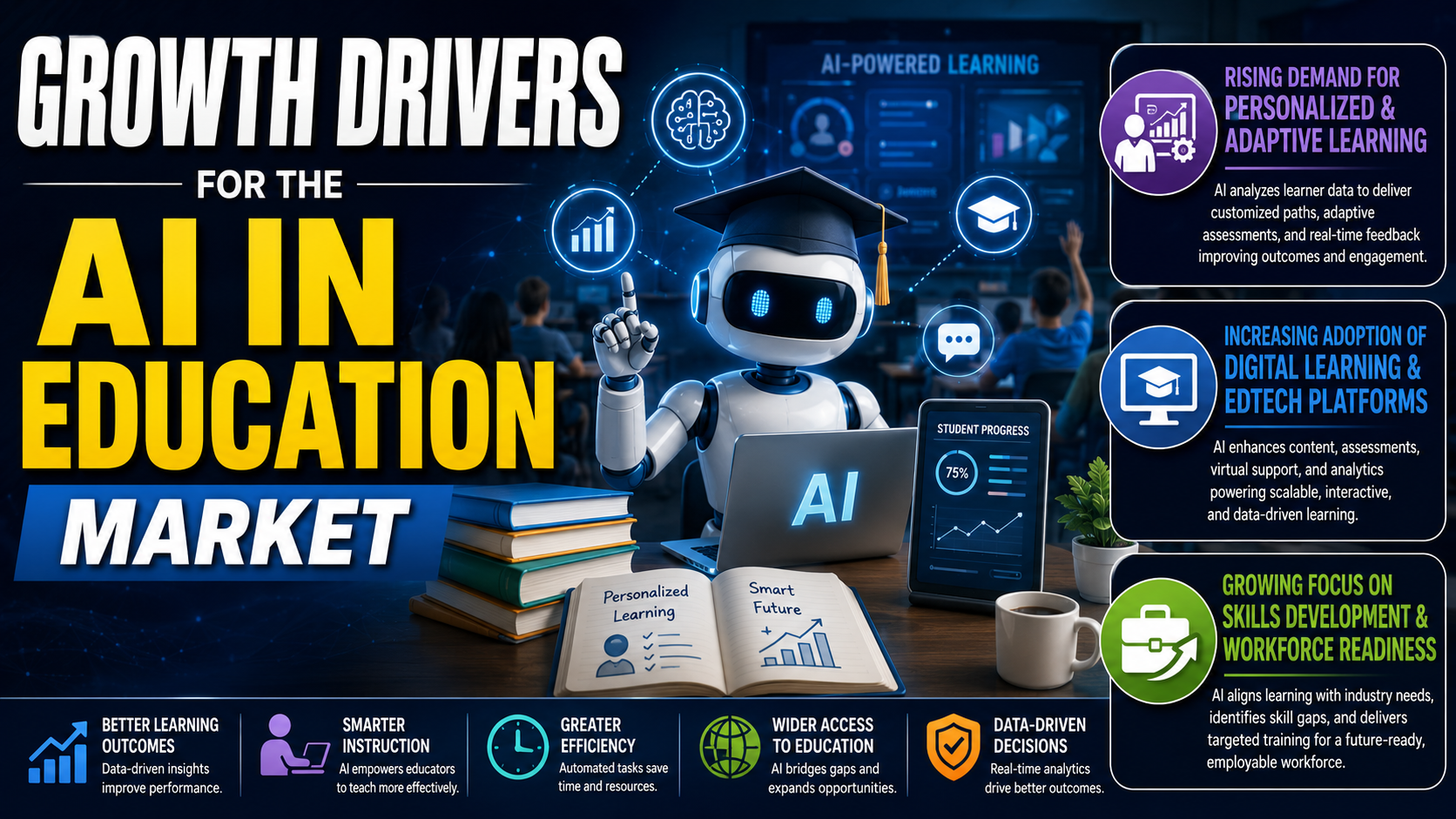
One of the biggest factors fueling market growth is the increasing demand for personalized education.
Students learn differently. Some grasp concepts quickly, while others require additional practice and support. AI enables educational platforms to tailor learning pathways based on individual progress and capabilities.
Adaptive learning systems can modify content difficulty, recommend additional resources, and create customized study plans. This approach helps maximize learning efficiency while improving student confidence and engagement.
As educators seek better ways to support diverse learners, personalized AI-powered learning continues to gain momentum.
Growth of Digital Learning Platforms
The expansion of digital education has created ideal conditions for AI adoption.
Online courses, virtual classrooms, mobile learning applications, and hybrid learning environments generate vast amounts of educational data. AI systems can analyze this data to improve learning experiences and optimize educational outcomes.
Intelligent chatbots answer student questions around the clock. Automated grading systems reduce administrative workloads. Recommendation engines suggest relevant learning materials based on student performance.
These capabilities make digital learning more interactive, scalable, and efficient.
The widespread acceptance of remote and blended learning models following the pandemic has accelerated investment in educational technologies, creating further opportunities for AI integration.
Preparing Students for Future Careers
The modern job market is evolving rapidly due to automation, digitalization, and technological innovation. As industries change, educational institutions face growing pressure to prepare students with future-ready skills.
AI-powered platforms help bridge this gap by analyzing labor market trends, identifying emerging skill requirements, and recommending personalized learning pathways.
Students can receive guidance on in-demand skills, career opportunities, and certification programs aligned with industry needs.
Corporate training providers are also embracing AI-driven learning systems to support workforce development, reskilling, and lifelong learning initiatives.
This growing emphasis on employability is becoming a major catalyst for AI adoption across educational ecosystems.
Transforming the Student Experience
The impact of AI extends far beyond personalized learning.
Today's educational technologies are creating entirely new ways for students to engage with knowledge.
Intelligent Tutoring Systems
AI-powered tutoring platforms can provide one-on-one support to students at any time of day. These systems analyze responses, identify misunderstandings, and offer explanations tailored to individual learning needs.
Unlike traditional tutoring, AI solutions can scale to support thousands or even millions of learners simultaneously.
Virtual Learning Assistants
Many institutions are deploying AI-driven assistants that help students navigate coursework, deadlines, schedules, and administrative processes.
These virtual assistants improve accessibility while reducing the burden on support staff.
Smart Content Creation
Artificial intelligence can also generate educational materials, quizzes, summaries, and interactive learning experiences.
Educators benefit from reduced preparation time, while students gain access to dynamic and engaging learning resources.
Immersive Learning Experiences
Machine learning, natural language processing, and advanced simulation technologies are helping create virtual labs and practical training environments.
These tools enable students to gain hands-on experience in a safe, cost-effective, and scalable manner.
Expanding Access and Inclusion
One of AI's most promising contributions to education is its ability to make learning more inclusive.
Millions of learners worldwide face barriers related to language differences, disabilities, geographic limitations, or economic challenges. AI technologies are helping overcome many of these obstacles.
Speech-to-text and text-to-speech systems assist students with hearing or visual impairments. Real-time translation tools support multilingual classrooms. Adaptive interfaces improve accessibility for learners with diverse needs.
By removing barriers to participation, AI helps create more equitable educational opportunities for students around the world.
This aligns closely with global efforts to improve educational access and reduce learning disparities across different communities and regions.
Benefits for Educational Institutions
AI is not only transforming student learning but also improving institutional management and decision-making.
Educational organizations generate enormous volumes of data related to enrollment, attendance, academic performance, resource allocation, and student retention.
AI-powered analytics platforms help institutions make sense of this information.
Predictive Student Support
By analyzing academic and behavioral indicators, AI systems can identify students who may be at risk of dropping out or struggling academically.
Early intervention programs can then be implemented to improve retention and student success rates.
Operational Efficiency
Administrative tasks such as grading, scheduling, attendance monitoring, and record management can be automated using AI tools.
This reduces workload for educators and administrators while improving operational efficiency.
Strategic Planning
Institutions can leverage AI-driven insights to forecast enrollment trends, evaluate curriculum effectiveness, and allocate resources more effectively.
As competition within the education sector increases, data-driven decision-making is becoming increasingly valuable.
Challenges Facing the AI in Education Market
Despite its enormous potential, AI adoption in education is not without challenges.
Data Privacy and Security Concerns
Educational AI systems rely heavily on sensitive student information, including academic records, behavioral data, and personal details.
Protecting this information from breaches and misuse remains a significant concern.
Institutions must comply with evolving data protection regulations while ensuring transparency regarding how student data is collected, stored, and utilized.
Maintaining trust among students, parents, and educators is essential for long-term success.
Ethical Considerations
Algorithmic bias remains a critical issue.
If AI systems are trained using incomplete or biased datasets, they may produce unfair outcomes that disadvantage certain groups of students.
Developers and institutions must prioritize fairness, accountability, and transparency when deploying AI-powered educational tools.
High Implementation Costs
While large institutions often possess the resources necessary for AI adoption, smaller schools and organizations may face financial barriers.
Implementing AI solutions frequently requires infrastructure upgrades, staff training, technical support, and ongoing maintenance.
These costs can slow adoption, particularly in developing regions with limited educational budgets.
Regional Markets Leading Adoption
AI adoption in education is occurring globally, but several countries stand out as major growth contributors.
United States
The United States remains one of the world's leading AI in Education markets.
Strong digital infrastructure, extensive EdTech innovation, and substantial investment in educational technologies have created a favorable environment for AI adoption.
Institutions across K-12 education, higher education, and corporate learning are increasingly leveraging AI to improve learning outcomes and operational efficiency.
Germany
Germany's approach is shaped by strong regulatory oversight and ethical considerations.
The European Union's AI Act classifies education as a high-risk sector, encouraging the development of transparent, accountable, and GDPR-compliant AI systems.
Government investments in digital infrastructure and teacher training continue to support responsible AI adoption.
India
India is emerging as one of the fastest-growing markets for AI in education.
The country's rapidly expanding digital ecosystem, growing internet penetration, and vibrant EdTech sector are driving widespread adoption.
Public-private partnerships and government initiatives aimed at developing digital skills are helping position India as a major force in AI-powered education.
United Arab Emirates
The UAE has become a regional leader in educational innovation.
Government-led initiatives are integrating AI into school curricula and promoting technology-driven learning environments.
The country's strong digital infrastructure and forward-looking policies continue to attract investment and accelerate adoption.
Recent Industry Developments
The pace of innovation within the AI in Education market remains exceptionally high.
Recent collaborations between major technology companies and educational organizations are accelerating the development of advanced learning tools.
AI-powered tutors, intelligent assessment systems, career guidance platforms, and personalized learning solutions are becoming increasingly sophisticated.
Governments are also taking proactive steps to integrate AI into national education strategies, recognizing its potential to improve competitiveness and workforce readiness.
These developments indicate that AI's role in education will continue to expand over the coming decade.
Final Thoughts
Artificial intelligence is no longer a supplementary technology within education—it is rapidly becoming a foundational component of modern learning ecosystems.
The ability to personalize instruction, improve accessibility, automate administrative tasks, and support workforce development positions AI as one of the most transformative innovations in education today.
With the global AI in Education market projected to grow from US$ 5.21 billion in 2025 to US$ 61.34 billion by 2034, the sector's future appears exceptionally bright. As institutions embrace digital transformation and learners seek more flexible, personalized experiences, AI will play an increasingly important role in shaping how knowledge is delivered and acquired.
The journey toward AI-driven education is still evolving, but one thing is already clear: the classrooms of tomorrow will look very different from those of today, and artificial intelligence will be a major reason why.
About the Creator
Enjoyed the story? Support the Creator.
Subscribe for free to receive all their stories in your feed.
Comments
There are no comments for this story
Be the first to respond and start the conversation.