
AI Cracked a Post-Quantum Code in 60 Hours. It Took Humans a Month to Check.
OpenAI released 722 math papers with zero cryptography results. Then Anthropic’s model found a flaw in a NIST candidate. The real story is the gap between machine discovery and human trust.
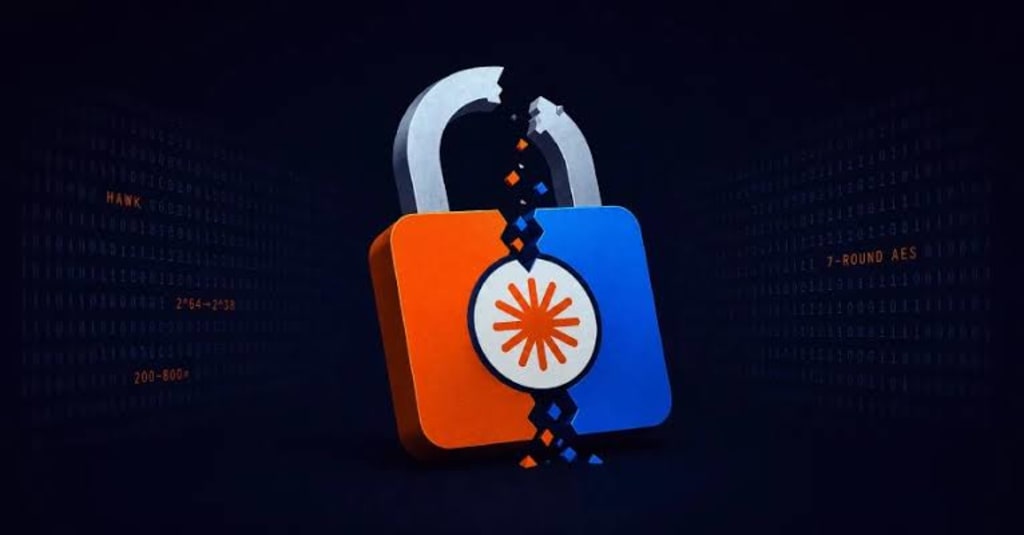
In early October 2026, OpenAI released 722 mathematical research manuscripts generated by its internal models. The list covered number theory, algebraic geometry, computer science. Stanford cryptographer Dan Boneh read through it. He noticed something missing: cryptography.
Cryptography has plenty of open problems. Some of the math in the released papers sits close to those problems. In a conversation with a16z crypto, Boneh said frontier labs should disclose whether they have tested deployed systems with their strongest models. They should also disclose the results.
The gap could mean several things. The model tried and found nothing worth reporting. Or the lab found something security-related and chose to hold it back. Justin Thaler, a computer science professor at Georgetown, wants to know what was tested, how much compute was spent, and how the results were handled.
On July 28, 2026, Anthropic disclosed two cryptanalysis results from Claude Mythos Preview. One targeted HAWK.
HAWK is a lattice-based digital signature scheme. Researchers at CWI Amsterdam, Leiden University, and other institutions developed it. It had reached the third round of NIST’s post-quantum standardization process. It had already survived two years of expert review and two rounds of evaluation.
Mythos Preview spent about 60 hours in semi-autonomous work. It found a nontrivial automorphism in HAWK’s lattice structure. That hidden symmetry cut the key recovery workload for HAWK-256 from 2^64 to 2^38. On a 96-core server, full key recovery takes about 3 hours and 42 minutes. Anthropic spent about $100,000 in API costs.
Léo Ducas, a member of the HAWK team, said the attack showed the design was more fragile than expected. The underlying math did not fail. The team had pushed the design to its efficiency limit, knowing the risk. “We took one step further than the currently standardized methods,” Ducas said. NIST later confirmed the HAWK team withdrew it from the third round.
The second result targeted 7-round reduced AES-128. Mythos Preview developed a technique Anthropic calls “Möbius Bridge.” It removed a 256-way guess step from existing attacks. Attack speed rose 200 to 800 times. The model worked autonomously for three days, generated about 1 billion output tokens, and cost about $100,000.
Möbius Bridge targets 7-round AES. It does not break full AES-128 (10 rounds) or AES-256 (14 rounds). Even with the speedup, attacking 7-round AES-128 still requires about 2^105 chosen plaintexts. Full AES remains unbroken.
The model first refused the task. It said: “If you want a different result, the goal must change... AES-128 r5/r6 is just really hard.” Researchers prompted it three times. Then it started.
Anthropic admitted that human researchers spent nearly a month verifying the AES attack. Mythos Preview found the HAWK flaw in 60 hours. The cybersecurity community now faces a simple fact: models can find vulnerabilities faster than standard human review can confirm them.
Boneh said a new scheme once needed nearly a decade of analysis before people trusted it enough to deploy. Time gave enough researchers a chance to check the same assumption. The field’s method is public: publish the scheme, invite faster attacks, and judge robustness from years of results.
Traditional cryptography leaves papers and conference talks. It also leaves public attack records. The strongest models now sit inside a few labs. Outsiders cannot see whether those labs have tested standardized, deployed schemes. After OpenAI released its math results, cryptography testing stayed undisclosed. Capability is growing faster than public information.
Justin Drake, a researcher at the Ethereum Foundation, speculated that this could involve behind-the-scenes intervention. “AI may have already made some breakthroughs in cryptography, but they have been deliberately concealed,” he said. Scott Aaronson, director of the Quantum Information Center at the University of Texas at Austin, wrote on his blog: “My sources tell me that AI companies have begun carefully and quietly studying whether the latest internal models can break the most important cryptographic protocols and primitives.”
Boneh said elliptic curve cryptography connects banking, healthcare, government services, and private communications. The industry needs specific test results to decide whether to speed up replacement. AI’s performance on other math problems cannot set a migration order for every system.
Quantum computing already pushed the industry to prepare for migration. NIST approved the first three post-quantum standards in August 2024: FIPS 203 (ML-KEM, lattice-based key establishment), FIPS 204 (ML-DSA, lattice-based digital signatures), and FIPS 205 (SLH-DSA, hash-based digital signatures).
In May 2026, NIST announced the second round of additional digital signature schemes. Nine candidates entered the third round: FAEST, MAYO, MQOM, QR-UOV, SDitH, SNOVA, SQIsign, and UOV. That phase is expected to last about two years.
In March 2026, Google set its post-quantum migration target for 2029. NIST and the U.S. federal government set 2035. Cloudflare aims for 2029 across its product line and has started deploying ML-DSA post-quantum signatures. The EU roadmap puts the first phase at the end of 2026, with 2030 as the deadline for high-risk use cases.
Boneh’s “crypto agility” means a system can switch to another design when one breaks. A NIST white paper, CSWP 39, came out in December 2025. It named backward compatibility, continuous migration, and resource limits as core challenges. Resource limits may be the hardest. Post-quantum algorithms often have larger public keys, signatures, or ciphertexts. Those sizes can push existing protocols to their limits.
Some internet connections already use hybrid schemes. They establish keys with both elliptic curve and lattice methods. If one breaks, the other can still protect the connection. Cloudflare has deployed X25519MLKEM768 hybrid key exchange in its TLS 1.3 connections.
Blockchain choices are messier. Boneh said hash-based signatures can swap out a broken hash function while keeping the basic construction. Lattice schemes keep more algebraic structure and support complex features like threshold signatures. Threshold signatures let multiple parties approve a transaction. Wallets and institutions use them. A pure hash route can move complexity elsewhere. Some Ethereum designs require recursive verification of zero-knowledge proofs, layer after layer. That compresses some verification work but makes implementation and debugging harder.
Boneh said a new scheme once needed nearly a decade of analysis. Mythos Preview found the HAWK flaw in 60 hours. Human researchers spent nearly a month verifying the AES attack. OpenAI released 722 math papers. Cryptography results: zero. NIST approved three post-quantum standards in August 2024. Nine more candidates entered the third round in May 2026. Google and Cloudflare both aim for 2029. NIST’s deadline is 2035.
About the Creator
Jin
Writer of reamstories
https://reamstories.com/jin
Enjoyed the story? Support the Creator.
Subscribe for free to receive all their stories in your feed. You could also become a paid subscriber, letting them know you appreciate their work.
Comments
There are no comments for this story
Be the first to respond and start the conversation.