
Agribusiness Market: Size, Share and Growth Forecast 2026-2034
How Agricultural Innovation, Climate Resilience, and Sustainable Farming Practices Are Transforming the Worldwide Agribusiness Sector

Market Overview
The global agribusiness market represents the world's most essential economic ecosystem, encompassing agricultural inputs, crop cultivation, livestock farming, food processing, distribution networks, and value-added agricultural services that sustain global food security and rural economies. This vast sector encompasses the complete agricultural value chain from farm inputs including seeds, fertilizers, and agricultural machinery through primary production of grains, oilseeds, and livestock products to processing, packaging, and distribution of food commodities worldwide. The agribusiness market serves as the critical foundation for food supply systems, supporting over 8 billion people globally while driving rural economic development, employment generation, and sustainable resource management. Despite facing multifaceted challenges including demographic shifts, climate variability, land availability constraints, and evolving consumer preferences toward sustainability, the global agribusiness sector continues modernizing through technological advancement, precision agriculture adoption, supply chain innovation, and sustainable farming practice integration. Increasing emphasis is being placed on improving agricultural productivity, enhancing sustainability performance, ensuring long-term food security, developing climate-resilient farming systems, and meeting growing demand from emerging markets experiencing rising prosperity and changing dietary preferences.
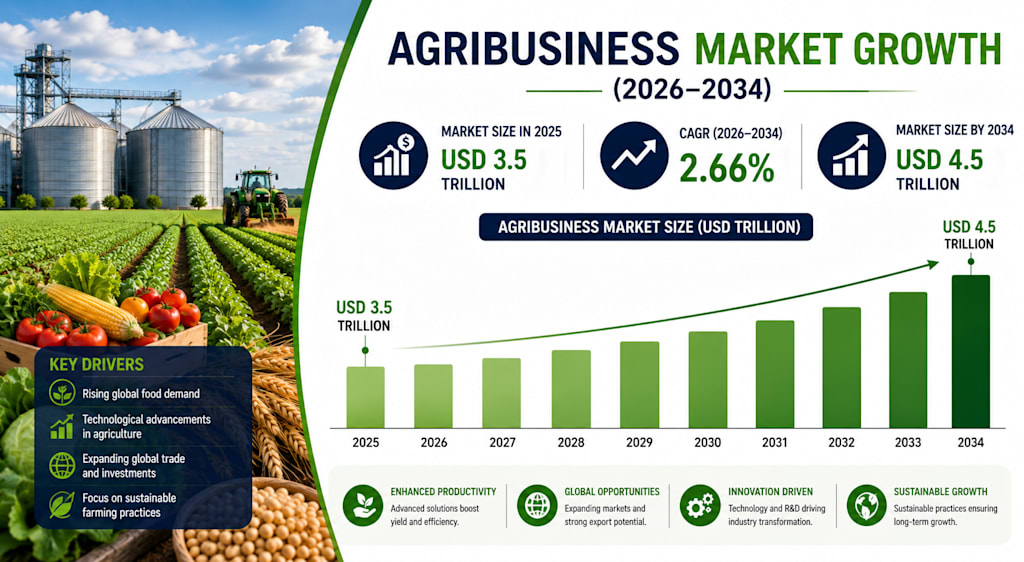
The global agribusiness market size was valued at USD 3.5 Trillion in 2025, reflecting the sector's massive scale and critical economic importance. Looking forward, IMARC Group estimates the market to reach USD 4.5 Trillion by 2034, exhibiting a CAGR of 2.66% from 2026-2034. Market expansion is driven by rising global population requiring increased food production, growing middle-class populations in developing nations seeking improved diets, technological innovations enabling productivity improvements, climate adaptation investments strengthening agricultural resilience, increasing government support for agricultural modernization, and expanding demand for sustainably-sourced food products.
Request PDF Sample for more detailed market insights:
Role of Innovation in Market Development
Precision Agriculture and Digital Farming Technologies
Innovation is fundamentally transforming traditional farming practices globally through adoption of precision agriculture technologies and digital farming solutions. Advanced technologies including soil sensors, satellite-based crop monitoring systems, automated irrigation systems, variable rate application technologies, and drone-based crop analysis enable farmers to optimize resource usage while improving crop productivity and environmental performance. These precision tools provide real-time data on soil conditions, moisture levels, nutrient status, and pest presence, enabling targeted interventions that reduce input waste, minimize chemical usage, and maximize yield efficiency. Data analytics platforms consolidate farm management information, enabling farmers to make evidence-based decisions regarding planting timing, fertilizer application, irrigation scheduling, and harvest decisions. These technology-driven approaches help reduce water consumption, minimize fertilizer waste, decrease pesticide usage, and lower operating costs while improving sustainability performance and product quality.
Automation and Agricultural Machinery Advancement
Automation is becoming increasingly critical as global agricultural labor availability constraints intensify in developed nations while wage pressures increase worldwide. Advanced agricultural machinery including autonomous tractors, precision harvesters, robotic systems for specialized tasks, and mechanized handling equipment enables farmers to maintain production levels while reducing reliance on manual labor. These technologies are particularly valuable in large-scale farming operations and controlled-environment agriculture systems including greenhouse and vertical farming facilities. Mechanization improvements enhance operational efficiency, reduce harvest losses, improve product quality consistency, and enable farmers to manage larger land areas with smaller workforces. Autonomous systems incorporate artificial intelligence and machine learning to optimize operational parameters, adapt to field conditions, and continuously improve performance.
Sustainable Agriculture and Climate-Resilient Farming Systems
Growing environmental consciousness and climate change impacts are driving innovation in sustainable and climate-resilient agricultural practices. Agroforestry systems that integrate trees with crop production improve environmental sustainability while providing additional income streams. Regenerative agriculture practices including cover cropping, reduced tillage, and crop rotation improve soil health, enhance carbon sequestration, and build long-term farm productivity. Development of drought-resistant crop varieties, improved irrigation efficiency, water harvesting systems, and soil conservation techniques enable farmers to adapt to changing climate patterns. These innovations align with consumer preferences for sustainably-produced food while supporting long-term farm viability and environmental stewardship.
Global Agribusiness Market Trends and Drivers
Rising Global Population and Dietary Diversification
Global population growth combined with rising prosperity in emerging markets is driving increased food demand with emphasis on diverse, high-quality products. Growing middle-class populations in Asia, Africa, and Latin America seek improved diets incorporating more protein, fresh produce, and value-added food products. This demand surge creates opportunities across all agribusiness segments including grains, oilseeds, dairy, and livestock products.
Climate Change Adaptation and Agricultural Resilience
Climate variability including changing precipitation patterns, temperature extremes, and weather unpredictability is prompting substantial investment in climate-resilient agricultural systems. Farmers and agribusinesses are adopting drought-resistant varieties, improving irrigation efficiency, implementing soil conservation practices, and developing crop diversification strategies. Government support for climate adaptation investments strengthens market development across sustainable agriculture technologies and practices.
Consolidation and Vertical Integration in Agribusiness
The agribusiness sector is experiencing continued consolidation as large multinational companies expand through acquisitions, joint ventures, and strategic partnerships. This consolidation trend creates opportunities for technology integration, supply chain optimization, and expanded market reach while raising competitive pressures on smaller producers.
Sustainability and Traceability Demands
Consumer preferences increasingly emphasize sustainably-sourced, traceable food products verified through transparent supply chains. Retailers and food companies are establishing sustainability standards for suppliers, driving adoption of sustainable farming practices, environmental certifications, and supply chain transparency systems. This trend particularly impacts premium and specialty agriculture segments.
Global Agribusiness Market Segmentation
Analysis by Product
Grains
• Wheat
• Rice
• Coarse Grains-Ragi
• Sorghum
• Millets
Oilseeds
• Soybean
• Canola
• Sunflower
• Palm Oil
• Others
Dairy
• Liquid Milk
• Milk Powder
• Ghee
• Butter
• Ice Cream
• Cheese
• Others
Livestock
• Pork
• Poultry
• Beef
• Sheep Meat
• Others
This comprehensive product segmentation reveals the global agribusiness market's complexity, spanning staple grains serving as dietary foundations, oilseeds providing essential fats and animal feed, diverse dairy products supporting nutrition and food security, and livestock products meeting growing protein demand across diverse global markets.
Competitive Landscape
The global agribusiness market comprises multinational agricultural companies, specialized agricultural input providers, food processing organizations, distribution and logistics firms, and emerging technology-driven agricultural enterprises. Leading competitive players include:
Major Industry Players:
• ABP Food Group
• Archer-Daniels-Midland Company
• Associated British Foods plc
• BASF SE
• Bayer AG
• Bunge Limited
• Cargill Incorporated
• CHS Inc.
• Nippon Soda Co. Ltd.
• Nutrien Ltd.
• Syngenta AG (China National Chemical Corporation)
• Wilmar International Limited
Competitive positioning is determined by supply chain integration, technological capability, product portfolio diversity, geographic market presence, research and development investment, sustainability credentials, and ability to serve diverse customer segments. Organizations offering integrated solutions spanning agricultural inputs, production support, processing capabilities, distribution infrastructure, and value-added services are strengthening market positions and building sustainable competitive advantages.
Market Outlook
The global agribusiness market is positioned for sustained growth as world population expansion continues, emerging market prosperity drives dietary diversification, technological innovations enhance productivity, climate adaptation becomes essential, government support for agricultural modernization increases, and consumer demand for sustainable food production strengthens. Continued investment in precision agriculture technologies, sustainable farming system development, supply chain optimization, climate-resilient crop varieties, and knowledge transfer to smallholder farmers will remain critical for supporting market expansion and meeting global food security objectives. Agribusiness will continue playing the vital role of feeding the world while adapting to climate challenges, resource constraints, and evolving consumer preferences for sustainable, safe, and nutritious food products.
About IMARC Group
IMARC Group is a leading market research and consulting firm providing strategy development, industry analysis, feasibility studies, and data-driven insights across global markets. The firm supports businesses, investors, and governments in making informed decisions through reliable and actionable research.
About the Creator
Yoshio
Market Research Analyst with 5+ years of experience in consumer insights and market segmentation. Skilled in data analysis and qualitative research.
Enjoyed the story? Support the Creator.
Subscribe for free to receive all their stories in your feed.
Comments
There are no comments for this story
Be the first to respond and start the conversation.