
Agile vs AI-Native Development: What Software Teams Should Know
Agile vs AI-Native Development

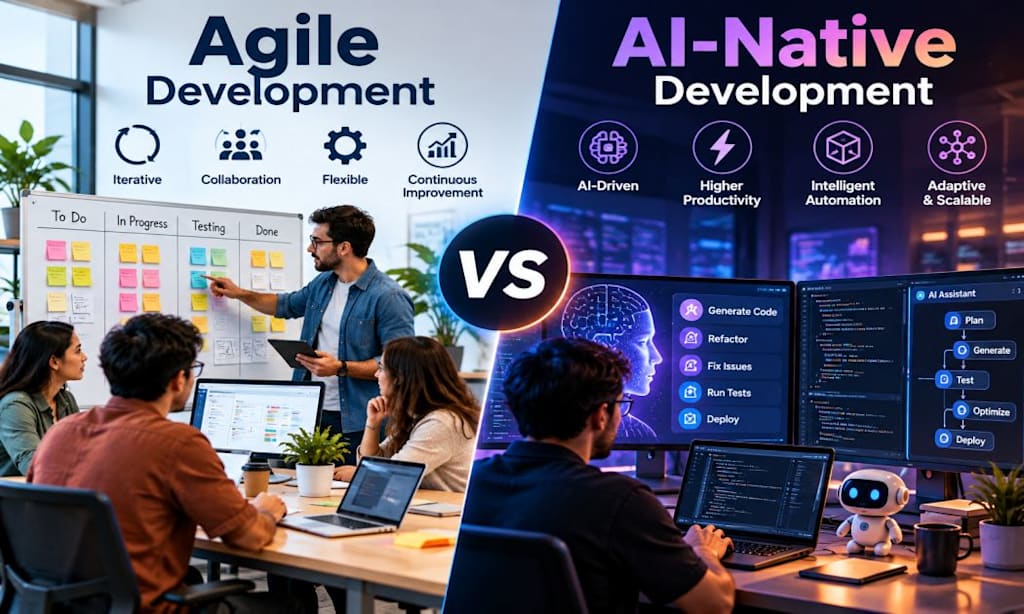
Software development is changing fast. AI now helps teams write code, create tests, review changes, and manage routine tasks. At the same time, Agile remains a popular way to plan and deliver software in small steps.
Understanding what is Agile Software Development helps teams see where the traditional Agile approach fits today. It also helps explain how AI-native development changes the role of developers, managers, and product teams.
This guide compares both approaches in simple terms. It also explains how teams can use Agile ideas while adopting AI-native practices.
What Is Agile Software Development?
Agile Software Development is an iterative way to build software. Teams break large projects into smaller pieces. They build, test, review, and improve those pieces over time.
The Agile Manifesto values working software, customer collaboration, people, and the ability to respond to change. Agile also encourages frequent delivery and regular team improvement.
In a typical Agile project, a team may work in short development cycles. Scrum teams often call these cycles sprints.
The team plans work, builds features, tests them, and reviews the results. Feedback then helps shape the next cycle.
What Is AI-Native Development?
AI-native development goes beyond simply adding an AI coding assistant to an existing process.
In an AI-native workflow, AI agents can take part in many stages of software development. These stages can include requirements, coding, testing, code review, documentation, and other engineering tasks. Humans still guide the work and check important results.
The main difference is the starting point.
Traditional teams may add AI tools to an existing development process. AI-native teams design their workflow around AI capabilities from the beginning.
That can change how teams divide work and measure progress.
Agile vs AI-Native Development
The two approaches are not direct competitors.
Agile mainly describes how teams organize work and respond to change. AI-native development describes how AI becomes a core part of the software delivery process.
AreaAgile DevelopmentAI-Native DevelopmentMain focusFlexible team deliveryAI-centered deliveryWork styleIterativeAI-assisted or agent-drivenCodingMainly human-ledAI can generate much of the codeTestingHuman and automatedAI can create and run many testsPlanningBacklogs and iterationsGoals, context, and AI tasksHuman roleBuilder and decision-makerDirector, architect, reviewerFeedbackCustomer and team feedbackHuman feedback plus AI evaluations
AI-native development is still an emerging approach. Recent research describes a shift toward intent-focused development, where people define goals and constraints while AI systems handle more implementation work.
What Changes for Software Teams?
One major change is the role of developers.
In a traditional Agile team, developers spend much of their time writing and reviewing code. AI-native teams can delegate more implementation work to AI agents.
Developers may instead spend more time defining requirements, designing systems, checking AI output, and solving complex problems.
This does not make human developers unnecessary.
AI-generated code can contain bugs, security problems, or incorrect assumptions. Human review remains important, especially for critical software. Current AI-native approaches also emphasize verification and clear quality gates.
Can Agile and AI-Native Development Work Together?
Yes. In fact, many teams may benefit from combining them.
Agile provides useful principles for customer feedback, incremental delivery, and continuous improvement. AI can make some of those activities faster.
For example, an Agile team could use AI to:
Create draft user stories
Generate test cases
Write routine code
Review pull requests
Find possible bugs
Update documentation
Summarize sprint results
Explore technical solutions
The team can then review the results before accepting them.
This creates a model where Agile controls the delivery mindset, while AI improves the execution process.
Benefits of an AI-Native Agile Team
A combined approach can offer several benefits.
Faster Development
AI can handle repetitive coding and testing tasks. This gives developers more time for architecture and product decisions.
Better Feedback Loops
AI tools can quickly analyze code, tests, and project information. Teams can use these results during short development cycles.
More Automation
AI-native workflows can automate tasks that once required manual effort. This can reduce delays between planning, coding, testing, and delivery.
Smaller Teams With More Leverage
AI can increase the amount of work a small team can handle. However, teams still need strong technical skills and clear ownership.
The goal should not simply be to produce more code. The goal is to deliver useful and reliable software.
Challenges Teams Should Consider
AI-native development also creates new risks.
AI can produce incorrect code. It can misunderstand requirements. It may also expose sensitive information if teams use tools without proper controls.
Recent reporting highlights the growing need for AI governance because employees are already using generative AI tools in workplaces. Security, privacy, accuracy, and oversight are key concerns.
Teams should therefore create clear rules for AI use.
They should decide which data AI tools can access. They should also define when human approval is required.
How Should Teams Move Toward AI-Native Development?
Teams do not need to replace Agile overnight.
A better approach is to start with low-risk tasks. Try AI for documentation, test generation, code suggestions, or repetitive analysis.
Next, measure the results.
Check whether AI actually saves time without reducing quality. Create automated tests and review processes before allowing AI to handle more important tasks.
Most importantly, keep humans responsible for major technical and business decisions.
Frequently Asked Questions
What is Agile Software Development in simple terms?
What is Agile Software Development? It is a flexible approach where teams build software in small steps, collect feedback, and improve the product throughout development.
Is AI-native development the same as Agile?
No. What is Agile Software Development is a question about an iterative team and delivery approach. AI-native development focuses on making AI a core participant in software development.
Can Agile teams use AI tools?
Yes. Agile teams can use AI for coding, testing, documentation, planning, and other tasks. The team should still review important AI-generated results.
What is the main benefit of AI-native development?
The main benefit is greater leverage. AI can handle many repetitive development tasks, allowing people to focus more on product decisions, architecture, problem-solving, and quality.
What is Agile Software Development's role in an AI-driven future?
What is Agile Software Development becomes even more useful when teams need to manage rapid change. Agile principles can provide structure while AI speeds up parts of the development process.
Conclusion
What is Agile Software Development? It is an approach built around incremental delivery, collaboration, customer feedback, and adapting to change. AI-native development adds another layer by making AI a core part of how software gets created.
Software teams do not have to choose one approach completely. They can combine Agile principles with AI-native tools and workflows.
The strongest teams will likely use AI for speed while keeping humans responsible for goals, architecture, quality, security, and final decisions.
About the Creator
Mohammad Akhtar
Mohammad Akhtar is an SEO and SEM Expert with over 10 years of experience in digital marketing and search engine optimization. A 2013 graduate of The Islamia University of Bahawalpur, he has worked with various IT companies.
Enjoyed the story? Support the Creator.
Subscribe for free to receive all their stories in your feed.
Comments
There are no comments for this story
Be the first to respond and start the conversation.