
Aerospace 3D Printing Market Soars as Lightweight Innovation and Defense Demand Accelerate Adoption
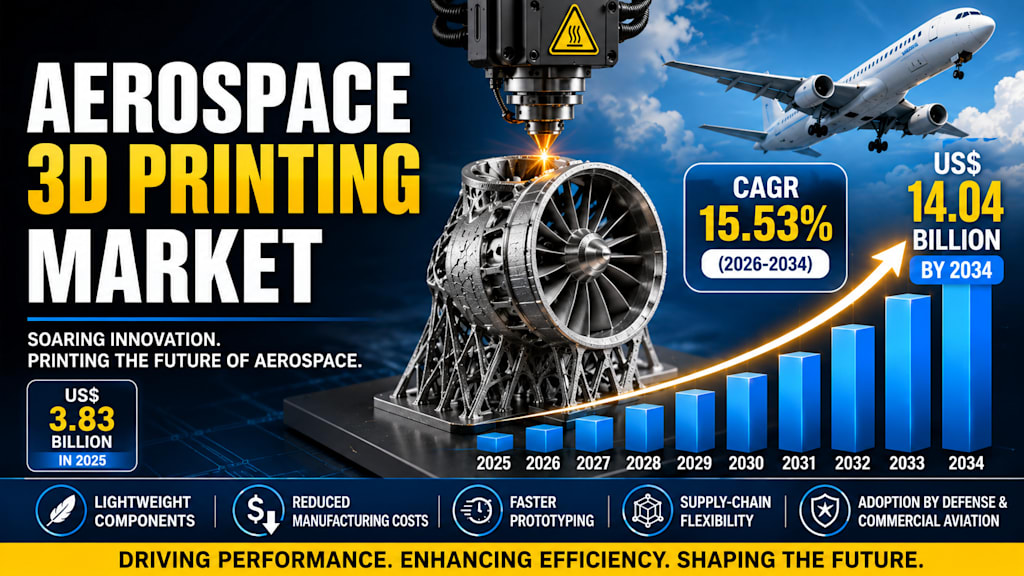
Driven by the need for high-performance components and supply-chain flexibility, the aerospace 3D printing market is projected to surge from US$ 3.83 billion in 2025 to US$ 14.04 billion by 2034 at a CAGR of 15.53%.

Aerospace 3D Printing Market Overview
The aerospace 3D printing market is rapidly transforming how aircraft and space components are designed, manufactured, and maintained. Once primarily used for prototyping, additive manufacturing has evolved into a critical production technology capable of delivering lightweight, high-performance parts with unmatched design flexibility. According to Renub Research, the market is expected to expand significantly from US$ 3.83 billion in 2025 to US$ 14.04 billion by 2034, growing at a robust CAGR of 15.53% from 2026 to 2034.
Aerospace 3D printing involves building components layer by layer using materials such as metals, polymers, and composites. This approach allows engineers to create complex geometries that are difficult or impossible to achieve using traditional manufacturing methods. The benefits include reduced weight, lower material waste, faster production timelines, and improved component performance. As both commercial aviation and defense sectors push for efficiency and innovation, additive manufacturing is becoming an essential tool across the aerospace value chain.
Key Growth Drivers in the Aerospace 3D Printing Market
One of the primary drivers of market growth is the increasing demand for lightweight and high-strength components. Aircraft manufacturers are constantly seeking ways to reduce weight in order to improve fuel efficiency, extend range, and enhance payload capacity. 3D printing enables the creation of topology-optimized structures that deliver strength while minimizing material usage. This capability not only improves performance but also reduces production costs over time.
Another major factor is the acceleration of prototyping and production cycles. Traditional manufacturing methods often require long lead times, especially for complex parts. Additive manufacturing allows engineers to quickly design, test, and produce components, significantly shortening development timelines. This flexibility is particularly valuable in aerospace, where rapid innovation and customization are critical.
Supply-chain resilience is also becoming a key advantage of 3D printing. Aerospace companies can produce parts closer to the point of use, reducing reliance on long and complex supply chains. This localized production capability minimizes downtime and ensures faster replacement of critical components, especially in maintenance, repair, and overhaul (MRO) operations.
Defense Sector Driving Market Expansion
The defense sector is playing a crucial role in accelerating the adoption of aerospace 3D printing. In November 2024, a competitive contract was awarded for a 3D-printed component designed to protect F-15 aircraft from structural damage, marking a significant milestone in defense procurement. This reflects a broader shift toward integrating additive manufacturing into military supply chains.
Defense organizations value 3D printing for its ability to produce mission-critical components quickly and efficiently. It allows for on-demand manufacturing of spare parts, reducing dependency on traditional supply chains and improving operational readiness. As global militaries continue to modernize their fleets and enhance resilience, additive manufacturing is becoming an indispensable technology in defense aviation.
Advancements in Materials and Industrial Partnerships
Material innovation is another major driver shaping the aerospace 3D printing market. Advanced metal powders, composites, and heat-resistant alloys are enabling the production of stronger and more reliable components. In November 2024, Equispheres announced a supply agreement with 3D Systems to integrate its aluminum powders with advanced printing platforms, improving quality and scalability.
Such partnerships are essential for expanding the ecosystem of aerospace-grade materials. Improvements in powder consistency, flowability, and performance are helping manufacturers produce parts with fewer defects and higher mechanical strength. As collaboration between material suppliers and printer manufacturers continues to grow, the industry is moving closer to large-scale production of certified aerospace components.
Challenges in the Aerospace 3D Printing Market
Despite its strong growth potential, the market faces several challenges. One of the most significant is the complexity of certification and regulatory approval. Aerospace components must meet strict safety and performance standards, requiring extensive testing and validation. Each material, process, and machine must be qualified before being used in operational aircraft, which increases time and cost.
High costs and limited skilled workforce also present barriers. Aerospace-grade 3D printing requires expensive equipment, specialized materials, and controlled production environments. Additionally, there is a shortage of professionals with expertise in additive manufacturing, material science, and advanced design techniques. These factors can slow adoption, particularly for smaller suppliers.
Supply constraints and post-processing requirements further add to the complexity. Even after printing, components often require finishing, inspection, and quality assurance processes, which increase production time and cost. Overcoming these challenges will be essential for scaling the technology across the aerospace industry.
United States Aerospace 3D Printing Market
The United States leads the global aerospace 3D printing market, supported by strong defense spending, advanced manufacturing capabilities, and a well-established ecosystem of technology providers. Major companies such as Boeing, Lockheed Martin, GE Aerospace, and Northrop Grumman are actively integrating additive manufacturing into their operations.
The U.S. Department of Defense is investing heavily in 3D printing to enhance supply-chain resilience and operational readiness. Research institutions, universities, and private companies are also contributing to innovation, making the U.S. the most mature and technologically advanced market in this space.
Germany Aerospace 3D Printing Market
Germany is a key player in the aerospace 3D printing market, known for its strong engineering capabilities and leadership in industrial manufacturing. Companies such as Airbus, MTU Aero Engines, and Siemens are driving innovation in metal additive manufacturing and advanced materials.
The country benefits from strong collaboration between industry, academia, and government, supported by research initiatives and funding programs. Germany’s focus on precision engineering and Industry 4.0 technologies makes it a highly advanced market for aerospace additive manufacturing.
China Aerospace 3D Printing Market
China’s aerospace 3D printing market is expanding rapidly due to government investment, strong manufacturing capabilities, and a strategic focus on aviation and space technologies. Additive manufacturing is being used for engine components, rocket parts, and structural assemblies.
The country is also increasing domestic production of metal powders and large-scale printers, reducing reliance on imports. With growing demand for aviation and defense modernization, China is positioning itself as a major global player in aerospace additive manufacturing.
Saudi Arabia Aerospace 3D Printing Market
Saudi Arabia is emerging as a promising market for aerospace 3D printing, driven by its Vision 2030 strategy to localize manufacturing and strengthen defense and aviation capabilities. Investments in research, infrastructure, and partnerships are helping build a domestic additive manufacturing ecosystem.
Airlines and maintenance providers in the region are exploring 3D printing for spare parts and repairs, improving operational efficiency and reducing dependence on imports. As the country continues to invest in advanced manufacturing technologies, its role in the global aerospace 3D printing market is expected to grow.
Recent Developments in the Aerospace 3D Printing Market
The market continues to evolve through innovation and strategic investments. In October 2024, the U.S. Air Force awarded Beehive Industries a USD 12.4 million contract to manufacture 3D-printed jet engines for unmanned aircraft, highlighting the growing importance of additive manufacturing in defense applications.
In August 2024, NASA partnered with 3DCERAM Sinto to develop ceramic components for space applications, expanding the use of 3D printing in extreme environments. Additionally, Relativity Space secured a contract to advance defect detection in additive manufacturing, focusing on improving quality and reliability in large-scale production.
These developments demonstrate the increasing role of 3D printing in both aerospace manufacturing and research.
Market Segmentation
The aerospace 3D printing market is segmented by offerings, printing technology, platform, application, end use, and geography. Offerings include materials, printers, software, and services, while technologies range from direct metal laser sintering (DMLS) to fused deposition modeling (FDM) and selective laser melting (SLM).
Applications cover engine components, structural parts, and space components, with end users including OEMs and MRO providers. Geographically, the market spans North America, Europe, Asia-Pacific, Latin America, and the Middle East & Africa, each offering unique growth opportunities.
Key Companies in the Aerospace 3D Printing Market
Leading companies in the market include 3D Systems Inc., General Electric Company, Markforged, Proto Labs, SLM Solutions Group AG (Nikon AM), Stratasys Ltd., The ExOne Company (Desktop Metal), and VoxelJet AG. These players are driving innovation through advanced technologies, material development, and strategic collaborations.
Final Thoughts
The aerospace 3D printing market is entering a high-growth phase as the industry embraces additive manufacturing for efficiency, performance, and innovation. Its ability to produce lightweight, complex, and high-performance components is reshaping how aircraft and spacecraft are built and maintained.
With strong demand from commercial aviation and defense sectors, along with continuous advancements in materials and technology, aerospace 3D printing is set to play a critical role in the future of global aviation and space exploration.
About the Creator
Enjoyed the story? Support the Creator.
Subscribe for free to receive all their stories in your feed.
Comments
There are no comments for this story
Be the first to respond and start the conversation.