
Aerospace 3D Printing Market Set for Rapid Expansion as Aviation Industry Embraces Additive Manufacturing
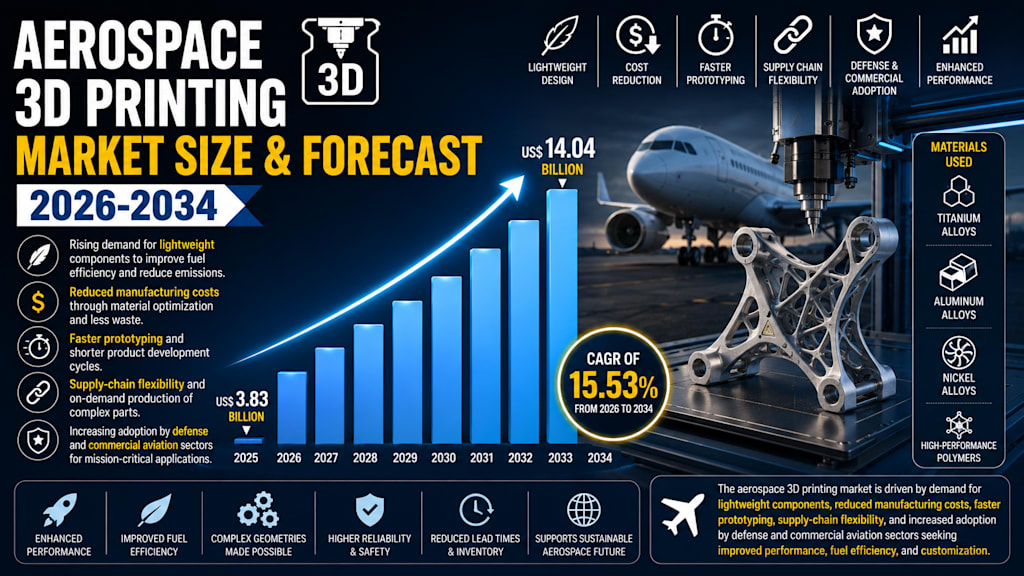
Global market projected to grow from US$3.83 billion in 2025 to US$14.04 billion by 2034, driven by demand for lightweight aircraft components, defense modernization, and advanced manufacturing technologies.

The aerospace industry is entering a transformative era, and at the center of this revolution is 3D printing. Once considered a niche technology used primarily for prototyping, additive manufacturing is now becoming an essential part of aircraft production, maintenance, and innovation. From commercial airliners to military jets and even spacecraft, aerospace organizations are increasingly turning to 3D printing to create lighter, stronger, and more efficient components.
According to Renub Research, the Aerospace 3D Printing Market is expected to grow from US$3.83 billion in 2025 to US$14.04 billion by 2034, expanding at a compound annual growth rate (CAGR) of 15.53% between 2026 and 2034. This impressive growth reflects the industry's growing confidence in additive manufacturing technologies and their ability to address long-standing challenges in aerospace production and supply chain management.
Why Aerospace Companies Are Betting on 3D Printing
Aircraft manufacturers have always faced a difficult balancing act. They need to create components that are strong enough to withstand extreme operating conditions while remaining lightweight enough to maximize fuel efficiency. Traditional manufacturing methods often limit what engineers can achieve in terms of design complexity and material optimization.
This is where 3D printing offers a significant advantage.
Unlike conventional manufacturing processes that remove material from a larger block, additive manufacturing builds components layer by layer. This allows engineers to design intricate geometries that would be difficult—or even impossible—to create using traditional techniques.
The result is a new generation of aerospace parts that are lighter, stronger, and more efficient. Reduced component weight translates directly into lower fuel consumption, reduced emissions, and improved aircraft performance. For airlines operating in a highly competitive environment, these benefits can produce substantial long-term cost savings.
Moreover, manufacturers can consolidate multiple parts into a single printed component, reducing assembly complexity and minimizing potential points of failure. This approach not only improves reliability but also shortens production timelines.
A Technology That Reduces Waste and Costs
One of the most compelling advantages of aerospace 3D printing is its ability to reduce material waste.
Traditional machining often removes large amounts of material to create a finished component. In contrast, additive manufacturing uses only the material necessary to build the part. This is particularly important in aerospace applications where expensive materials such as titanium, nickel-based superalloys, and advanced composites are frequently used.
The ability to minimize waste while maintaining structural integrity makes additive manufacturing both economically and environmentally attractive.
Additionally, aerospace companies can rapidly prototype new designs without the need for costly tooling or molds. Engineers can test, refine, and improve products much faster than with conventional methods, accelerating innovation cycles and reducing development costs.
Defense Sector Driving Adoption
The defense industry has emerged as one of the strongest supporters of aerospace additive manufacturing.
Military organizations around the world increasingly view 3D printing as a strategic capability that enhances operational readiness and supply chain resilience. Rather than waiting weeks or months for replacement components to arrive from centralized manufacturing facilities, defense organizations can produce critical parts closer to deployment locations.
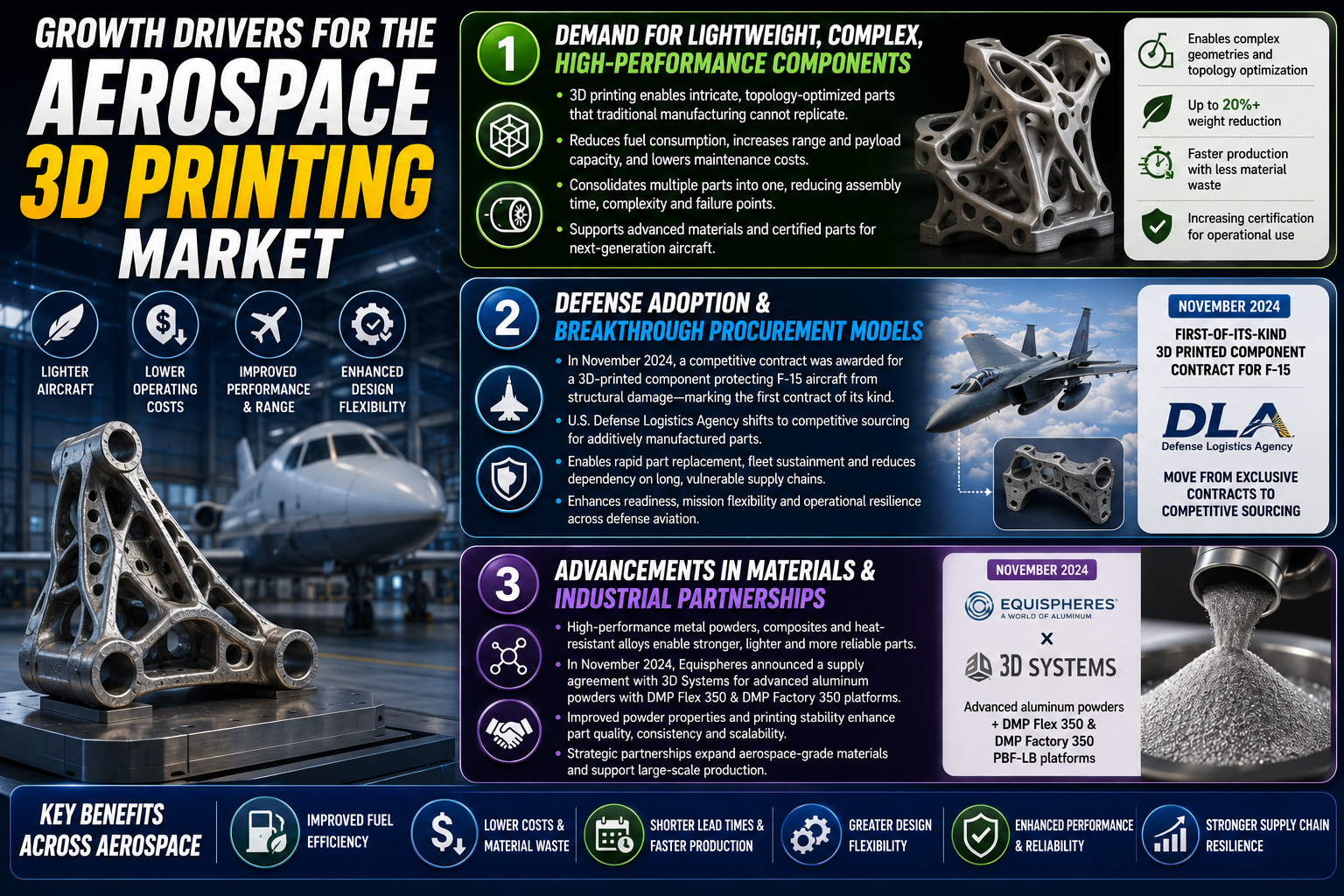
A significant milestone occurred in November 2024 when a competitive contract was awarded for a 3D-printed component designed to protect F-15 aircraft from structural damage. The development marked an important shift in defense procurement practices and demonstrated growing confidence in additive manufacturing for mission-critical applications.
Military adoption extends beyond replacement parts. Defense agencies are increasingly exploring additive manufacturing for aircraft sustainment, rapid repairs, custom tooling, and next-generation aerospace systems.
As geopolitical tensions continue to influence defense spending priorities, investments in advanced manufacturing technologies are expected to remain strong.
Material Innovation Is Expanding Possibilities
The future of aerospace 3D printing is closely linked to advances in materials science.
In recent years, researchers and manufacturers have developed increasingly sophisticated metal powders and composite materials designed specifically for additive manufacturing. These materials offer improved strength, heat resistance, durability, and reliability—qualities essential for aerospace applications.
Industry partnerships are accelerating this progress. Collaborations between material suppliers and printer manufacturers are helping create more consistent production processes while improving the quality of finished components.
Improved powder flow characteristics, greater particle uniformity, and enhanced printing stability are enabling manufacturers to achieve higher-quality results with fewer defects. These developments are critical as aerospace companies move from prototyping toward large-scale production of certified components.
The continued evolution of aerospace-grade materials is expected to unlock new applications and further increase market adoption over the coming decade.
Commercial Aviation Sees Growing Opportunities
While defense remains a major growth driver, commercial aviation is also embracing additive manufacturing at an accelerating pace.
Aircraft manufacturers are using 3D printing to produce engine components, structural brackets, cabin interiors, air ducts, and numerous other parts. The technology enables airlines and original equipment manufacturers (OEMs) to respond more quickly to changing design requirements while improving overall operational efficiency.
As airlines seek ways to reduce fuel consumption and meet increasingly stringent environmental targets, lightweight components produced through additive manufacturing offer a compelling solution.
Additionally, the ability to manufacture spare parts on demand can help airlines reduce inventory costs and improve maintenance efficiency. Instead of storing thousands of components in warehouses, organizations can produce certain parts when needed, creating a more flexible and responsive supply chain.
This capability is particularly valuable as global air travel continues to recover and expand.
Challenges Still Remain
Despite its impressive growth trajectory, aerospace 3D printing is not without obstacles.
One of the most significant challenges involves certification and regulatory compliance. Aerospace is among the most heavily regulated industries in the world, and every component must meet strict safety and performance standards.
Before a 3D-printed part can be installed on an operational aircraft, manufacturers must demonstrate consistent quality, durability, and reliability. Each material, machine, and manufacturing process often requires extensive testing and validation.
These requirements increase both the time and cost associated with bringing new additive manufacturing solutions to market.
Another challenge is the high cost of aerospace-grade equipment and materials. Advanced metal printers, specialized powders, and controlled production environments require substantial investment. Smaller suppliers may struggle to absorb these costs, limiting broader adoption across the industry.
Workforce development also remains a concern. Aerospace additive manufacturing requires expertise in design optimization, materials science, quality assurance, and advanced manufacturing processes. Finding professionals with these specialized skills can be difficult in many regions.
Global Leaders in Aerospace Additive Manufacturing
The United States currently leads the global aerospace 3D printing market thanks to its strong defense spending, advanced manufacturing ecosystem, and presence of major aerospace companies such as Boeing, Lockheed Martin, GE Aerospace, and Northrop Grumman. The country's investment in research, development, and certification frameworks continues to support innovation and commercialization.
Germany also plays a major role in the market, benefiting from its engineering expertise and leadership in industrial manufacturing. Companies including Airbus, Siemens, and MTU Aero Engines continue to advance metal additive manufacturing technologies and expand aerospace applications.
Meanwhile, China is rapidly expanding its aerospace additive manufacturing capabilities through government support, investment in domestic production technologies, and growing demand from both commercial aviation and defense sectors.
Emerging markets such as Saudi Arabia are also entering the field, leveraging additive manufacturing as part of broader industrial diversification initiatives and efforts to strengthen local aerospace capabilities.
Recent Industry Developments Signal Strong Momentum
Recent announcements highlight the increasing strategic importance of aerospace additive manufacturing.
In October 2024, the U.S. Air Force awarded Beehive Industries a US$12.4 million contract to manufacture 3D-printed jet engines for unmanned military aircraft. The initiative aims to develop low-cost turbine engines that can support future military operations while reducing production expenses.
NASA also expanded its commitment to additive manufacturing in August 2024 by selecting 3DCERAM Sinto to provide advanced ceramic printing capabilities. The partnership focuses on producing components capable of performing in space and other extreme environments.
Meanwhile, Relativity Space secured an US$8.7 million contract from the U.S. Air Force Research Laboratory to advance real-time defect detection technologies in large-format metal additive manufacturing. Such efforts could significantly improve quality assurance and reliability in future aerospace production.
Final Thoughts
Aerospace 3D printing is no longer an experimental technology operating on the fringes of the aviation industry. It is rapidly becoming a cornerstone of modern aerospace manufacturing.
The combination of lighter components, faster production cycles, reduced material waste, and greater supply chain flexibility makes additive manufacturing an attractive solution for both commercial and defense organizations. While regulatory challenges and high costs remain barriers, ongoing advances in materials, certification processes, and industrial partnerships are steadily overcoming these obstacles.
With the global market projected to reach US$14.04 billion by 2034, aerospace 3D printing appears poised to reshape how aircraft, spacecraft, and defense systems are designed, manufactured, and maintained for years to come.
About the Creator
Enjoyed the story? Support the Creator.
Subscribe for free to receive all their stories in your feed.
Comments
There are no comments for this story
Be the first to respond and start the conversation.