
A Tesla With 'Full Self-Driving' Couldn't Complete A Single Trip Without Human Intervention
Researchers tested Tesla's FSD system for 100 days in Australia. In over 500 safety-critical incidents, the car was confused by simple things humans never think about. Here's what went wrong and what it reveals about how far away we really are.

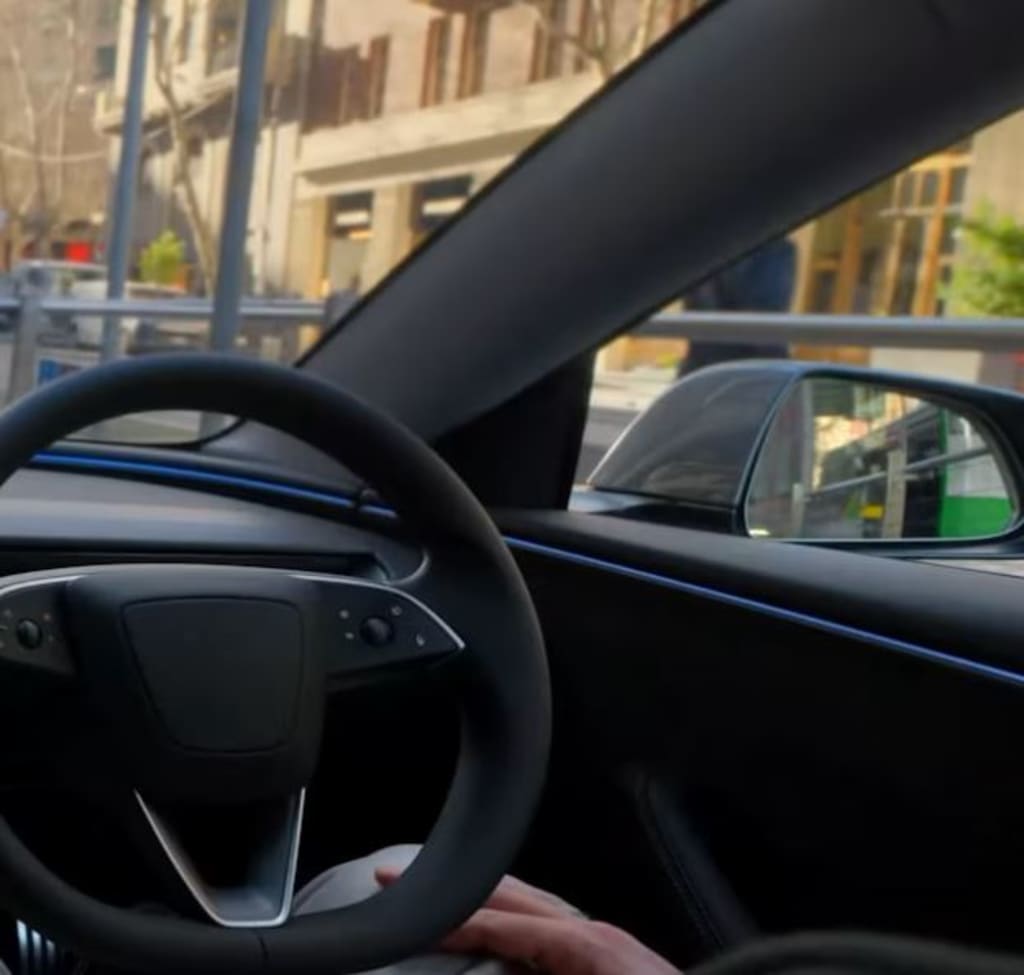
For 100 days, researchers in Queensland, Australia, drove a Tesla Model Y with Full Self-Driving (FSD) enabled.
They drove it every day. In normal conditions. On normal roads. They were testing whether autonomous driving could actually work in real-world situations.
And in 100-plus days of testing, they didn't complete a single trip, not one where FSD drove independently from start to finish without requiring human intervention.
Not one.
They recorded over 500 safety-critical events where the system either needed the driver to take over or revealed a significant limitation in how it understood the road.
And here's the thing that should actually matter: most of these failures weren't edge cases. They weren't rare, weird situations that happen once a year. They were everyday driving problems that every human driver solves automatically without thinking.
The car just... couldn't.
The Bridge (And What It Reveals)
There's a small bridge in the researchers' neighborhood. Nothing special about it. Most drivers pass over it without thinking.
But almost every time FSD approached it, the vehicle got confused. Started weaving. Couldn't figure out what was happening.
A human driver doesn't have to think about a small bridge. You just drive over it. Your brain processes the visual information, and your hands adjust automatically.
FSD couldn't do that. The bridge broke something in how the system was interpreting the road.
This isn't a technical problem with machine learning. This is a fundamental problem with how the system perceives the environment. It can't read things we find trivial.
And it's not alone. The researchers found the same pattern repeating:
Time-restricted speed limits (like school zones): FSD had to be manually overridden more than 90% of the time. In one case, it correctly followed a school zone limit at 7 p.m., hours after school ended.
Railway crossings: A car ahead stopped near the tracks. If FSD had continued, it would have stopped on the rails. The driver had to slam on the brakes.
Zipper merges (the Australian merge rule): Neither FSD nor the other vehicle slowed down at the merge point. The driver had to intervene immediately.
Complex roundabouts: Australia has a lot of them. FSD struggled with most.
Poorly marked or steep streets with parked cars: The system lost accuracy.
E-scooter riders: Mistook them for pedestrians and behaved accordingly which is dangerous because e-scooters don't behave like pedestrians.
Bad weather: Harsh or variable weather that obscures lane markings confused the system.
The Hype vs. Reality Gap
In March 2026, Jensen Huang (CEO of NVIDIA) declared the "ChatGPT moment" for self-driving cars had arrived.
Waymo is exploring robotaxi operations in Australia. Tesla's FSD is already available on public roads. The narrative is: autonomous driving has arrived. We're here. This is happening.
Then, researchers spend 100 days testing it in normal conditions and can't complete a single trip without human intervention.
This is the gap between the hype and what's actually working.
The researchers make an important distinction: the technology is "far more capable than many people realise" in smooth situations. FSD can handle highway driving with precision that exceeds human performance. It's genuinely impressive at specific tasks.
But it's "less capable than many people assume" at everything else. It fails at things experienced drivers handle almost automatically. And it fails in surprising ways, not like human errors, but like errors only a machine could make.
The Infrastructure Angle (And Why It Matters)
Here's where the research gets interesting beyond just "FSD isn't perfect."
The researchers propose something radical: instead of making vehicles smart enough to handle all existing roads, what if we made roads smarter to help vehicles?
This isn't about filling streets with expensive technology. It's about basics:
Clearer lane markings
More consistent signs
Better-maintained road surfaces
Less ambiguous intersection design
Reliable speed-limit information
Repeated visual cues instead of single signs
Instead of a speed-limit sign that appears once, put them at regular intervals so the system has multiple opportunities to read them correctly. Instead of a bicycle symbol painted only at the start and end of a lane, repeat it throughout.
These are the kinds of changes that can be made during routine maintenance. They'd help autonomous vehicles. And they'd probably help human drivers too.
The Broader Implication
This research is relevant to Malaysia's automotive policy debates in a way most people don't realize.
When Malaysia debates whether to allow Chinese EV companies to assemble cars, when they worry about supply chains and local content, part of what's actually being decided is: what kind of roads and infrastructure do we want to support?
If autonomous driving is coming and the research suggests it's further away than hype suggests, but still coming, then countries need to decide: are we going to invest in infrastructure that supports it?
Smarter roads. Better markings. More consistent signage. Road systems designed for both human and machine intelligence.
That's a policy decision. That's an investment decision. That's something MITI should be thinking about.
But most governments aren't. They're waiting for vehicles to be perfect. Then wondering why perfect vehicles aren't arriving.
The Honest Assessment
Tesla FSD is genuinely impressive technology. It can do things human drivers can't. But it can't do things human drivers do automatically.
In 100 days of normal driving, it failed to complete a single trip without intervention. Most failures were everyday situations, not rare edge cases.
This suggests we're still years away from truly autonomous driving. Not because the technology won't eventually work, but because the gap between "impressive in specific situations" and "safe and reliable in all situations" is enormous.
And closing that gap requires not just better technology, but better infrastructure.
The researchers' conclusion is simple: if Australia wants to be ready for autonomous driving, it needs to work on both smarter vehicles and smarter roads.
Most governments are only betting on one side of that equation.
That's why we're still a long way from the "ChatGPT moment" for self-driving cars.
It's not the cars that are the problem.
It's the roads.
About the Creator
Mark Lim
Hi I am mark an automotive student and a car, tech and food enthusiast ! Im gonna try and post daily & hope you enjoy what I write and do share my page with people you know. I would gladly appreciate it! Cheers
Enjoyed the story? Support the Creator.
Subscribe for free to receive all their stories in your feed.
Comments
There are no comments for this story
Be the first to respond and start the conversation.