
A Practical Guide to ERP Challenges and Solutions
This blog will cover ERP challenges with solution.

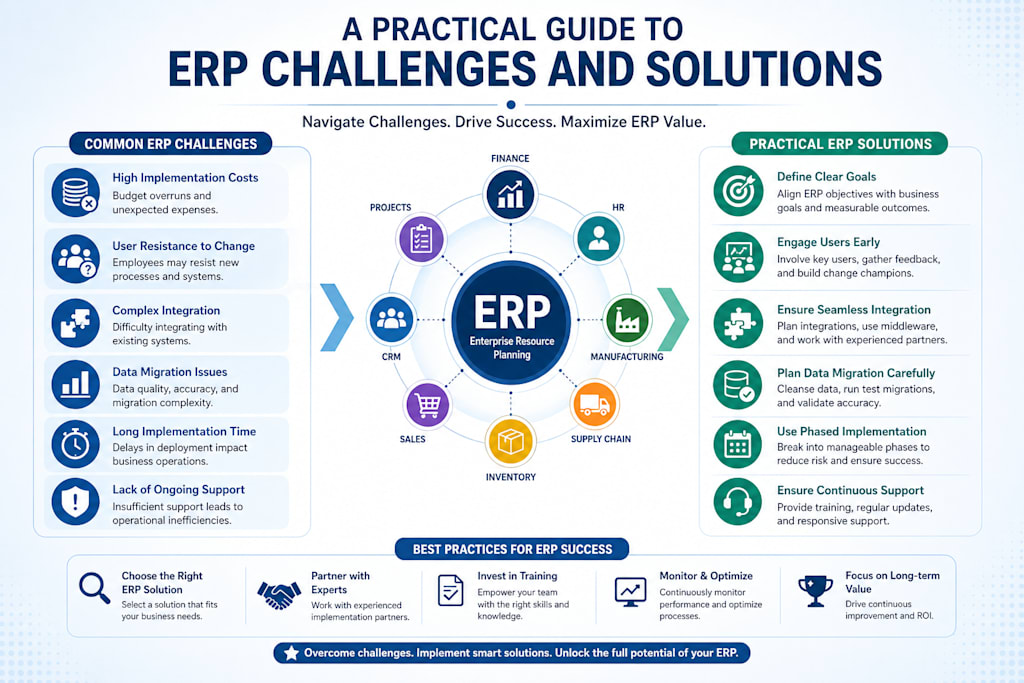
For better or worse, ERP systems power most organizations’ day-to-day operations. They host line of business (LOB) applications such as finance, supply chain, procurement, and more. Because they’re tasked with storing critical business data and enabling robust processes, ERPs must remain accurate and stable. At the same time, demand for ERP modernization is accelerating as today’s businesses operate in an environment of constant change.
Outdated ERP systems were built for the steady state, not the new normal. As a result, many companies struggle to overcome data silos, limited visibility, etc. Updating and expanding existing systems can also prove difficult. This could lead to cost overruns and interference with regular business activities to name a few. Since ERPs touch so many parts of the organization, even the smallest technical glitch or instance of poor data hygiene can impact the entire company. For these reasons (and more!), upgrading legacy ERP systems to dynamic, intelligent platforms has become a top business objective for organizations looking to thrive in this new era.
In this blog, I will discuss why ERP implementations fail and then we will move on to common challenges related to the implementation with potential solutions.
Why Some of ERP Projects Struggle to Succeed?
One of the most common reasons cited for ERP failures is treating them as technology projects instead of business projects. This could include inadequate change management and poor data governance. Others include not properly scoping the needs of the business to what the ERP system will be required to do as well as lack of continued executive sponsorship (making it difficult to get departments to cooperate with each other to work through issues).
A Practical Guide to ERP Challenges and Solutions
Implementing an ERP system can transform operations, but the journey is rarely without obstacles. From data migration issues and user resistance to integration complexities and budget overruns, organizations face multiple challenges. Understanding these hurdles and their solutions is essential for achieving a successful ERP implementation.
Listed are some of the common ERP challenges with their solutions;
- Data migration: Data stored on legacy systems is likely going to be "dirty". You'll likely find duplicate records, incomplete fields, etc. Attempting to migrate your data as-will result in your shiny new ERP system generating incorrect reports and failing at automation. Start with a stringent data cleansing and validation process. Also audit your existing data for duplication and formatting, and map data fields to your new system before migrating any information.
- Change management: The most common form of resistance is from employees that do not like learning new ways of working. Or perhaps they fear losing their jobs. Users fail to engage with the system resulting in low adoption and continual reliance on manual work "workarounds" of the new system. Begin your management communication and training efforts begin months before the ERP goes live. And make sure to involve key users from each department during both the selection process and design process. This ensures the new system will meet functional needs. You must also offer training courses and assign "super users" within each department to assist their fellow employees.
- Data integration: Companies tend to have several software that do not automatically exchange information. ERP integration means bridging functional gaps. To what end? Well, so that data flows between the ERP and other software tools such as CRM or warehouse management. Implement standardized APIs or middleware specifically designed to link systems together. Define a master data management plan that standardizes how information is duplicated and synced to every application.
- Integration of legacy systems: Customers often have outdated mission-critical homegrown software that doesn't play nicely with modern cloud ERP applications. These systems can be impossible or cost-prohibitive to replace. Yet, they can cause all sorts of headaches when it is time to integrate. The key is to first determine if you should replace or refactor the legacy systems. Often, you can interface new ERP with old systems using integration adapters or custom connectors. If the system's ancient, architect your integration so you can slowly sunset the old system as you move pieces of its functionality to the new ERP.
Concluding Thoughts
If you too have been looking for avant-garde solutions for digital manufacturing, you need an ERP. However, make sure to watch out for the integration challenges.
About the Creator
Ryan Williamson
Tech-savvy professional with 13+ years of experience in app development, leveraging technical knowledge to build strategic partnerships and promote innovative solutions. Passionate about engaging with technical communities, and more.
Enjoyed the story? Support the Creator.
Subscribe for free to receive all their stories in your feed.
Comments
There are no comments for this story
Be the first to respond and start the conversation.