
A Phishing Scam Attacks!
It started with a warning that an article was being flagged for spam, but it turned out to be more than that. Suddenly, writers including me became the victim of a Phishing scam that could’ve had serious implications. This is a reflection and warning to others.


Spammy Flag
The red circle popped up over the bell icon for the Vocal Media site. Another notice, no big deal, I thought. I figured it was just to announce that the previous article I posted was now published on the writing site.
After getting my coffee in the cafe I was in, I briefly checked the number of announcements, again before returning to the draft of my second article. There were three.
Again, nothing to worry about. Other people I followed most likely posted their articles. This was normal. I clicked on my story draft on the site and proceeded to edit the second article I aimed to publish.
The important task was completed. I hit the publish button and now I could pay attention to the notifications; however, when I looked up at it, the number changed. Now there were five notifications. That red dot with the number was distracting enough to get my attention. Still, I had no real reason to worry. I figured I’d see the usual things when I opened it.
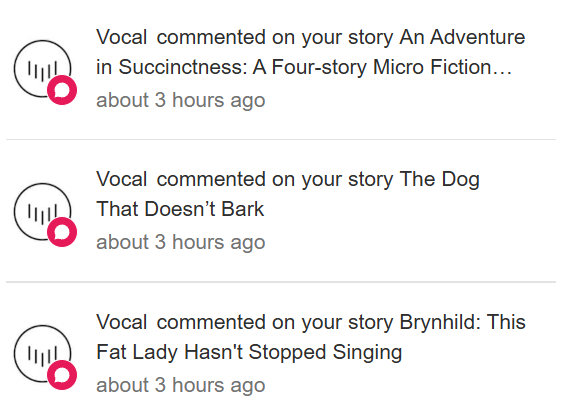
The notification for my first article popped up, indicating that it was published on the site. So far, so good. But, the other notifications didn't come from other writers with new stories. Instead it was addressed to me and stated there was a response on two of my published articles.
It came from Vocal. I could tell due to seeing its logo on the message. Different? Sure. Suspicious? Not really. I believed that the notification may have been stating that these stories were going to be featured.
Usually, it can be fixed with a few tweaks here and there. But, on certain occasions I’ve had to radically alter the article in order for it to be accepted for publishing.
While that doesn’t always happen, it recently happened twice. I clicked on one of the messages expecting to see some form of accolades.
Instead, I got something else that darkened my mood. The comment stated something about being flagged for spammy content. But this notification would later turn into a panic when I discovered the truth after I allowed my emotions on the matter to get the best of me.
Not the First time
I’ve been writing for nearly 20 years on Internet Writing platforms. Often, I will run into moments like these. The editors or administration of a page would have issues with something I wrote. And, they would prevent me from publishing a particular article until I removed something that was considered “spammy”.
I’ve been on Vocal Media for a year. While most of my publishing endeavors have gone smoothly, I’ve been stopped in my tracks by the site's automated spam detection system.
This has become one of my biggest pet peeves since writing for Vocal Media (aside from its slow passive income gains). I rarely, if ever, write about a company or play public relations for them. And, I never wrote anything I considered spammy. Yet, this system had flagged me in the past.
Usually, it can be fixed with a few tweaks here and there. But, on certain occasions I’ve had to radically alter the article in order for it to be accepted for publishing. In some cases, it happened to an article several times even after I revised it.
Sometimes, revisions worked. Other times, I had to contact Vocal Media editors to rectify the problem. This proved to be effective. Someone would respond and let me know about the problem they were having with their automated system. In exchange, they would remove the limitations placed on it and allow for the final process of publishing.
Warning Signs I Ignored
I’ve been able to spot a fake post in that past. But this time, I ignored the warning signs. In hindsight, I missed several of them in this situation. What were they?
The articles in question were already published. In the past when Vocal Media flagged you for spammy content, they’d do it before the article was published and it would be moved back to draft.
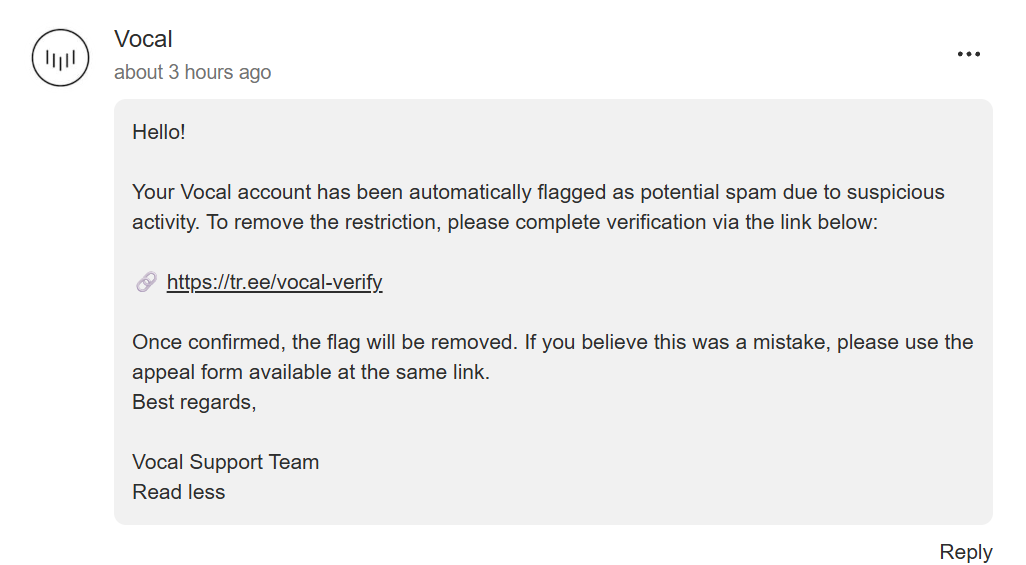
There was a link to an unfamiliar site that oddly took me to a Stripe page. A chat page popped up and covered much of the page. It gave more information about how to remove the flag from the articles by posting your debit card instructions or fill out an appeal to challenge this charge.
There were no links to the appeal process and all indication was that you have to enter your card information before doing that.
They posted directly onto the article. For how much I complained about the automated spammy detector, I know that they would’ve sent me an email and not published my article.
The automated spam system has been used on other sites I’ve written for. Usually they misidentify a word as being spammy. However, other sites like Hubpages and the long defunct Helium would send notifications if your article had been plagiarized (and that’s a topic for another article).
In my anxiety riddle mind, I began to fear that someone may have been lifting my story, again. While transferring articles from Helium to Hubpages several people scrapped my articles and published them on their site. That was a headache to deal with at the time. And, for the longest time when I transferred an article from one site to another, I copied the first paragraph and used the Google search engine to see if there was a copy.
Although I reported these to DCMA, they were slow at changing things. As a result, I got into the habit of rewriting these articles so they can be different from the original articles. In many respects, I felt this was the case because the articles (a series of poems) I was publishing were originally published on a site nearly 20 years ago.
Additionally, I’m still unfamiliar with the way Vocal Media regulates the articles and how they communicate their notifications. Also, this is the first year I’ve dealt with Stripe as a paying platform. Up until the demise of Hubpages as a writing platform, I used PayPal, instead.
The Link
At this point, agitation turned to anxiety. Often, those who have anxiety disorders are not thinking straight. The emotions take over rather than rational thinking. Thus, I cleared the chat after not receiving a response from them and observed the pay platform I believed was for Stripe.
“Dammit!” I uttered in the middle of the coffee shop I was in.
Admittingly, I thought it was odd that Stripe would get involved and would want my card number. Then again, I recently received a new card. It was possible that the account they had on their site wasn’t working.
Still, I hesitated. I wish my hesitation didn’t get drowned out by utter frustration with this situation. Also, if I had hesitated, I wouldn’t have typed in the information from my debit card.
Realization Sets In
The next thing to pop up was a message stating that my information was incomplete. I needed to post additional material: the amount of money in my account. If I ignored all the warning signs, this particular clue hit me hard.
I stopped what I was doing and went to the Vocal Media Home page to see if there was an announcement for this. The announcement of this phishing scam didn't come from the site’s administrators (that would come later).
It came from other writers that posted their story on the matter. In addition, they posted screenshots that were similar to mine and they had glaring headlines that warned that a phishing scam or spam had hacked Vocal, again.
Evidently, this wasn’t the first time this has happened. And according to those that posted, they claimed that the person or people behind this were getting more sophisticated.
“Dammit!” I uttered in the middle of the coffee shop I was in.
This wasn't so much about the situation, but was self-critique for not seeing the warning signs that were in front of my face.

I responded again, when I noticed the five notifications ballooned to over 20. All the stories affected by this were published in the month of November and some had two or three messages from this bogus hacker.
And through it all, the last of the articles I wrote that day was confirmed to be published (and within a minute, the hacker posted a response on the article).
I may have put my account in danger. I jumped off my stool, packed my computer and rushed out the door. My bank was up the street and if I was lucky, I’d make it there to get a new card. In the meantime, I called them to immediately to close my current card.
Although the bank had already closed, I was able to close that card. Luckily, upon checking there were no nefarious charges on the card. Still, there was no way I was going to use that card. It was best to get a new one.
Many Vocal Writers Communicated
After this event, I sought more information. Several people who initially wrote on the subject were working overtime in their response threads, telling others to report them, close your bank card, and to change your Stripe password.
Everybody on Vocal was affected, but they all came together to spread the message to avoid this. Still, the scammers were busy onward through November 14 and after midnight. I know this because my second story of the day received the last bogus response in this matter.
By the morning of the 15th, Vocal management finally posted a message about this situation, confirming that they didn’t post it and warned others not to click on the link.
Close Call?
The incident is a good example why one should be wary if you work on the Internet, let alone a writing platform. There are a lot of scammers out there ready to plagiarize your stories, or to steal your finances directly from your bank.
This time, I was able to prevent a major disaster from happening. And, there were plenty of people out there to point out it was a scam. This was a close call, and now we need to be careful moving forward.
Aside from comments about scams and spams, other word mentioned in several responses was "sophisticated", as in that they are becoming more savvy (even one person pointed out that they knew to attack on the weekend when Vocal administrators were possibly offline and that banks were closing early).
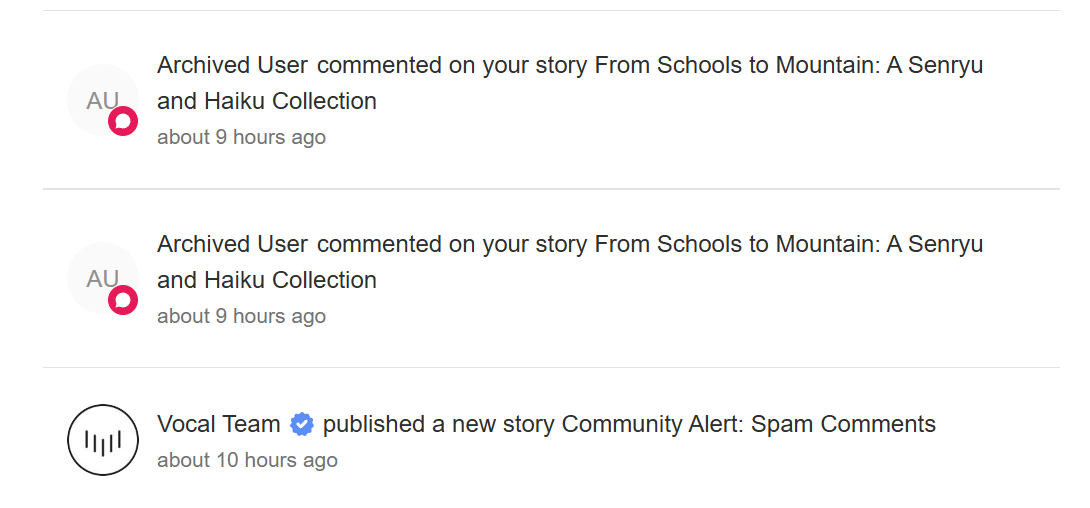
Most importantly, you need to pay attention to your hunches and spot the patterns. As of this writing, the response from these hackers has been removed. They still show up in the notification as "Archived User", the message they've sent has been removed.
Will it be that easy in the future? One can only speculate and just be cautious.
About the Creator
Dean Traylor
* Masters in special education and degree in journalism.
*Seasoned writer for the last 30+ years (Newspapers, Magazines, Internet sites)
* Former writer at Hubpages, Helium, and Wikinut.
* Current: Medium (https://medium.com/@ds_traylor)
Enjoyed the story? Support the Creator.
Subscribe for free to receive all their stories in your feed.
Comments
There are no comments for this story
Be the first to respond and start the conversation.