
A Perfect AI Could Predict Almost Everything. Here’s the One Thing It Never Will.
A world model might simulate weather, markets, and even your next thought, but surprise is not a bug. It is the shadow of being finite.

What a world model cannot predict
I
Suppose such a model existed. It has seen enough data. Physics, chemistry, biology, economics, psychology. Cities, oceans, atmospheres, neurons, markets, wars, love. It resembles a giant crystal ball. You ask whether it will rain tomorrow at three. You ask whether a street will have an accident. You ask whether a person will resign, or an election will flip. It can answer.
The dream is old. Two hundred years ago, Laplace imagined something similar. If an intelligence knew the positions and momenta of all particles and had enough computing power, then past and future would be equally clear. No uncertainty. No surprise. Only determinate facts not yet calculated.
That is Laplace's demon. It is the high point of classical determinism. It is also a fantasy of omniscience.
The demon has a condition. It must stand outside the universe. It must know everything without interfering with anything. It must predict everything without becoming part of everything. A world model that reaches its limit is inside the world. It is a pair of eyes grown from within the world.
So the question changes. The old question was whether the world is deterministic. The new question is whether an internal observer can perfectly predict a world that includes itself. The answer is more complicated than determinists imagine, and more subtle than randomists imagine.
II
The classical deterministic world is a clock. Gears mesh, springs turn, and the next second is written into the previous one.
Modern physics has cracked that wall.
Heisenberg's uncertainty principle:
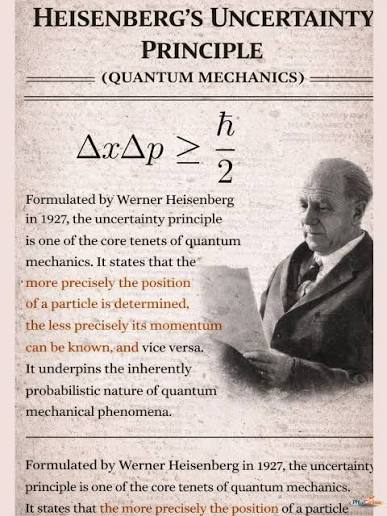
Position and momentum cannot both be determined with arbitrary precision. This is an intrinsic limit of the quantum world. Better instruments will not remove it. The more you pin down one quantity, the blurrier the other becomes.
Bell's inequality rules out local hidden-variable theories. The probabilistic nature of quantum mechanics does not come from unseen cards. It comes from the fact that the local deterministic card table is very hard to sustain. In standard quantum mechanics, measurement outcomes are probabilities. You cannot know a specific outcome before measurement. You can only know a distribution.
This does not mean quantum mechanics has killed determinism under every interpretation. Many-worlds can be deterministic. Bohmian mechanics can be nonlocal and deterministic. The safer statement is this: quantum mechanics killed the classical, local-deterministic Laplace's demon. For any internal observer, perfect prediction remains impossible.
The world may have a hidden card. A player inside the world cannot necessarily turn it over. Even if he turns it over, the act may change the game.
III
Set quantum mechanics aside. Look only at the macroscopic world. Classical physics should be predictable. It is not.
The three-body problem was the first warning. Three bodies move under gravity. The equations are simple. The long-term behavior is not. Poincaré found that such systems are extremely sensitive to initial conditions. A tiny difference in initial position, and after a few orbits the trajectories diverge.
Lorenz brought this idea into popular imagination with the butterfly effect. A butterfly in Brazil may trigger a tornado in Texas. The image is exaggerated. The direction is right. Weather systems, turbulence, ecosystems, traffic flows, and financial markets are nonlinear chaotic systems. They have laws. Those laws are sensitive to error.
To predict a chaotic system accurately over the long term, you need infinitely precise initial data. Every real measurement has error. Error grows exponentially. The tenth decimal place today may decide which city gets the rainstorm next month.
Measurement also requires energy. Energy changes the system. To know a particle's precise state, you must interact with it. Stronger interaction means greater disturbance. The more you want perfect data, the more likely you are to distort the data as you obtain it.
Chaos does not teach that the world has no laws. It teaches that a system with laws is not necessarily predictable by a finite intelligence over the long term.
IV
Even with infinite precision, computation blocks the way.
Turing showed that no general algorithm can decide whether an arbitrary program will halt after a finite number of steps. This is the halting problem. The method cannot exist.
If some events in the world reduce to the halting problem, or to stronger undecidable problems, you cannot calculate the outcome in advance. You can only run it step by step and see whether it halts. The future is run step by step.
Wolfram called this computational irreducibility. Some systems cannot be compressed into a short formula. You must go through every intermediate step to know the endpoint. The universe may be an incompressible computer.
Real numbers add another problem. Initial conditions in physical equations are often real numbers. A real number may require infinitely many digits to describe precisely. A standard Turing machine has finite memory. You cannot store an infinitely precise real number on a finite drive. Even if you could, measuring it to infinite precision might require more energy than the universe contains.
The ultimate world model is not the final answer in The Hitchhiker's Guide to the Galaxy. It is a super-simulator. It can run fast, give probabilities, and generate scenarios. It cannot skip computation. It cannot compress an incompressible future out of thin air.
V
The obstacles above belong to an external predictor. The predictor is also inside the system.
If an AI predicts the whole world, its prediction becomes part of the world. It predicts that it will output A next. It can output not-A. It predicts that the stock market will rise. Once the prediction is public, traders may buy early or do the opposite. It predicts that a person will resign. When the person sees the prediction, he may refuse to resign, or he may want to resign more.
This is self-reference and reflexivity.
Social science has similar phenomena: self-fulfilling prophecies, self-defeating prophecies, Goodhart's law. Once a metric becomes a target, it is no longer the original metric. Once a prediction enters the mind of the predicted, it changes the predicted person's behavior.
A world model embedded in the world cannot perfectly predict the entire future, including its own output. The more powerful it is, the more likely its predictions are to be perceived, and the more likely they are to change the world. It is a speaker trying to predict its own next sentence. When it speaks the prediction, the sentence has already changed what it will say next.
VI
When the world model reaches its limit, surprise does not disappear. It changes form.
In primitive society, surprise was "I never saw it coming." People asked why it rained, why someone died of illness, why the prey did not come today. That is surprise born of ignorance.
In the ultimate world model, many surprises become probabilities. It says that tomorrow the accident risk on this road is 0.03 percent. It says that this person's probability of depression in the next year is 12 percent. It says that this region's probability of a major earthquake in ten years is 7 percent. It says that this AI system's probability of deceptive behavior is 0.001 percent.
Surprise has been given a household registration.
Low-probability events still happen. Black swans still fly. Long tails still bite. The model can list possible occurrences. It cannot determine which day, which moment, which person, or which sentence becomes reality. Probability is certainty's shadow.
The world model also has events outside itself. New technologies, new viruses, new ideas, new religions, and new art movements may fall outside the training distribution. The long tail of the open world has no end. The more complex the model, the more complex the world it faces. The more it knows, the more it knows that it does not know.
The ultimate world model will not become an oracle. It will become a detailed weather map. A weather map can tell you the probability of rain. It cannot decide which drop falls on your forehead.
VII
The prediction of a momentary impulse.
The non-mysterious part comes first. A person's thoughts do not pop out of a gap in the soul. They relate to neural activity, hormones, memory, emotion, environmental cues, sleep, blood sugar, and social pressure. What you think is sudden may have been brewing in the subconscious for a long time. An AI may discover earlier than you that you want to resign, fall in love, commit a crime, or create.
Predicting a tendency is not the same as predicting the specific thought at the specific moment.
The brain is a complex system. Neural activity has noise, critical phase transitions, and chaotic dynamics. A thought may be born like an avalanche. Countless small disturbances come first. When the last snowflake falls, the whole slope collapses. You can explain every snowflake. You cannot predict which one will fall.
Self-reference makes it harder. If a person knows he is being predicted, he may comply or resist. He may change his behavior to prove the prediction wrong. He may become anxious because he is being predicted, and the anxiety changes his decision. The prediction becomes part of his psychological environment. The psychological environment changes the prediction.
An AI might say that this person has an 18 percent probability of changing jobs within three months. It can hardly say that this person will, at 3:26 p.m. on April 17, see a bird outside the window and suddenly decide to go to the sea.
Human will is not sacred and inviolable. The specific thought at a specific moment is the intersection of multiple causes, random disturbances, self-referential feedback, and chaotic amplification. It has causes. It cannot be perfectly predicted.
VIII
Two kinds of surprise exist.
The first is ontological. It asks whether the world has genuine randomness and whether quantum mechanics implies irreducible probability. The answer depends on interpretation. There is no unified answer. The world may be deterministic at bottom. It may not be. For an internal observer, the outcome is unknowable before measurement.
The second is epistemological. For a finite observer, unforeseen events always exist.
Even if the universe were completely deterministic, an intelligence with finite information, computing power, and precision would still face surprise. You are not God. You see part of it. You have a finite model. You make probabilistic judgments. Your predictions change you. Your model becomes outdated. Your data is missing. Your computation is insufficient.
Surprise is the shadow of a finite observer.
God has no surprises. God is not in the universe. The world model is in the universe. The more powerful it becomes, the more godlike it becomes. It remains a part grown from the world, a subsystem within the predicted system. It cannot stand outside itself and look at itself.
IX
If the world model reaches its limit, it will not be a future answer machine. It will be a huge probability scenario tree.
It will tell you which futures are likely, which are low-probability but cannot be ignored, which depend on a key fork, which change the moment they are spoken, and which cannot be compressed at all and can only evolve in real time.
It will become infrastructure. It will be embedded in the world like electricity, the internet, and language. It will help with transportation, healthcare, climate, finance, and governance. It will turn many surprises into listed risks. It will pull surprise out of the dark forest and place it into a probability cloud. Surprise remains.
Human beings will live in a new cognitive state. More knowledge will not remove surprise. It will only give surprise a probability. We will still have accidents, impulses, and thoughts that no model can pin down. We will simulate the world without becoming it.
X
If the world model reaches its limit, the world will become highly simulatable, probabilizable, and scenario-generatable. It will still not be perfectly predictable.
Surprise will still exist. It will be divided into layers. There is irreducible probability at the quantum level. There is long-term imprecision at the chaos level. There is undecidability at the computational level. There is reflexive interference at the self-reference level. There are unknown long tails at the open-world level. There is eternal ignorance at the level of the finite observer.
Laplace's demon must stand outside the universe. The world model is always inside the universe. The more powerful it becomes, the more it discovers that it is not God. The more precise it becomes, the more it sees the ocean of probability.
Surprise will not disappear. It will change its name. What was once "I never saw it coming" becomes "low probability." Mystery becomes long tail. Fate becomes one branch of the scenario tree.
The gap remains open because the predictor is in the world, the observer can be observed, and the model can become part of the world.
The world will still have surprises. Surprise is the gap between a finite being and an infinite world. We live in that gap. A world model can illuminate it. It cannot fill it.
About the Creator
Jin
Writer of reamstories
https://reamstories.com/jin
Enjoyed the story? Support the Creator.
Subscribe for free to receive all their stories in your feed. You could also become a paid subscriber, letting them know you appreciate their work.
Comments
There are no comments for this story
Be the first to respond and start the conversation.