
$96 Billion in Three Months
NVIDIA just doubled its revenue again. But the real story is what they said about 2028.
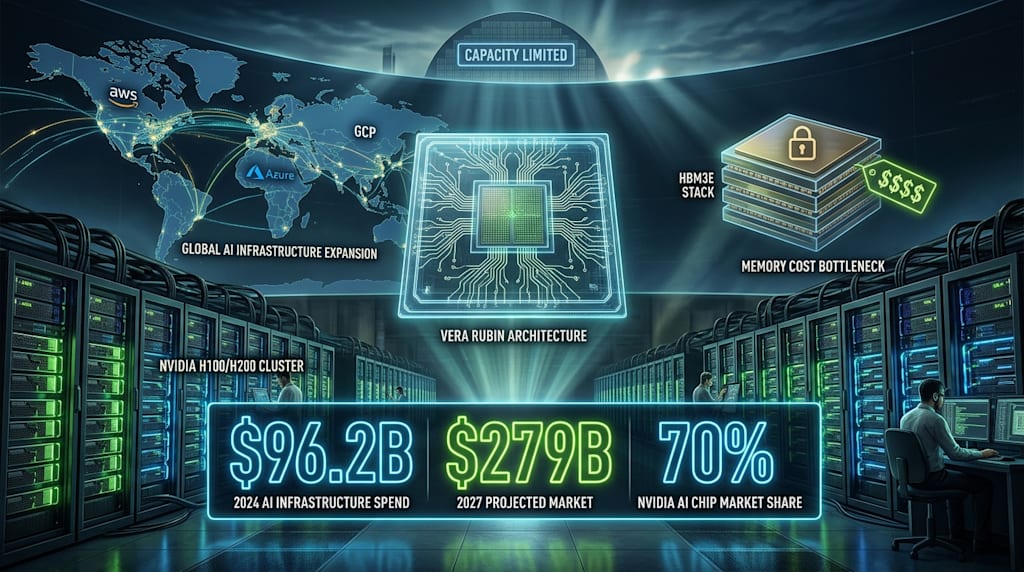
NVIDIA’s Q2 FY2027: The Numbers and What They Mean
In the quarter ending July 26, 2026, NVIDIA reported $96.22 billion in revenue – double its year‑ago figure and $4 billion above the $92.17 billion analysts had expected.
That is the 13th consecutive quarterly record.
After hours, the stock fell 4% then rose 4.5%. The market flipped from underwhelmed to impressed in two hours.
The turn came on the earnings call. The CFO said fiscal 2028 revenue would grow about 70%. He added: without supply constraints, that number would be much higher.
Where the money came from
Data Center accounted for $89 billion – 92.5% of total revenue – up 117% year over year.
The remaining $7.2 billion came from Gaming, Professional Visualization, and Automotive/Robotics. Those are not trivial, but they are footnotes against Data Center’s scale.
Breaking Data Center down:
Hyperscalers (AWS, Azure, GCP): $48.7 billion, up 102%.
AI cloud, industrial, and enterprise customers: $40.3 billion, up 138%.
The second number missed the $41.96 billion consensus.
Now look at this: NVIDIA’s purchase commitments jumped from $119 billion last quarter to $279 billion – more than double in six months. That is not revenue yet; it is deposits for future delivery.
Compare short‑term and long‑term:
This quarter: hyperscalers bought $5.2 billion more than expected; smaller clients bought $1.6 billion less.
Over the next 2‑3 years: commitments rose from $119B to $279B.
The pattern: compute capacity is tilting toward the largest players, but overall demand is still rising. Smaller clients bought less this quarter because factories were busy fulfilling the big orders. They are now further back in the queue.
Why the 70% guidance changed the mood
The headline numbers beat estimates. But the stock initially dropped because gross margin fell from 75% this quarter to a projected 74% next quarter, and possibly 71‑72% in the following one.
Memory prices are climbing faster than NVIDIA predicted. That squeeze is real.
Then the call happened. The CFO said fiscal 2028 revenue would grow about 70%. The Street had been at 45%.
A 25‑point gap.
Jensen Huang added: without supply limits, growth would be much higher.
That reframed the story.
The old worry: is growth peaking? Are margins collapsing?
The new question: can they build enough capacity to meet demand?
Those are different. The first asks where the ceiling is. The second asks how fast they can extend the staircase.
Huang described the demand side: a year ago, only a few labs were buying compute. Now, countless AI labs, startups, open‑source projects, physical‑AI initiatives, and institutions across the globe are all expanding at once.
That is not hype – it shows up in backlogs.
NVIDIA announced a specific commitment: between 2027 and 2028, it will ship 2 million GPUs to AWS – Blackwell Ultra, Rubin, and Rubin Ultra. That is on top of the 1 million already being deployed this year.
AWS is not alone. The $279 billion purchase commitment aggregates multiple cloud providers.
The cost pressure and NVIDIA’s countermove
Gross margin is set to drop from 75% to 71% for one main reason: HBM (high‑bandwidth memory) costs too much.
The CFO put it bluntly: memory prices are extremely high, rising faster than expected, and likely to go higher next year.
NVIDIA cannot negotiate that away through scale. HBM capacity is controlled by SK Hynix and Samsung, and their capacity is also booked for years.
So NVIDIA took action. It publicly disclosed its first custom HBM solution, codenamed NVHBM.
The technical shift: move the memory controller from the main accelerator chip to the Base Die inside the HBM stack. That frees 25‑30% of the main chip’s area for compute cores.
Bandwidth increases about 30%, power drops 15%.
But the more interesting part is the partner. The first NVHBM collaborator is Amazon’s Annapurna Labs – the team behind Trainium.
NVIDIA is not just applying this to its own GPUs; it wants cloud vendors’ custom chips to adopt the same standard. If NVHBM becomes the de facto standard, NVIDIA gains more leverage over the memory value chain – it is less dependent on what Hynix and Samsung decide to charge.
That is a long‑term play. Short‑term margin pressure remains, but NVIDIA has given the market a reason to look beyond the next quarter.
Two implications
First, end‑user devices may not get cheaper.
Huang’s view is that compute supply shortages will persist through at least fiscal 2028. That affects the whole industry.
Advanced process capacity is taken up by GPUs. HBM’s high margins draw DRAM capacity away. Smartphone SoCs, PC processors, and standard memory get less.
The new Mac Mini’s price already raised eyebrows. For the next few years, low‑price, high‑spec electronics may be scarce – not because manufacturers do not want them, but because core components are allocated elsewhere.
Second, the “competition catching up” narrative is weakening.
AMD, Google TPU, and Microsoft Maia are moving forward. But NVIDIA’s 70% guidance tells the market: the incremental pie is large enough.
It is not that competitors are stealing share – it is that NVIDIA cannot fill all orders. The discussion is now about who picks up the overflow.
Huang listed three moats: a platform that works with every model, a full‑stack AI‑factory system (where per‑gigawatt market opportunity grew from $18B to $40B), and the CUDA ecosystem. Not everything he says is objective, but customers are voting with their purchase orders.
Closing
Huang’s own line: “Compute itself is a source of revenue.”
That statement rests on numbers:
$96.2 billion quarterly revenue
$279 billion in purchase commitments
70% growth guidance for fiscal 2028
Three numbers, aligned: AI infrastructure is still accelerating, and supply‑demand imbalance is the core constraint.
Margins are falling – true. HBM prices are rising – true. But NVIDIA’s response is not to cut prices or clear inventory – it has no inventory. It lacks capacity.
The most important takeaway from this report may not be that NVIDIA is still growing. It is that the reason for that growth has not changed.
About the Creator
Jin
Writer of reamstories
https://reamstories.com/jin
Enjoyed the story? Support the Creator.
Subscribe for free to receive all their stories in your feed. You could also become a paid subscriber, letting them know you appreciate their work.
Comments
There are no comments for this story
Be the first to respond and start the conversation.