
8 order management software tools for distributors, and the step each one owns
A distributor can pay $99 a month for order management software, or be quoted $150,000 to $250,000 to implement the same capability inside an ERP. Both systems take an order and hand it to a warehouse. The difference is how many other jobs come attached.


Key takeaways
Published pricing for order management software runs from $99 to $729 per month. The same job inside a full ERP has been quoted to distributors at $150,000 to $250,000 to implement.
An order fails in four places: capture, validation, fulfillment handoff, and accounting sync. Most tools are strong at one or two and weak at the rest.
Wholesale distribution moves an estimated $8.6 trillion through the US economy, and most of it still starts as an unstructured message from a buyer.
The right tool depends on where orders break, not on which platform has the longest feature list.
A distributor can pay $99 a month for order management software, or be quoted $150,000 to $250,000 to implement the same capability inside an ERP. Both systems take an order and hand it to a warehouse. The difference is how many other jobs come attached.
That price spread explains why this category is so hard to shop. Every vendor uses the same three words, and the products underneath range from a voice app that captures an order in 40 seconds to a full order-to-cash suite with a nine-month rollout.
The useful way to sort them is by the step each one owns. An order can fail in four distinct places, and a tool that fixes one of them will do nothing for the other three. Below are eight platforms mapped to those steps, with published pricing where it exists and the honest limit on each.
Where orders actually break
Wholesale distribution moves roughly $8.6 trillion through the US economy each year, and a surprising share of it still begins as a voicemail or a photo of a handwritten list. Turning that into a delivered, invoiced order involves four steps, and each one has its own failure mode.
Capture is getting the order out of the customer's head and into a system. This fails when the order arrives as an unstructured message that a person has to read and retype.
Validation is checking the order against live stock, that customer's price list, their order guide, and their credit terms. This fails quietly, and the distributor finds out at delivery or at invoicing.
Fulfillment handoff is turning a validated order into a pick list, a route, and a delivery. This fails when the warehouse works from a printout that no longer matches the order.
Accounting sync is turning the delivered order into an invoice without a second round of data entry. This fails when someone rekeys the order into the accounting system and drops a digit.
Knowing which of the four breaks most often turns a twelve-vendor shortlist into a two-vendor one.
The eight tools
The list runs from tools that own capture through to systems that own all four steps.
1. VoiceOrder Solutions
Best for: distributors whose orders arrive by phone, voicemail, or text.
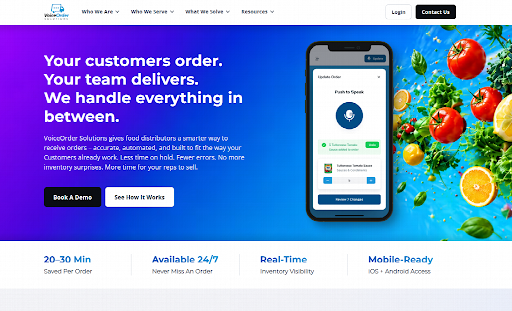
VoiceOrder Solutions owns the first two steps and deliberately leaves the rest alone. A buyer speaks the order into an iOS or Android app, and it arrives digitized, confirmed, and timestamped, with no rep on the phone and no transcription afterwards.
Validation happens at the point of speech rather than after it. Each customer has a personalized order guide holding their real SKUs and contract prices, so an informal name resolves to the correct item and price before the order is ever transmitted. Every order gets a unique number, date, and timestamp, which settles most short-delivery disputes with a lookup instead of an argument. An auto-save picks up an interrupted order at the same line.
The handoff is format-agnostic, which is why this works as order management software for distributors who are not replacing anything: orders land as email, PDF, Excel, EDI, API, or straight into QuickBooks. Capture runs around the clock, so an order placed at 11pm is queued rather than lost. The company reports 20 to 30 minutes saved per order and setup in 24 to 48 hours for independent distributors.
The trade-off: it is built for food and beverage distribution, and intake is voice-first rather than a branded self-service portal. Pricing is on request.
2. Pepper
Best for: distributors who want messy inbound orders cleaned up without asking customers to change.
Pepper is an AI platform for independent food distributors. Its Order Agent ingests voice, text, email, PDF, images, and handwriting, then extracts structured orders and syncs them into the distributor's system. A storefront, a sales hub, and a finance hub sit alongside it.
The distinction worth understanding: Pepper works on the distributor's inbound side rather than being an app the buyer opens. Nothing changes for the customer, which removes the hardest part of any rollout.
The trade-off: no published pricing, and it is a broad suite to adopt if the only real need was cleaner capture.
3. Cut+Dry
Best for: distributors whose customers are ready to order themselves.
Cut+Dry is an ecommerce and sales-enablement platform for foodservice distributors. It gives each distributor a branded B2B storefront with structured catalog data, plus tooling for sales reps and collections. Customers browse, reorder, and check pricing without calling anyone.
Done well, self-service moves the whole capture step onto the customer, which is the cheapest possible version of order management.
The trade-off: it requires customers to change behaviour, and buyers who have called their order in for fifteen years often do not. Pricing is on request.
4. OrderCircle
Best for: smaller wholesalers who want a predictable monthly bill.
OrderCircle is a B2B wholesale ecommerce and order management platform with genuinely public pricing: Silver at $199 a month for 25 orders, Gold at $299 for 50 orders with unlimited staff, and Platinum at $399 for unlimited orders. Enterprise runs $599 to $799. Every tier includes unlimited customers and products, plus inventory forecasting and shipment tracking.
The trade-off: the order caps on lower tiers matter, and QuickBooks is the only named integration, so an ERP-driven distributor will hit a wall.
5. B2B Wave
Best for: distributors who want a storefront with customer-specific pricing and no transaction fees.
B2B Wave runs a branded storefront with per-customer price lists, unlimited orders and quotes on every tier, and a native sales rep app for iOS and Android. It supports catalogs past 500,000 products and charges no platform transaction fee, which matters at wholesale order values.
Pricing is published at £270 a month for the Pro and Scale tiers, with a discount over the first three months and custom enterprise pricing above that.
The trade-off: billing is in GBP, the approach is ecommerce-first, and advanced validation rules sit on higher tiers.
6. Unleashed
Best for: wholesalers where stock accuracy is the real constraint.
Unleashed is cloud inventory and order management with real-time multi-location stock visibility, batch and serial traceability, and automated purchase reordering. A B2B portal is available on top. Pricing is published: Lite at $99 a month for three users and 100 orders, Core at $399 for 500 orders, Pro at $729, with warehouse and advanced inventory add-ons at $149 each and the B2B store from $129.
For a distributor whose orders fail at validation because stock figures are wrong, fixing inventory fixes order management as a side effect.
The trade-off: order caps on the lower tiers, and the add-ons move the real monthly cost well above the headline.
7. inSitu Sales
Best for: direct store delivery operations that need a named ERP integration.
inSitu Sales covers field sales, warehouse, and driver apps in one stack: an offline rep app with GPS and route optimization, a picker app with auto-generated pick lists, and driver dispatch with proof of delivery. It owns the fulfillment handoff more completely than anything else at its price.
Pricing is public at $200 a month for Starter with three users, $329 for Pro, and $429 for Enterprise, with extra users at $34.99. ERP integration setup for NetSuite or SAP Business One is a $500 one-time fee, and card processing runs 3.9% plus $0.30.
The trade-off: setup fees on integrations, and more separate apps for a small team to manage.
8. NetSuite
Best for: mid-market and enterprise distributors who want order-to-cash in one system.
NetSuite's order management module owns all four steps. Multichannel capture, available-to-promise logic, split shipments, drop-ship, and returns run against the same database as inventory, procurement, and financials, so an order becomes an invoice with no handoff at all.
The trade-off: total cost and timeline. Pricing is quote-only, one distributor reported an implementation budgeted at $150,000 to $250,000, and it is widely considered oversized below roughly $15 to $20 million in revenue.
Those eight span the full price range in the category, which makes the budget question easier to answer than it first looks.
What it costs
Pricing here splits cleanly into two groups.
Published subscription tools run from $99 to $729 a month, with per-user options like inSitu at $200 and up. These are the tools a distributor can trial and cancel.
Quote-only platforms cover the AI digitization tools and the ERPs. For the ERPs specifically, the license is rarely the main number: implementation, data migration, and training usually cost more than the first year of software.
That difference should shape the shortlist before any demo, because the two groups involve different kinds of decisions.
How to choose
Start with a week of evidence rather than a feature comparison. Log every order that arrives for five working days and note what format it came in and where it went wrong.
If most orders arrive as speech, buy capture. If most orders arrive fine but ship wrong, buy validation and inventory. If orders ship fine but invoicing is a mess, the problem is the accounting sync, and no amount of front-end polish will fix it.
Then check the integration question honestly. McKinsey has found AI-driven forecasting can cut supply chain forecasting errors by 20 to 50% and administration costs by 25 to 40%, but none of that arrives if the order data never reaches the system doing the forecasting.
One last filter matters more than any of the above: adoption. The tool that wins is the one customers will actually use next Tuesday morning.
The arithmetic of a fixed order desk
The business case is easier to see with numbers attached, so here is the rough shape of it for a mid-size distributor.
Take an operation handling 40 orders a day by phone and voicemail. At 20 to 30 minutes per order once the call, the callback about a missing item, and the typing are counted, that is roughly 16 hours of work every day, spread across whoever picks up the phone. Two full-time roles, spent turning speech into structured data.
Structured capture does not delete those two roles. It moves them. The same people spend their day chasing overdue invoices, calling accounts that have quietly stopped ordering, and handling the exceptions that genuinely need a human. That is the same headcount pointed at revenue instead of transcription.
Errors carry their own line. Distribution software vendors commonly report order errors dropping by around 30% after customers move off manual entry. A distributor shipping 10,000 orders a year at a 3% error rate gets 300 wrong orders; a 30% reduction prevents 90 of them. At a conservative $75 each in redelivery, credits, and admin time, that is about $6,750 a year, before counting the customer who was already thinking about switching.
None of those figures are guarantees, and every distributor should run them against their own order count. They do explain why capture tools priced in the low hundreds per month keep paying back faster than platforms costing twenty times more.
The short version
Order management software is not one product. It is four jobs, and most distributors only need help with one of them. Find the step that breaks, buy the tool that owns that step, and resist the platform that promises to own all four unless the business is genuinely big enough to need it.
Frequently asked questions
What is the difference between order management software and an ERP?
Order management software handles the order lifecycle: capture, validation, fulfillment, and the handoff to accounting. An ERP is a broader suite covering finance, inventory, procurement, and sometimes HR, with order management as one module inside it. Distributors buy the first to fix a workflow and the second to replace a system of record.
How much does order management software for distributors cost?
Published tiers run from $99 to $729 per month, and per-user platforms start around $60 to $200 per month. Quote-only platforms include the AI digitization tools and full ERPs, where implementation costs commonly exceed the software licence in year one.
Do customers have to change how they order?
That depends on the tool. Storefront platforms require buyers to log in and self-serve, which is a real behaviour change. Voice and AI digitization tools work with how customers already order, capturing speech, texts, or emails and structuring them on the distributor's side. Rollout risk is much lower with the second group.
About the Creator
Enjoyed the story? Support the Creator.
Subscribe for free to receive all their stories in your feed.
Comments
There are no comments for this story
Be the first to respond and start the conversation.